Generating investment signals for heavy industry decarbonisation
Yusuf Latief
Posted on: 13 June 2025
-

In this week’s Power Playbook: Creating investment signals for heavy industry to decarbonisation is no small matter. For Aviva Investors’ Nick Molho though, looking at experiences from the renewables and power sector may show us a way forward.
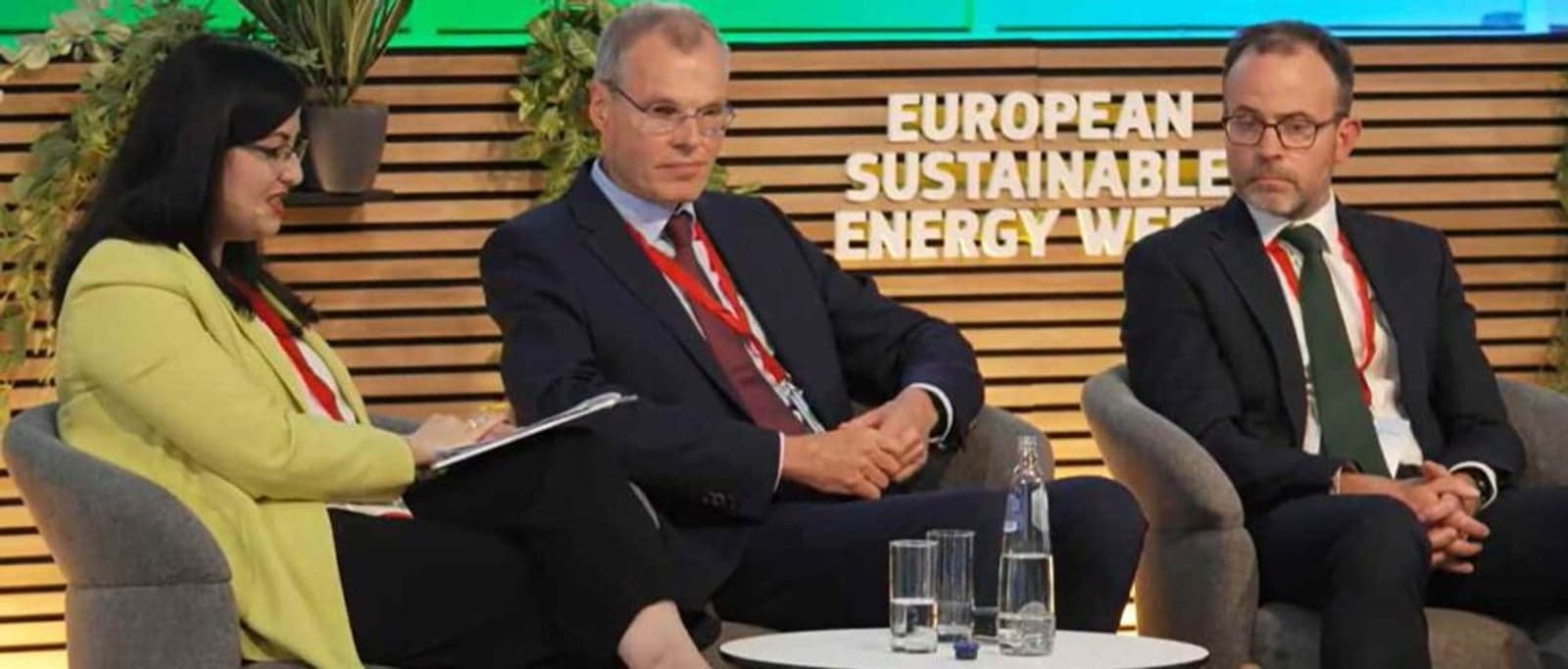
“Critically, in heavy industry, we need to get that balance right as well.” So said Molho Wednesday during a panel discussion at European Sustainable Energy Week (EUSEW).
Molho, Aviva’s head of Sustainability Policy Advocacy (UK and EU), was talking about getting the balance right between different types of policies to spur investments for the sector.
Namely, between policies on the supply and demand sides.
Heavy industry decarbonisation
While of critical importance, Molho’s words don’t necessarily mark a ‘eureka’ moment for energy economics.
It applies across business but comes at a time when the energy sector is increasingly concerned about how to drive decarbonisation in heavy and hard-to-abate sectors.
Indeed, decarbonisation of sectors like steel, cement, petrochemicals, and heavy transportation is essential for achieving global net-zero targets and maintaining financial stability.
And according to the Bank for International Settlements, these sectors face unique challenges, including high capital intensity and technological barriers, making conventional electrification strategies less applicable.
So on the high capital front, it is refreshing to hear about how ‘basic’ demand v supply economics can be readdressed to drive decarbonisation.
And at least on the supply side, says Molho, things may already be looking up.
“When you look at sectors like steel, chemicals, cement: there’s a lot of focus in the clean industrial deal on supporting the electrification of those … and incentivising it and making it cheaper – that’s really important.
“There’s also a focus on the supply side on trying to make hydrogen more affordable, on trying to make CCS deployed at greater scale. All that’s really important.”
But this is on the supply side. The other side…may need some work.
According to Molho, policy signals are lacking on the demand side to make it clear to investors that there is a growing demand for low-carbon steel, cement and chemicals, for example.
“Because, given the high capital cost involved, if you cannot see that demand, those real economy businesses and those investors behind it will not take the risk of investing in low carbon production methods in those sectors.
“We really need that balance.”
More from the Power Playbook:
Global highs for energy investment despite Trumponomics
The $331bn market potential for smart energy and two European startups staking a claim
Demand side success stories
When looking to generate this balance, Molho cites examples from the renewables and power scene, where certain mechanisms have already proven effective.
“We’ve done that quite well across Europe in the power sector. On the supply side there’s been plenty of EU level and national level innovation funding.”
Namely, instruments such as contracts for differences, renewable obligation certificates and other forms of revenue certainty mechanisms, have brought renewable technologies, such as onshore wind, solar, offshore wind and, in certain cases, wave and tidal power to market.
On the demand side, he adds, renewable energy targets have always been very clear, “for 2020, for 2030, which have given investors a clear long term market signal that renewable energy technologies are here to stay.”
Namely, the signal sings for investors: “It’s a growing market; we can invest in it.”
Translating for heavy industry
According to Molho, the trick is to now replicate this to other parts of the low-carbon economy.
For heating, this would relate to incentivising uptake of heat pumps and low-carbon heat networks. For transport, spurring demand of electric vehicles, for example, as well as vans and busses.
And in heavy industry, says Molho, there are already some promising prospects to keep our eyes on.
Namely, measures such as green public procurement, improving sustainability criteria in procurement, and low-carbon standards, would all help.
Other elements from the Clean Industrial Deal also stand out, such as sustainability labelling and criteria in product legislation to influence private procurement decisions.
Again, all of this comes down to a balance.
Said Molho: “Unless you have that balance, it is really difficult for private sector investors to commit private capital in the long term to support the growth of clean tech supply chains.”
Molho’s words come at a time of uncertainty in the investment community.
The implementation of measures like the Clean Industrial Deal and even the Carbon Border Adjustment Mechanism (CBAM) are still in their infancy.
These policies aim to create a level playing field and stimulate demand, but their ultimate success hinges on clear and consistent market signals that incentivise crucial private capital.
Without a robust and visible pipeline for low-carbon products, the significant investment required for heavy industry decarbonisation may remain elusive.
But what do you think?
Reach out and let me know so I can feature your insights in the Power Playbook.
Cheers,
Yusuf Latief
Content Producer
Smart Energy International

Follow me on Linkedin