How regulation can help the private sector direct money to the energy transition
Yusuf Latief
Posted on: 21 June 2024
Yusuf Latief looks at a real estate case study demonstrating how EU regulation can guide private sector investments in the energy transition.

In this edition of Smart Energy’s Power Playbook, Yusuf Latief looks at a real estate case study demonstrating how EU regulation can guide private sector investments into the energy transition.
In last week’s Power Playbook, I covered three dimensions we need to watch when considering the investment needed to finance Europe’s energy transition.
Miguel de Terres, chief economist in the European Commission’s Directorate-General for Energy (DG ENER), highlighted during European Sustainable Energy Week (EUSEW) how the public sector should be geared for the private sector. And his speech was followed by a concrete example of how this might be done.
Thibauld Clisson – climate change lead for BNP Paribas Asset Management – spoke on how the European Performance of Buildings Directive (EPBD) and its energy performance certificate (EPC) provide a lighthouse for investors to assess the value of their assets.
The EPBD’s EPC
For some background, the EPBD sets out the minimum requirements for the energy performance of new and existing buildings in the EU, requiring all Member States to establish energy certification schemes for buildings and to ensure that all buildings that are constructed, sold, or rented out have an energy performance certificate (EPC).
The EPC provides information on the energy efficiency of the building, including its energy consumption and carbon emissions. The EPBD also sets out minimum requirements for the energy performance of new and existing buildings in the EU.
But its true value, at least for a private bank looking to doll out cash such as BNP Paribas, lies in its ability to provide guiding criteria for investment.
More from the Power Playbook:
National Grid’s shares plunge: watershed or warning sign for energy financing?
Grid + renewables spend hikes beyond fossil fuels
“The regulation has a lot of external benefits to society,” says Clisson on how the regulation aims to boost energy efficiency, improve bills and help Member States reach the climate targets of the EU.
He adds: “From an investor’s point of view, the regulation also helps us to identify and understand the quality of our holdings or investments in the real estate sector…Before the EPC, we didn’t have any clue of the energy performance of the loans or the buildings that we finance.
“For the professional building sectors, there is also some constraint in terms of EPC [for buildings] that can be sold or used. That’s something very important for investors because we are able to understand…the quality of the asset.
“But this is also an opportunity because this can help us drive money flow towards the best performing buildings.”
Residential mortgage fund
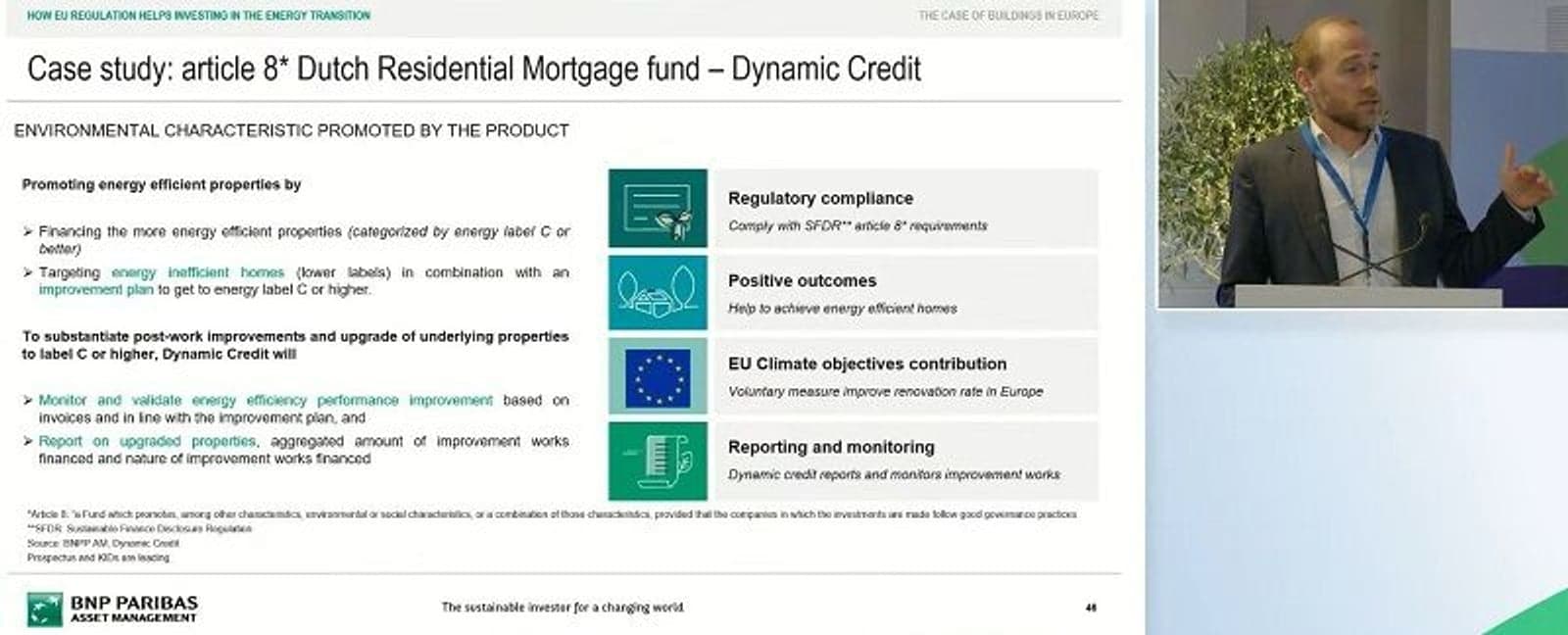
Clisson references a new strategy launched by BNP subsidiary Dynamic Credit, which aims to impose restrictions on investments in the real estate sector, centring on energy efficiency.
The company’s Dutch Residential Mortgage strategy aims to promote energy efficiency in two ways: financing more energy efficient properties; targeting energy inefficient homes in combination with an improvement plan to get to energy label C or higher.
“Anything that is below EPC C in the Netherlands will not be financed, except if there is another loan which will finance the energy improvements of the buildings. The money will be set aside and it will be released if we receive the bills that demonstrate the work it has undergone.
“The idea is to target the 30% lowest energy efficiency buildings in the Netherlands that we have on our portfolio and to make sure that those are getting better energy performance by setting limits at EPC C.”
Clisson’s examples of both the EPC and their mortgage strategy provide interesting case studies for linking the public and private sector to guide investment. They are not, however, perfect.
Specifically, a major barrier for the EPBD and the EPC is a lack of standardisation.
According to Clisson, although the EPC has become a cornerstone of the energy transition in the real estate sector, “the issue right now is that [there are] as many EPC classifications and rating systems as countries in the EU. Right now, it’s impossible for investors to really understand or compare…”
Thus, harmonisation will be key. And with 2026 marking a date for EPCs to follow a common model in the EU, implementation – a common theme through EUSEW – needs to be a priority.
The energy sector continues struggling to determine how to fill the financial gap needed to reach net zero targets. One often-cited recommendation is to bridge the divide between the public and private, which is easier said than done for obvious reasons, especially in the demarcated EU.
To do so would lead not only to increased financial flows but also, at the end of the road, to upping Europe’s competitiveness as the US continues to fly high on the back of the IRA and China dominates thanks to their foresight in the sector.
Clisson’s example of the EPBD and the EPC are but one example of how we can gear regulation to help the private sector generate investment in the EU's energy sector. What are some others that have crossed your radar?
Reach out and let me know.
Cheers,
Yusuf Latief
Content Producer
Smart Energy International

Follow me on LinkedIn
Smart Energy International is a media partner for the European Sustainable Energy Week, which took place in Brussels, Belgium.