Green hydrogen in Europe – 2022 is the year to make it a reality
Jonathan Spencer Jones
Posted on: 22 February 2022
2022 should be the year to build the groundwork for green hydrogen in order to pick up the pace thereafter, says Dr Robert Bloom, Delta-EE’s expert in clean hydrogen.

2022 should be the year to build the groundwork for green hydrogen in order to pick up the pace thereafter, says Dr Robert Bloom, Delta-EE’s expert in clean hydrogen.
In an exclusive interview Bloom said that while policies take time to transform into action, key is that project developers are able to get a sense of the incentives and other supports that are going to be available to give them the certainty to advance.
Delta-EE’s project database indicates that the majority of the projects that have reached the planned stage or are already under construction for 2022 can be classified as ‘firm’. However, looking ahead to 2023 only one quarter are ‘firm’ and three-quarters of the projects remain uncertain.
“This illustrates the importance of decisions in 2022. Whether this is the year when the legislation is actually passed by national governments could be tricky given the timescales. But I think over this year, we're going to see the policies really firm up in what they're trying to do,” he says.
“For example, in the UK there has been a reference to a contracts for difference approach and similarly in Germany. That's going to do a lot to de-risk some of the projects and allow project organisers to feel more confident in the scale up for green hydrogen.”
Green hydrogen is very much the topic of the day, attracting almost unprecedented interest from developers. However, currently, only about 1% of the global hydrogen production is green, from approximately 300MW of electrolyser capacity.
But new projects are being announced almost daily, with some sources, such as Bloomberg NEF, reporting more than 120GW of capacity announcements to 2030 and beyond.
Hydrogen production and demand
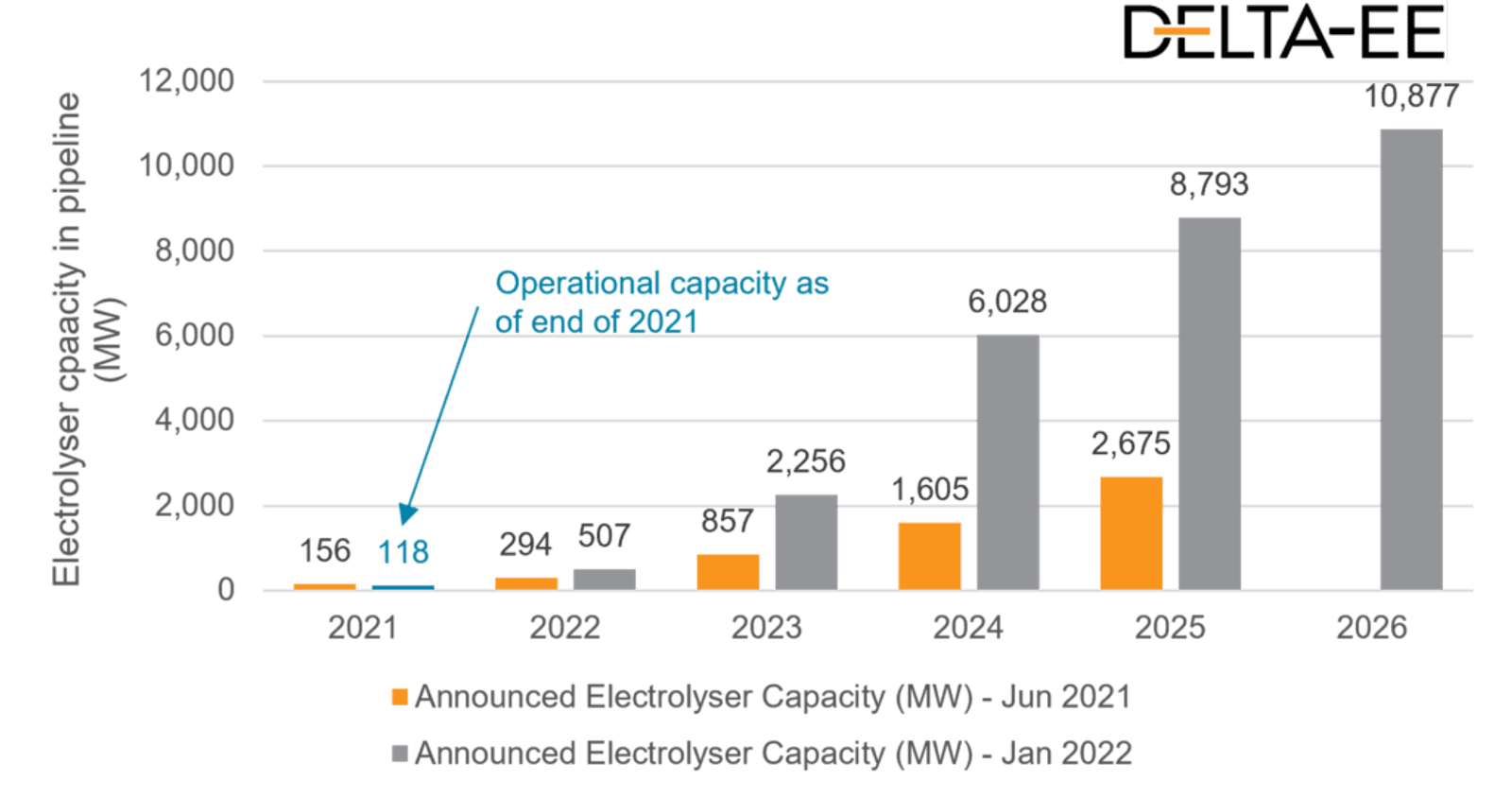
Bloom says that Delta-EE is currently tracking just over 6GW of electrolyser capacity planned to come online in Europe by 2024 – up from the 1.6GW reported just six months ago – and a total of 10.9GW in the next five years by 2026.
Of these, the top five countries in terms of announced capacity are Germany, Spain, Denmark, the Netherlands, and close behind the UK and Sweden.
In addition to the number of new projects, he comments that notable trends are the rapid increase in the average project size – e.g. expected to exceed 50MW in 2023 compared to 6.5MW in 2022 – and a shift from piloting in order to build experience to becoming more commercially focused.
“A lot of the projects are being set up with the production tied to a specific end use sector. But we are now starting to see projects trying to secure multiple offtake agreements, which reduces the financial risk.”
In terms of demand Bloom says the greatest demand is emerging from the industrial sector, with green hydrogen both as a replacement for gray hydrogen and for new projects.
“We see industry as the primary demand sector in the short to medium term, for use cases such as green ammonia, petrochemical refining and green steel,” he comments.
“Our updated figures at the end of 2021 suggest there is now more green hydrogen going into industry than any other sector, whereas previously transport was the leading sector. So we're seeing that shift and that will continue with the number of projects around the 20MW mark we expect to come online in the next year.”
He adds that there is still a lot of learning to be done on how best to produce and use green hydrogen and to establish the value chain in what is essentially a new industry starting from scratch.
More about hydrogen
Policy tipping point for green hydrogen predicted in 2022
Green hydrogen hub for rural northern Germany
Stimulating the growth of Europe’s green hydrogen economy
Green vs blue hydrogen
Alongside green hydrogen is also an emergence of blue hydrogen, which has attracted some controversy due to its fossil fuel based production.
Bloom says initial findings from Delta-EE’s database are that the blue hydrogen projects are far fewer in number – less than 100 globally – but are larger, generally far in excess of of 100MW in capacity.
“There are issues with blue hydrogen such as the reliance on fossil fuels, exposure to volatility in natural gas prices, the much higher capex due to the larger minimum viable size for blue plants and the possibility of becoming stranded assets,” he says.
But with the electrolyser industry still in its infancy and the need for economies of scale to reduce prices, he points out that blue hydrogen brings with it the opportunity to scale up demand and supply chains more quickly.
“It shouldn’t be a case of either ‘green’ or ‘blue’ and we should be doing both given the level of demand we expect to be there. We are not going to be able to decarbonise at the speeds required if we're just relying on electrolysis and we need both technologies but it needs to be a balance between the two.”
Policy actions
In terms of policy actions that are necessary, Bloom says a key one in Europe is “a solid definition” of green hydrogen.
“We know green hydrogen is hydrogen produced in an electrolyser fueled by renewable electricity but there is talk about the additionality of the renewables and for example is it only new renewables or less than two years old and can it be by PPA or must it be tied by cable?”
Citing the example of Germany, which has a working definition of green hydrogen that allows tax relief for electrolysers, he says: “The reasoning appears to be to ensure that hydrogen production is backed by the necessary renewables production but how this definition forms on an EU level will massively influence how it is enacted at a country level and Germany may have to bring its definition in line with a European one.”
Similarly in the UK, where there is a greater focus on blue hydrogen than in other European countries, a standard for low carbon hydrogen is intended, which will determine the associated incentives.
“The information I have at the moment is probably going to look somewhat like a contracts for difference to make blue or green hydrogen more or competitive with grey hydrogen as it stands today.”
HydroSpider
As an example of a green hydrogen project that has achieved cost competitiveness – potentially the first in Europe, and an example of a government action that could be replicated – Bloom cites HydroSpider in Switzerland – a 2MW hydrolyser producing up to 300t of green hydrogen annually for fuel cell powered heavy goods vehicles.
“Through a niche in Swiss law, those HGVs don’t pay road tax because they are zero emission and so the economics balance out in favour of the green hydrogen. And that’s the case at the moment, for a really commercial proposition, one has to rely on finding a niche application in which the green hydrogen can be cost-competitive.”
Another example he cites is H&R Ölwerke, a refinery in northern Germany that replaced the supply of grey hydrogen by tanker with on-site green hydrogen. By cutting the costs associated with the distribution of the hydrogen, this project, in contrast to many others operational today, has reached commercial operation and has been producing most of the plant’s hydrogen demand since 2017.
Commercialisation
Bloom says that projects such as these are illustrative of the changing shift of project emphasis from piloting, usually with upfront EU or national government support, with the need to find viable solutions to commercialisation.
This brings the discussion back to the need for clarity on policy and issues such as incentives, with green hydrogen not cost-competitive in most cases with other options, particularly grey hydrogen, at this time.
“A lot of project organisers are doing feasibility studies and going ‘if we had x incentive, which we have a pretty good idea is coming, we think that that's going to be competitive’. And that's why we think we're seeing a lot of projects at the pre-final investment decision stage as they are waiting for the incentives to come in to de-risk their projects.
“As projects scale-up, project organisers won’t want them to be loss leaders and they have got to be commercially driven and that’s got to happen in the next year or so.”
For more on this topic, see Delta-EE's white paper on green hydrogen in Europe.