Green hydrogen in TRINEFLEX: Application in wastewater treatment plants
Guest/partner contributor
Posted on: 19 February 2026
This article focuses on simulating green hydrogen production through electrolysis powered by PV at the ESAMUR wastewater treatment plant in Spain.

The Horizon Europe TRINEFLEX project is focused on transforming energy intensive industrial processes through the integration of energy, process and feedstock flexibility. Currently, the energy consumption is becoming an economic and environmental challenge, so it is crucial to align energy intensive operations with low carbon systems that encourage renewable energy integration without compromising productivity.
However, the key challenge is the intermittency of renewable sources, which requires the implementation of hybrid energy systems and energy storage solutions to harness excess energy during peak phases and stabilise operations system during period of lower output.
Over the last decade, several technologies have emerged to address these challenges. Hydrogen is one of them: it can play a central role in this transition with flexibility storage and utilisation. The production of green hydrogen by an electrolysis process powered by a PV system can be a good opportunity for wastewater treatment plants. The hydrogen produced can be react with carbon dioxide from an anaerobic digester to generate e-fuels, while oxygen can be utilised in the aerobic or disinfection process reducing energy costs, enhancing efficiency and contributing to overall decarbonization goals in line with EU targets for industrial processes.
A simulation of the process applied to the Esamur wastewater plant, a demo case of the TRINEFLEX located in Spain, has been performed with the aim of estimating the amount of hydrogen obtained with a 200kWp PV system and providing the opportunity to assess whether the green hydrogen production is an environmentally and economically sustainable alternative for the company.
TRINEFLEX methodology
The simulation of the steady state model has been developed by the open source chemical process simulator DWSIM. The main parts of the green hydrogen model are the PV system and the electrolysis process. The first one was simulated using a specific DWSIM block, while the second one was simulated by an ad hoc user block written in Python.
For the electrolysis process, proton exchange membrane (PEM) electrolysis cells were chosen because they have been known for over sixty years and have a number of advantages, such as high current density, greater energy efficiency, low gas permeability, wider operating temperatures (20–80°C), easy handling and maintenance.
In the PEM water electrolyser, water is introduced at the anode and decomposed into oxygen, protons and electrons. The protons are driven through the membrane to the cathode under an electric field where they combine with the electrons arriving from the external circuit to form hydrogen gas.
The following main assumptions have been considered:
- The system is modelled through a lump parameter approach: it is a simplified representation of the system that assumes all components are concentrated at a single point neglecting possible gradients along three dimensions.
- The operating pressure (1atm) is constant, and pressure effects are neglected.
- The temperature is supposed to be uniform in the electrolyser stack.
- The cell is already at working conditions and start-up or transient phases are not analysed.
- The stack model includes identical PEM electrolytic cells connected in series.
- The membrane is considered to be completely saturated with water; thus its conductivity depends only on temperature.
The model development has been performed taking into account previous work (Valverde et al., 2012; Datta et al., 2016; Jarvinen et al., 2022; Abdol Rahim, 2016).
Project results
The flowsheet of the process simulation in DWSIM is reported in Figure 1.
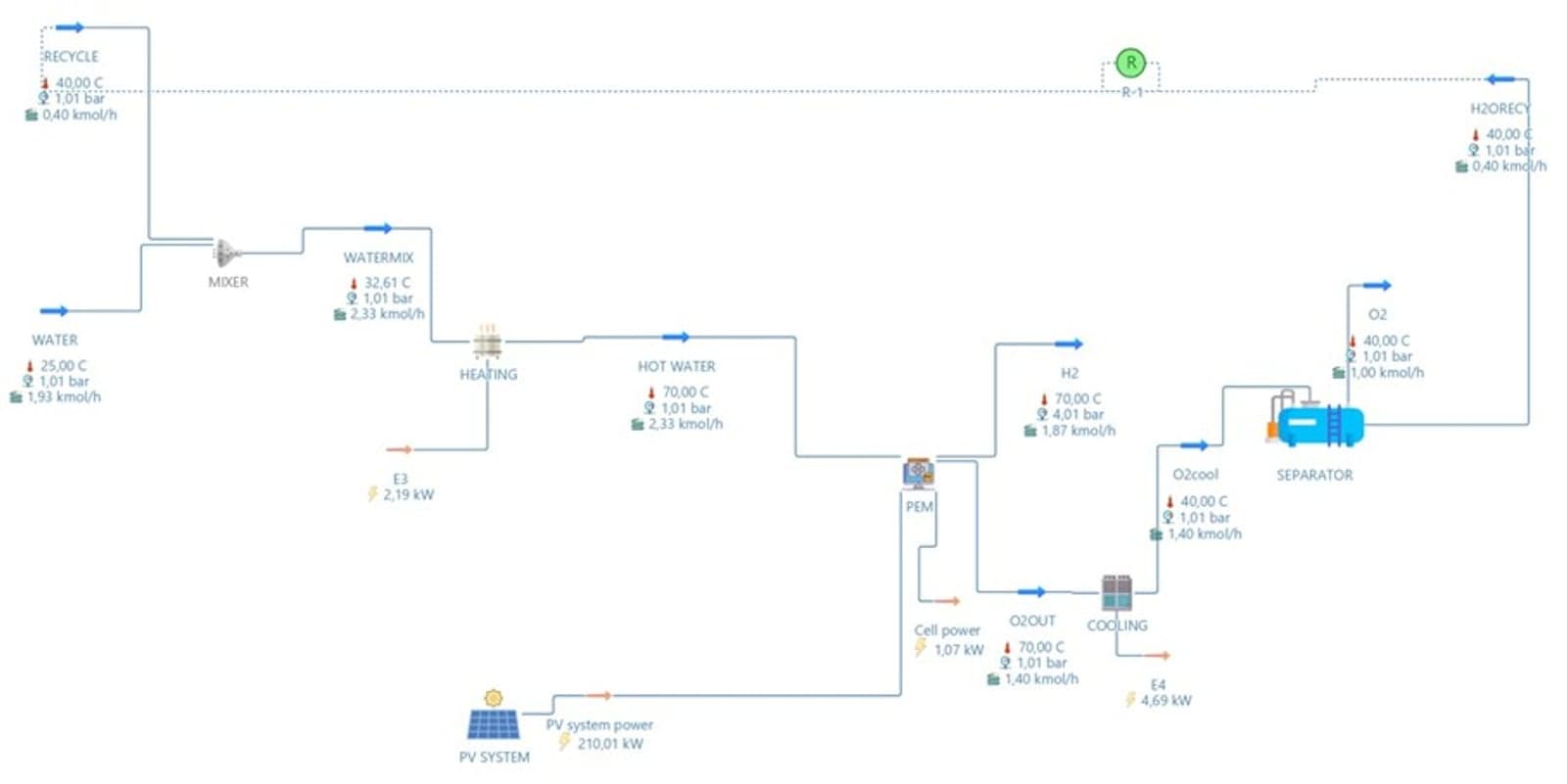
The system is fed with water at room temperature (25°C), which is mixed with the water stream from the separator after the electrolyser. Subsequently, the stream is heated to process temperature (70°C) and fed to the electrolyser. The main outputs of the electrolyser are hydrogen, oxygen and unreacted water. After a cooling system and a separator, the oxygen is separated from water and the latter is recycled to the start of the process. The energy required for the electrolytic reactions was provided by the PV system.
The model results were successfully compared both with literature (Millet et al., 2010) and commercial data.
Considering a panel power of 210kW, the hydrogen and oxygen obtained are 3.8kg/h and 30kg/h respectively. The average system efficiency achieved by the model, 56kWh/kgH2, is in line with the commercial one (round 55-60kWh/kgH2).
In a wastewater treatment plant, the hydrogen can be used to produce biomethane by reacting with the carbon dioxide coming from the anaerobic digestion, a process used to treat sludge. The biomethane could allow to increase energy self-sufficiency and reduce the CO2 emissions.
Additionally, in a wastewater treatment plant, oxygen, usually a byproduct of an electrolysis process, can also be used for the ozonation process.
Conclusion
Green hydrogen, being a fuel not producing CO2 emissions, has gained more and more interest within the decarbonisation of energy intensive industries.
For wastewater treatment plants, there are additional advantages:
- The plant 'produces' treated water which can be used in the electrolysis process, after a purification process.
- Hydrogen could be used to synthesise methane by reacting with CO2 produced in the anaerobic digestion process.
- The electrolysis process also produces oxygen which can be used to produce ozone.
However, one of the main challenges in implementing this technology is its cost, which remains high. The next step in the TRINEFLEX project will be a techno-economic analysis of the entire process, from hydrogen to biomethane, in order to identify concrete solutions that allow to overcome issues hindering its implementation.
References
Abdol Rahim, A., 2016. An overview of polymer electrolyte membrane electrolyzer for hydrogen production: Modeling and mass transport. Journal of Power Sources , 309, 56-65.
Datta, R. et al., 2016. Modeling of PEM Water Electrolyzer. Taylor & Francis Group, LLC.
Jarvinen, L. et al., 2022. Automized parametrization of PEM and alkaline water electrolyzer polarisation curves. International Journal of Hydrogen Energy, 47, 31985-32003.
Millet, P. et al. (2010). PEM water electrolyzers: From electrocatalysis to stack development. International Journal of Hydrogen Energy, 35, 5043-5052.
Valverde, G. et al. (2012). Simple PEM water electrolyser model and experimental validation. International Journal of Hydrogen Energy, 37, 1927-1938.
About the authors
Michela Mazzoccoli is a project manager and expert on the energy transition, circular economy and bioeconomy, European projects and stakeholder engagement at TICASS. She holds an MSc in chemical engineering and PhD in Fluid dynamics and environmental engineering.
Said Benouba is a senior researcher at NORCE research centre. With a PhD in physics, his key interests encompass energy systems, renewable energies, power generation technologies, smart grids, flexibility and CO2 impacts. He also has experience in thermoelectricity, energy harvesting and hydrogen applications.
Most popular
Join the community for freeAnd get access to all content
Related projects
TRINEFLEX
1 September 2022 - 31 August 2026
View projectLatest content
+1
How Australia’s waste-to-energy sector can overcome community resistance
Community resistance toward waste-to-energy is largely driven by misconceptions about air pollution and perceived environmental risks, write Kristen Clarke and Lyon McLeod of Ramboll Australia.
- Guest/partner contributor
- 01/05/2026