How ASCEND helps cities design positive clean energy district business models
Guest/partner contributor
Posted on: 9 April 2026
ASCEND has addressed one of the most persistent bottlenecks in urban energy transitions: the gap between technical solutions and viable city-scale business models.
Across Europe, cities move toward climate neutrality, but many struggle to move beyond isolated projects into scalable, investable solutions.
As they pilot positive clean energy districts, traditional business models no longer fit the realities of shared energy systems, citizen participation and social affordability.
As a response to this shift, the ASCEND EU-funded project has created a framework that helps cities prototype, test and refine their positive clean energy district business model strategies.
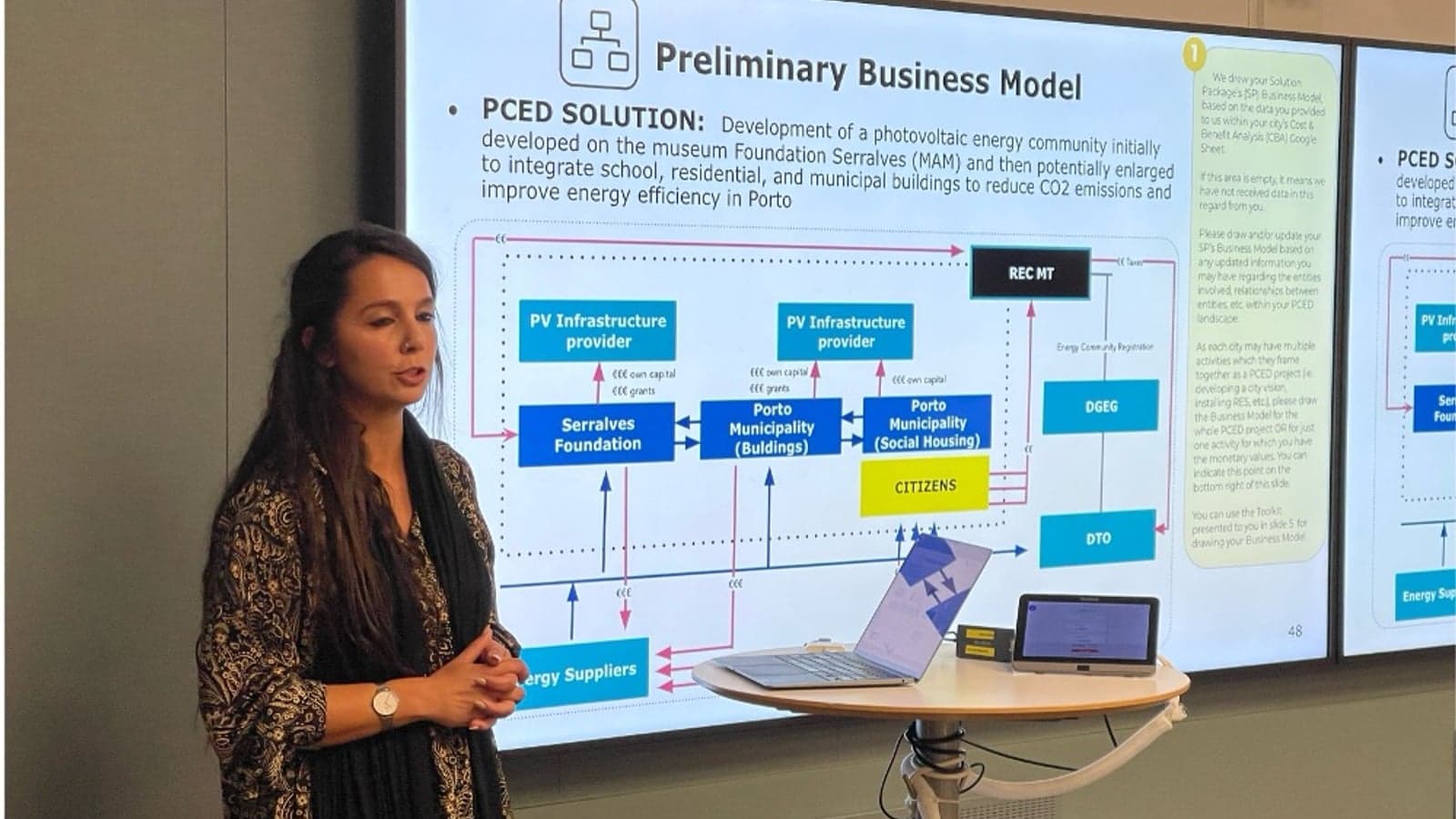
Over the last year, ASCEND cities had the opportunity to participate in three interactive workshops. At the heart of these workshops was the positive clean energy districts business model assembler, a collaborative tool developed by the University of St. Gallen .
The business model assembler exists as both a physical card game and an online digital sandbox created by Twenty Communications. It offers a risk-free, interactive structured sandbox where cities can simulate governance, financing and value flows before committing political or financial capital.
During the workshops, participants used the assembler to simulate real-world decision-making. Teams explored questions like: Which governance model fits our district? How does value flow across stakeholders? How can risks be mitigated? Which financing and operational strategies are scalable?
By combining cards representing stakeholders, business models and operational patterns, cities could iteratively co-create district designs that balance technology, financing and social objectives.
From lessons to practice
These exercises highlighted how cities are putting lessons into practice. Lyon and Porto explored community-based energy schemes that link local renewable production to social benefits, from lower energy bills to increased energy literacy.
Munich and Stockholm examined how citizen engagement strengthens district resilience and builds a shared sense of responsibility for energy and sustainability.
In Prague and Budapest, affordability was front and centre, demonstrating that the energy transition must also address housing, equity and everyday living conditions.
Meanwhile, Charleroi used the workshops to test its net-zero carbon master plan for the Porte Ouest area, exploring how waste, geothermal, and aquathermal energy sources can feed a renewable thermal network.
Together, these cases show that positive clean energy district success depends less on technology choices than on how value, responsibility and risk are shared.
The tool shows that successful positive clean energy districts depend as much on governance, participation and trust as on technology and funding. By providing a structured, interactive sandbox, the assembler helps cities reconnect governance, business models and financing logic, reducing uncertainty, accelerating decision-making and creating concepts that can move beyond the pilot stage.
As cities move from experimentation to implementation, tools like the positive clean energy district business model assembler will be essential; not as games, but as decision infrastructures for Europe’s climate-neutral future.
ASCEND is working to accelerate the deployment of positive clean energy districts as a default solution for climate-neutral, inclusive and resilient cities across Europe.
About the author
Veronika Cerna is the founder and CEO of TWNTY, a consultancy specialising in strategy, governance and business models for climate-neutral cities. With over 20 years of experience across EU institutions, international organisations and multi-stakeholder programmes, she focuses on the organisational models, continuity, business strategy and decision-making frameworks that move projects beyond pilots into long-term implementation.