How vehicle to grid can drive down EU energy system costs
Yusuf Latief
Posted on: 6 December 2024
Yusuf Latief discusses how much, with optimal implementation, V2G tech can save in EU power system costs. The answer: billion.
In this Power Playbook, Yusuf Latief discusses a report from Fraunhofer ISI and ISE, which finds that V2G tech has the potential to save billions in euros for EU energy system costs, so long as policy keeps pace.
The value proposition behind electric vehicles comes fully into view when we look at V2G – a system where the electric automobile becomes a ‘battery on wheels’, allowing the driver to charge and discharge their vehicles.
The system has huge implications. If used correctly, it can even out supply-demand imbalances and buff up the grid to ensure reliability.
Now, let’s put a financial label on things.
According to the Fraunhofer study, Potential of a full EV-power-system-integration in Europe & how to realise it, if adopted widely, bidirectional charging could reduce annual energy system costs across the EU by 8.6%.
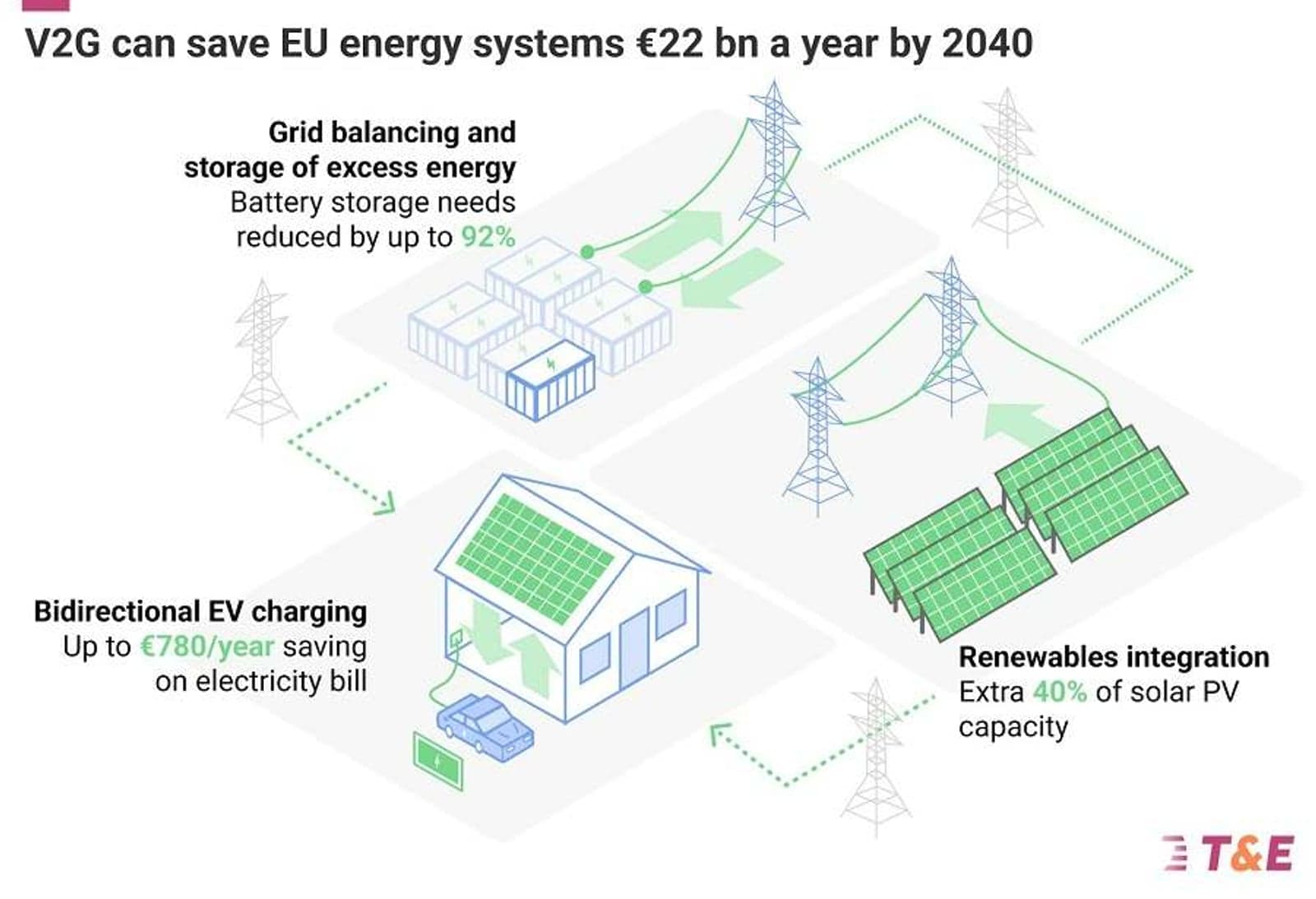
This would amount to €22.2 billion ($23.4 billion) in savings per year. Even by 2030, savings of 5.5% or €9.7 billion ($10.2 billion) annually are projected.
The study - commissioned for European environmental organisation Transport & Environment (T&E) - takes it a notch further, finding that in total, up to €175.45 billion ($184.7 billion) would be saved.
The reasons? Reductions. In generation capacity, curtailment, and fuel consumption.
Batteries on wheels
Storing energy when there’s an excess supply of renewables, EVs plugged in at home or work reduce the need for stationary battery storage.
According to the report, this reduction goes up to as high as 92% by 2040. With this, back-up power plant capacity could be reduced by 126GW.
Fraunhoffer’s stats go on.
With more V2G, the European grid would be able to integrate up to 40% more solar PV capacity - 430GW by 2030 – nearly doubling the current capacity.
In fact, the study projects that, by 2040, the European electric vehicle fleet will become one of the main power resources for the electricity system.
Based on the study's findings, assuming widespread adoption of bidirectional charging technology, the fleet could potentially contribute up to 9% of the annual power supply in Europe. This would catapult EVs to become the 4th biggest overall power ‘supplier’.
This would mean that EVs could feed back hundreds of terawatt-hours of electricity to the grid annually, acting as a massive, distributed virtual power plant. During peak demand periods, the contribution could be even higher, potentially supplying 15-20% of the instantaneous electricity demand.
These transformative changes in generation capacity and power supply would then translate into to the earlier-mentioned €22.2 billion and €9.7 billion in cost savings.
Creating momentum
Fraunhofer’s study puts the V2G value case into numbers, indirectly demonstrating the momentum behind the tech, especially as we go into the new year.
But it is not the only study.
According to a report from ResearchAndMarkets that was issued in November, the V2G market is forecast to reach $25.540 billion by 2029, at a CAGR of 38.24% up from $5.059 billion this year.
To no surprise, the growth will be propelled by surging electricity demand from growing EV adoption and grid expansion.
In the US specifically, according to a report from Nuvve, 2025 is going to be a pivotal year for the tech. Gregory Poilasne, the e-mobility company’s CEO, said as much in a release:
“2025 is poised to be a transformative year for V2G technology because of the convergence of grid reliability concerns, rising utility rates, and government mandates”.
And indeed, this year already, companies, OEMs, and utilities alike have all seen the value and start to act on it.
Just last week, in fact, Renault Group, We Drive Solar, MyWheels and the Dutch city of Utrecht joined forces to launch the first large-scale car-sharing service in Europe that utilises V2G technology.
In mid-October, seven partners joined an EDF-led consortium for the EVVE project to expedite the rollout of V2G charging stations in Europe.
And in September in the US, BMW, Ford and Honda began operations of ChargeScape, a joint venture focused on the integration of EVs into the power grid.
These are but a few announcements, signalling that the coming year will most likely see a huge shift.
More from the Power Playbook:
Jørgensen takes office: How to prioritise grid financing?
COP29: The X-factor and why energy financing needs a double down
So, what's holding this momentum back?
The AC-DC question
According to the Fraunhofer study, as different car manufacturers are currently focusing on either AC or DC bidirectional systems, a lack of interoperability continues to hold back the adoption of V2G.
Fabian Sperka, vehicles policy manager at T&E, said: “V2G can only take off if we ensure all EVs can work with all chargers. Lawmakers can unlock the potential of this technology by deciding the EU standards for bidirectional charging.
“That will be a win for consumers, the environment and progress towards the EU’s climate and energy goals.”
Specifically, the study recommends that EU and national regulatory frameworks set minimum requirements: make onboard chargers mandatory and bidirectional; ensure charging infrastructure is bidirectional; implement the energy market design with haste; adapt network codes to allow onboard chargers to work in distribution grids.
With the next College of Commissioners having this week taken on their mandate, this will be a critical point to tackle in the coming year.
And there are already players who having been working to overcome it.
Take ElaadNL for example. A research lab based in Arnhem, the Netherlands, ElaadNL has been looking into cybersecurity, interoperability and smart charging.
Earlier this year during an interview with Arjan Wargers, a manager of research and innovation at the lab, he explained to me the very next steps on the V2G roadmap:
“The most straightforward roadmap is to develop and, more importantly, implement the ISO 15118-20 standard so that it is implemented in the right way, in the same way, by every OEM, EV OEM and EVSE OEM.
“Other standards in the ‘V2G chain’, like the latest version of OCPP, should also be implemented to facilitate V2G.
“Next to that, information like state of charge and energy need are very important for managed charging and we need to develop an app or settings in the EV to get this information. Making this data open, shareable and cyber secure is also very, very important.”
Said Wargers: “The tech is important. Customers want it. Customers like it. There are a lot of business opportunities as well. So, I see this happening.”
Indeed, the market is sure to ripen for the technology, so it will be critical to have it on our radar as we wind down 2024 and shift into 2025.
Cheers,
Yusuf Latief
Content Producer
Smart Energy International

Follow me on Linkedin