Hydrogen shipments at sea – a first
Jonathan Spencer Jones
Posted on: 1 February 2022
The first shipment of liquid hydrogen by sea has started with the transit of Kawasaki Heavy Industries’ ‘Suiso Frontier’ from Hastings, Australia to Kobe, Japan.
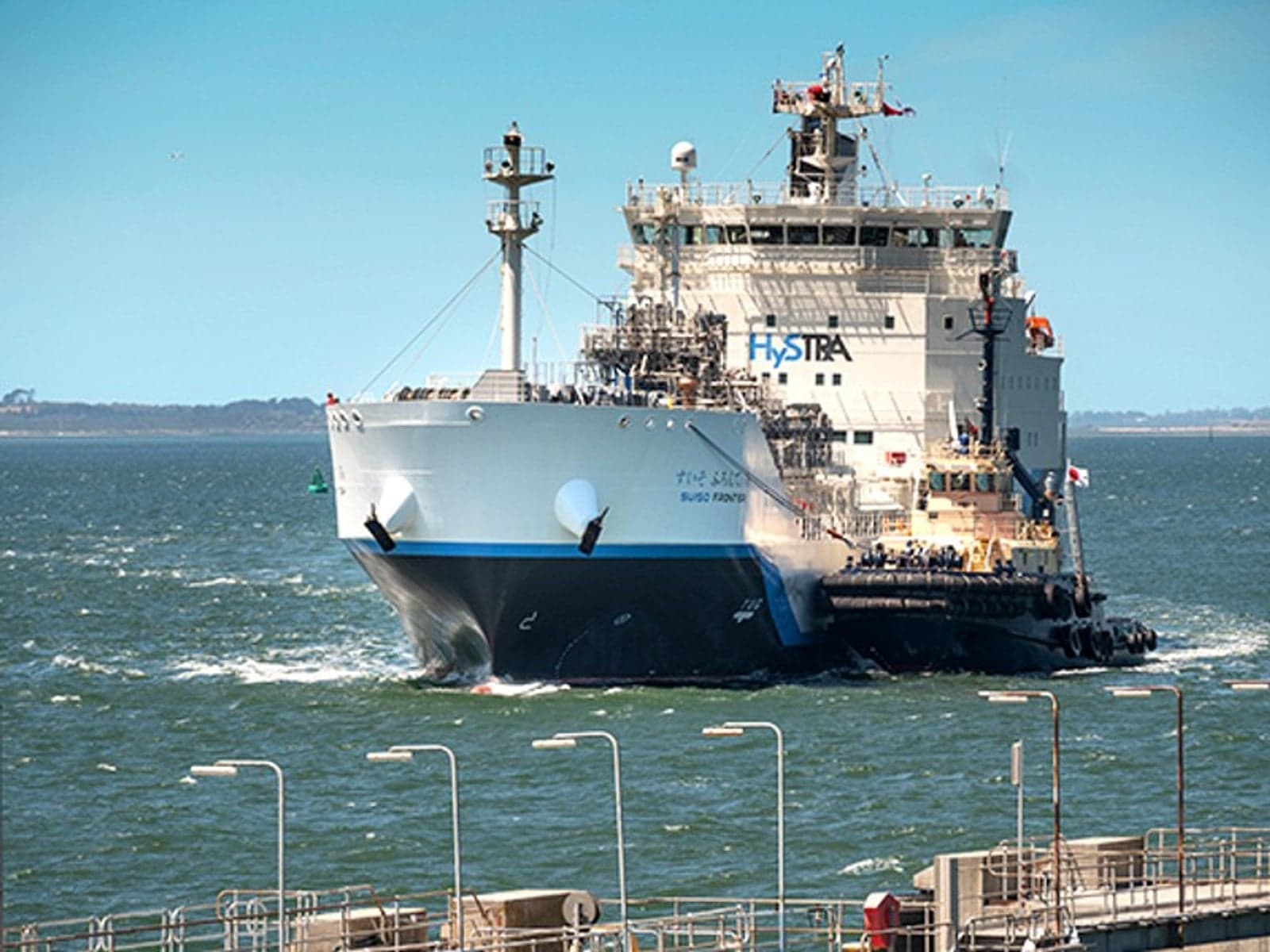
The first shipment of liquid hydrogen by sea has started with the transit of Kawasaki Heavy Industries’ ‘Suiso Frontier’ from Hastings, Australia to Kobe, Japan.
The shipment, a joint initiative between the Hydrogen Energy Supply Chain project of Australia and the Hydrogen Energy Supply-chain Technology Research Association (HySTRA) of Japan, is aimed at demonstrating a hydrogen supply chain between the two countries encompassing production in Australia to delivery in Japan.
To this end, the Suiso Frontier was developed as a purpose-built hydrogen tanker, making its maiden voyage from Kobe to the port of Hastings in Victoria between December 24 to January 21 and setting out from Hastings with its cargo for the return journey on January 28.
With many countries eyeing the prospect of hydrogen exports, particularly from those in the southern hemisphere such as Australia, South Africa and Chile to Europe and elsewhere in the northern, the venture should start to give some insights on the practicalities and costs of a future large scale international hydrogen trade.
Have you seen?
Green hydrogen megaprojects on three continents
The role of offshore green hydrogen in Europe’s decarbonisation journey
Catching hydrogen’s next big wave
“We are very happy with how things have progressed at Hastings,” said Hirofumi Kawazoe, Hydrogen Engineering Australia’s General Manager.
“We have successfully completed all safety, technical and operational aspects of the loading of liquefied hydrogen.”
The Suiso Frontier is a 116m, 8,000t vessel with the capacity to carry 1,250m3 of liquefied hydrogen cooled to -253oC in a vacuum insulated double shell structure storage tank.
In liquefied state, the hydrogen has approximately 1/800 of its original gaseous state volume, which makes it more practical for transport, although around one-third of its original volume in consumed in the liquefaction process.
It also demands the extreme cooling requirements, which also are required for the infrastructure for storage and the loading and unloading of the liquefied hydrogen to avoid losses.
Hydrogen production
The hydrogen for the Hydrogen Energy Supply Chain project is being produced through gasification from coal at a newly constructed plant located at AGL Energy’s Loy Yang coal-fired power plant complex in the Latrobe Valley.
It is then transported by truck to the liquefaction and loading terminal at the port of Hastings, some 170km to the west of the Latrobe Valley.
As such in this phase, the hydrogen is ‘brown hydrogen’, although carbon offsets are being purchased to mitigate the emissions.
In time, however, for the commercial phase the plan is to convert it to ‘blue hydrogen’ with the addition of carbon capture and storage via Victoria’s CarbonNet project, which envisions collecting carbon from industries across the Latrobe Valley and transporting it for storage below the seabed in the Bass Strait.
It also is intended to introduce biomass as a supplementary fuel stock for hydrogen production.
Shipping hydrogen
Key issues in this first shipment include cargo handling and equipment testing. Over the next two years as further shipments are undertaken the project partners intend to undertake the R&D to expand the venture to a commercial scale in the mid to late-2020s.
IRENA’s recently published Geopolitics of the Energy Transformation report identifies liquefied hydrogen as one of the three main ways to transport hydrogen by ship. The others are as liquid organic hydrogen or as ammonia, of which the latter is stated as the most promising and already an internationally traded commodity.
Moreover, shipping is likely to be most cost-effective in most cases for distances over 4,000km and obviously is the only option for intercontinental trade.
With ammonia a planned by-product alongside hydrogen in Chile, for example, ultimately an array of factors including costs and the levels of production and demand of the various products are likely to determine the play of the future hydrogen trade.
Latest content
+3
UK: £5 million for research into hydrogen production from biomass
The UK government has launched the new Hydrogen BECCS (biomass with carbon capture and storage) Innovation Programme to support the development of new technologies that will generate hydrogen from biomass and waste.
- Jonathan Spencer Jones
- 17/01/2022