Hyundai and Kia in V2G expansion across Europe, US and Asia
Yusuf Latief
Posted on: 1 December 2025
Services include the first V2G on South Korean island where oversupply of renewable energy is an issue for the power grid.
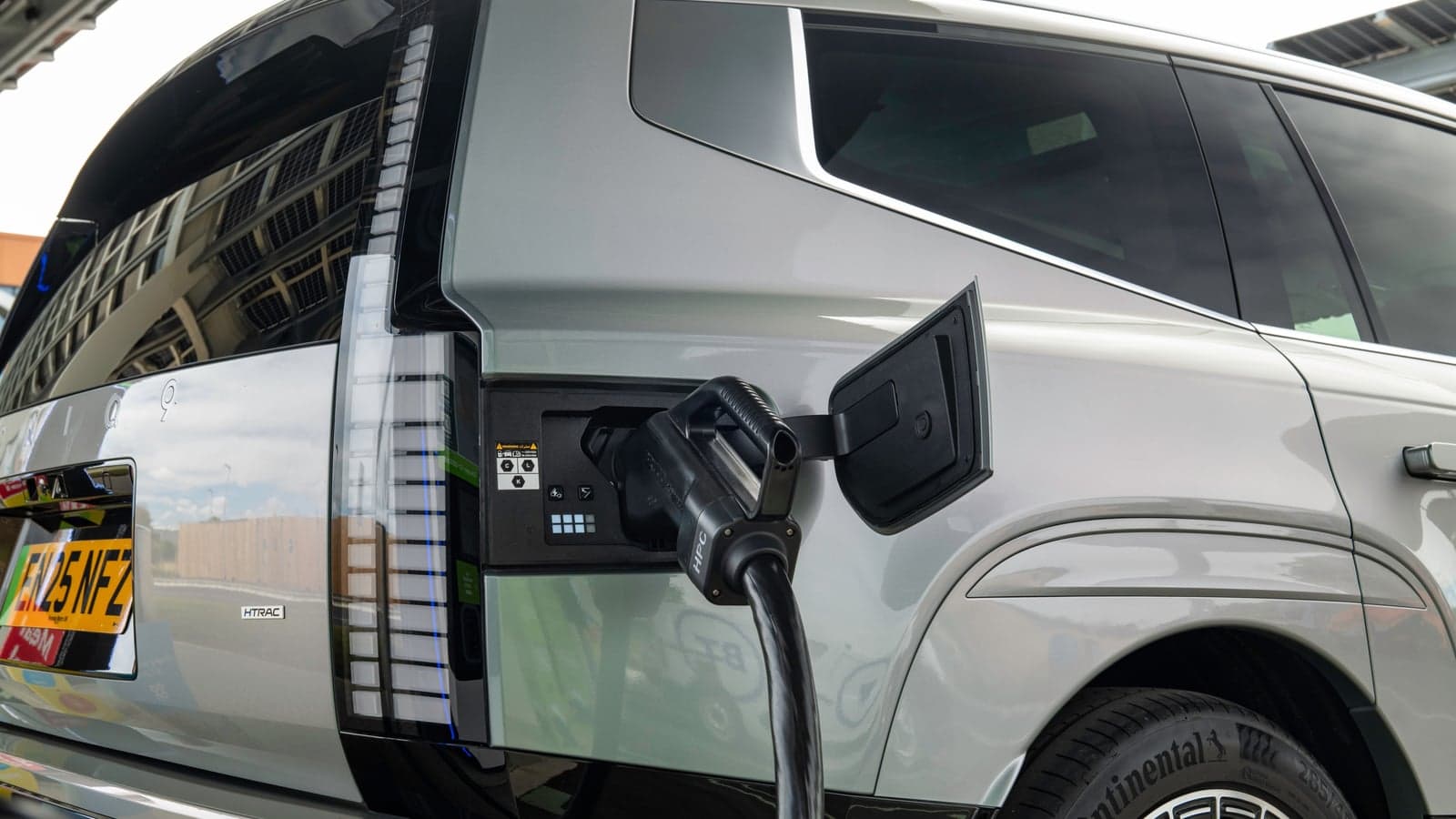
Hyundai Motor Group and Kia are accelerating the worldwide rollout of services that enable EVs to store, supply and share electricity with homes and power grids.
The expanded services include vehicle-to-grid (V2G) services in South Korea and Europe, and a vehicle-to-home (V2H) service in the US.
In South Korea, Hyundai will launch the nation’s first V2G pilot service in Jeju Island by the end of 2025. Jeju is the largest island in South Korea with abundant renewable resources, aiming to meet 100% of its 2030 power demand with renewable energy. However, controlling the fluctuation of renewables is challenging due to the lack of appropriate energy distribution strategies.
It is this challenge that Hyundai and Kia are tackling, using the car models Kia EV9 and Hyundai IONIQ 9 to address Jeju’s renewable-energy oversupply issue by leveraging EVs as flexible grid resources that can return stored electricity to the grid.
Through the domestic and overseas V2G services, we aim to strengthen the competitiveness of EVs while also playing a pivotal role in leading the eco-friendly mobility market and future energy market.
A public–private collaboration, Hyundai says the project emphasizes the joint effort between government and industry to advance V2G technology in Korea.
As the project lead, Hyundai oversees the technology verification of V2G and manages the overall operation. Jeju Special Self-Governing Province supports regulatory and policy improvements essential for implementation. Korea Electric Power Corporation (KEPCO) facilitates the integration of EVs into the distribution grid, while Hyundai Engineering focuses on analysing charging station operations and exploring future service enhancements.
Participants can charge their EVs when energy prices are low and discharge electricity when prices rise through Jeju’s real-time energy market, supporting grid stability while helping reduce overall energy costs. Following the pilot phase, the Hyundai plans to expand V2G services nationwide in cooperation with government and municipal partners.
Hokeun Chung, Executive Vice-President of Future Strategy Division at Hyundai Motor Group, said V2G services "are expected to provide EV customers with a new mobility experience related to their energy life".
"Through the domestic and overseas V2G services, we aim to strengthen the competitiveness of EVs while also playing a pivotal role in leading the eco-friendly mobility market and future energy market.”
More on V2G:
Volkswagen’s Elli launches bidirectional charging pilot in Germany
Plugging V2G into Austria’s energy system ambitions
Businesses are eyeing V2G in Germany – is the market shifting?
In Europe, Hyundai is expanding its customer-centric energy solutions by introducing a commercialised V2G service in the Netherlands.
As the first OEM to launch a customer-focused V2G service, this initiative builds on the Smart Charging (V1G) service introduced earlier this year. Customer recruitment for the V2G service will begin at the end of 2025.
The V2G service leverages bidirectional charging technology and chargers compatible with Hyundai and Kia vehicles. Customers subscribing to a tariff plan from Hyundai’s utility partners can access automated V2G scheduling, which optimises charging during low-rate periods and enables the sale of surplus energy back to the grid during peak-price times. This reduces electricity expenses for customers and enables active participation in energy trading.
In the Netherlands, where electricity prices are high and the power system is increasingly variable, the V2G service enhances Hyundai Motor and Kia EV accessibility while aiding in the stabilisation of the electricity grid. It will also facilitate the expansion of renewable energy across the country by supporting grid flexibility and reliability.
Initially the service will be available for Kia EV9 and Hyundai IONIQ 9, with plans to expand coverage to other EV models. Hyundai also aims to roll out the V2G service to other European countries, further advancing customer convenience and supporting the region’s transition toward smarter energy systems.
In the US, Hyundai will launch its V2H services in the near term, enabling EVs to provide energy solutions during natural disasters such as large wildfires, routine power outages, or peak-demand periods.
The V2H service utilises EV power as an emergency power source for homes during these critical times, further enhancing household energy resilience.
Kia’s V2H service – launched earlier this year in February 2025 – allows EV9 owners to use their vehicles as reliable household backup power sources. Hyundai Motor will introduce V2H functionality starting with IONIQ 9, while Kia expands its offering to include EV6.
The service enables EV owners to store electricity in their vehicle’s battery during off-peak hours and discharge back into their homes during peak periods, potentially reducing household electricity costs and enhancing energy resilience.
The Group is accelerating its V2X strategy, connecting EVs, energy systems and society in a unified ecosystem. These initiatives are key to transforming the customer ownership experience while promoting efficient, renewable energy use across major markets.