Inflation Reduction Act: Two years on, to whom has the clean tech money gone?
Yusuf Latief
Posted on: 23 August 2024
In 2022, US President Biden signed into law the Inflation Reduction Act. In this Power Playbook, Yusuf Latief discusses its success.
In this week's Power Playbook, Yusuf Latief discusses the Inflation Reduction Act two years after its passage into law, breaking down the finance flows from one of the most prolific pieces of US legislation.
On August 16, 2022, US President Biden with a stroke of pen signed into law one of the most transformative pieces of federal legislation – the Inflation Reduction Act (IRA).
Biden's Administration hailed the IRA as the largest investment in clean energy and climate action ever.
Now, two years since its passing, companies have announced over $265 billion in clean energy investments, according to a White House IRA anniversary fact sheet.
Which brings to mind two questions: how successful has this watershed policy been and where have the investments gone?
And I am not the only one asking.
Some staggering numbers
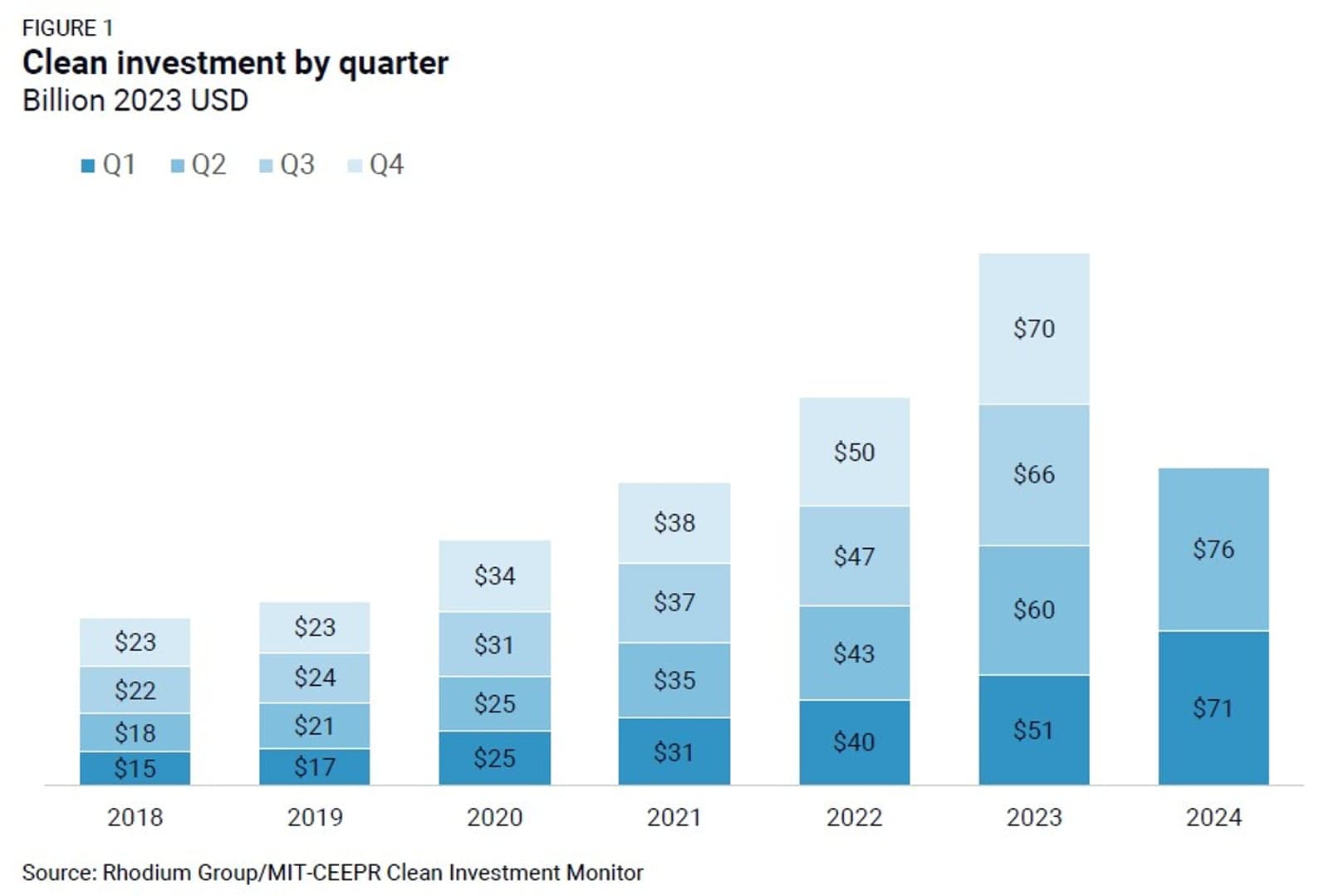
This was the very subject of a recent report by the Clean Investment Monitor, a project launched by Rhodium Group and MIT CEEPR in 2023 to track US public and private investments in decarbonisation.
The project’s report, Tallying the Two-Year Impact of the Inflation Reduction Act, takes the already-impressive figure from the White House a notch further, stating that, from the second half of 2022 through the first half of this year, business and consumer investment totalled $493 billion.
By segment, that includes:
- $89 billion into ‘manufacturing’, including the facilities and equipment used to manufacture GHG-emission-reducing technology;
- $161 billion into ‘energy & industry’, which refers to investments for the deployment of the ‘manufacturing’ technology, both to produce clean energy or decarbonise industrial production;
- $242 billion into ‘retail’, which includes the purchase and installation of this technology by individual households and businesses.
To place it comparatively, this $493 billion represents a 71% increase in these investments from the two years preceding the IRA.
More from Smart Energy's Power Playbook:
Europe’s system operators’ profits are up – let’s break it down
Indian energy giant Adani raked in $643 million YoY – here’s how
Let’s break it down
According to the report, investment in manufacturing posted the fastest growth, more than quadruple the $22 billion invested in the two years prior to the IRA’s enactment. Over $1 in every $4 of clean investment went to manufacturing in Q2 2024, an increase from $1 in every $10 in Q3 2022.
The lion’s share went into the electric vehicle supply chain, including critical minerals, vehicle assembly, charging equipment and batteries.
For energy & industry, the report noted that the IRA injected momentum into investment with a 43% increase relative to the preceding two years. Specifically, utility-scale solar and storage investments increased 56% and 130%, respectively, while wind investment declined by 52%.
Also under energy & industry, $28 billion was invested in deploying emerging climate technologies (ECT) of carbon management, clean hydrogen and sustainable aviation fuels, nearly 12 times larger than the pre-IRA period.
Under retail, states the report, US businesses and households invested over $242 billion in the purchase and installation of zero-emission vehicles (ZEVs), heat pumps and distributed renewable generation, fuel cells and storage systems.
That’s a 58% increase relative to the previous two-year period.
According to the Investment Monitor, purchases of ZEVs grew fastest, to $157 billion, nearly double pre-IRA investment. The remainder technologies, excluding heat pumps which declined 4%, also increased robustly, up 40%.
334 new projects
Further analysis was provided by E2, a policy advocacy group in the US, who state in Clean Economy Works: Inflation Reduction Act Two-Year Analysis, that in the last two years, companies have announced at least 334 major new clean energy and clean vehicle projects across the country.
The report lays the projects out by sector, with some projects falling under multiple sectors:
- Grid, transmission and electrification: 16 projects totalling $1.8 billion estimated investment
- EVs: 152 projects totalling $81.3 billion estimated investment
- Solar: 80 projects totalling $14.7 billion estimated investment
- Battery/Storage: 74 projects totalling $41.7 billion estimated investment
- Wind: 24 projects totalling $4 billion estimated investment
- Hydrogen: 18 projects totalling $6.1 billion estimated investment
- Energy efficiency: 1 project totalling $1.8 billion estimated investment
- Biofuel: 1 project without a given amount
- Geothermal: 1 project without a given amount
Of note, the report states that automakers and their suppliers announced 132 new or expanded EV and battery plants and related factories in 23 states, including 39 clean vehicle manufacturing projects in the past year.
Additionally, solar panel equipment manufacturers are building or expanding 53 factories in 23 states while renewable energy operators are planning 24 new large-scale wind and solar generation projects across 22 states and at least 51 new battery/storage projects are in development.
E2 adds that foreign companies led or were involved with about 160 of the projects announced since the IRA became law – nearly identical to the number of announced projects from US-based companies. Specifically, South Korean companies have announced the most projects – about three-dozen in the past two years.
On a more sombre note, E2’s report adds that the number of major IRA-related clean energy projects announced during the past twelve months have declined from the previous year, when 216 projects were announced.
The decline comes amid the uncertainty of the 2024 elections and more than 40 attempts to roll back or reduce parts of the IRA by the US House.
According to law firm Holland & Knight, former US president Donald Trump and some of his policy advisors have indicated that, if elected, it would be their intent to defund certain initiatives from the Biden-Harris administration, including the clean energy funds appropriated in the IIJA (Infrastructure Investment and Jobs Act) and IRA.
Thus, although the numbers from above are certainly to be lauded, there is palpable uncertainty hanging on the November elections. Does this influence your investment planning?
Cheers,
Yusuf Latief
Content Producer
Smart Energy International

Follow me on Linkedin