Integrating flexibility resources into distribution network planning
Guest/partner contributor
Posted on: 6 April 2026
The STREAM project is investigating how flexibility can serve as a credible, quantifiable complement or alternative to conventional network reinforcement.

The accelerating integration of distributed energy resources into Europe’s distribution networks is placing growing demands on infrastructure designed for a different era of power systems.
Distribution networks were originally designed to deliver electricity unidirectionally, from substation to end consumer. The widespread connection of distributed energy resources such as photovoltaic systems, battery storage, electric vehicles and heat pumps is altering this dynamic, introducing reverse power flows, voltage deviations and congestion that conventional planning approaches were not designed to address.
The conventional response reinforcing cables and transformers is costly, time consuming and often results in over-sized infrastructure that sits underutilised for most of its life. There is an alternative: flexibility. In the energy sector, flexibility means adjusting consumption or generation profiles in response to a signal, delivering a service to the grid.
The EU Clean Energy Package provides a regulatory framework that encourages DSOs to act as independent facilitators of flexibility markets, with market-based procurement as the preferred default. In practice, however, most DSOs still treat flexibility as a short-term operational measure rather than a mainstream planning tool, partly because prevailing revenue frameworks reward capital expenditure over efficient use of existing assets.
STREAM: a Horizon Europe ecosystem for flexibility
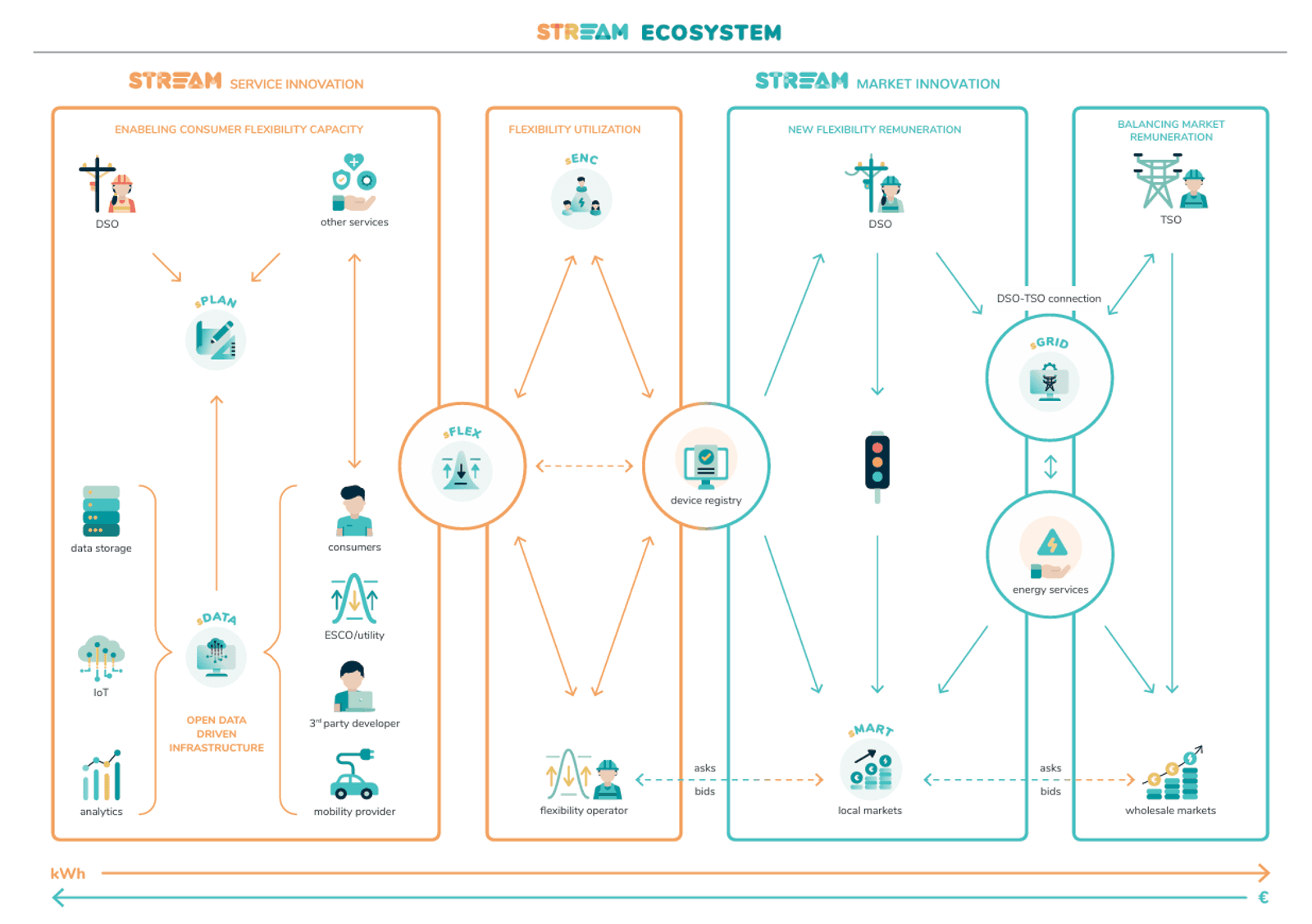
Launched in October 2022 with 20 partners and a 48-month duration, STREAM is developing an integrated ecosystem of tools to enable the systematic use of flexibility, primarily at the LV network level. The project aims to connect flexibility resource owners, aggregators, DSOs and transmission operators through standardised data exchange and local flexibility market structures.
The ecosystem comprises six tools operating in concert: sGRID for network state estimation and flexibility asset pre-qualification; sMART for local flexibility market operation; sDATA for secure inter-platform data exchange; sENC for energy community management and aggregation; sFLEX for flexibility portfolio management; and sPLAN for network planning and investment appraisal.
sPLAN: making the case for flexibility in network planning
sPLAN is designed to support DSOs in assessing network development options by combining power flow simulation with structured cost comparison. The tool constructs network models from measured load profiles and operator supplied topology data, then introduces scenarios incorporating new devices including PV systems, battery storage, heat pumps and electric vehicles allocated to network users based on connection type and electrical distance from the supply point. These synthetic profiles serve as inputs to power flow calculations performed via the open-source Pandapower library.
Where simulation results indicate overloading or voltage limit violations, sPLAN presents two parallel resolution pathways:
- Network reinforcement: The tool identifies the affected elements, proposes technically equivalent replacements of greater capacity, and generates an indicative investment cost based on unit pricing data entered by the operator.
- Flexibility activation: sPLAN modifies the output profiles of identified flexibility resources during periods of constraint, reruns the power flow simulation, and assigns a service cost derived from pricing signals provided by the sMART market tool within the STREAM ecosystem.
Both pathways are evaluated in parallel, enabling a direct, like-for-like comparison of their technical efficacy and associated costs. This technology-neutral framing reflects the broader principle that neither reinforcement nor flexibility should be assumed the default solution; the appropriate choice depends on the specific network context, the availability and cost of flexibility resources and the time horizon under consideration.
Key capabilities of sPLAN are:
- Technology-neutral investment appraisal: Conventional reinforcement and flexibility-based alternatives are evaluated on the same technical and economic footing, supporting objective decision-making.
- Measured data foundation: Simulations draw on actual historical load profiles and regularly updated network topology, grounding results in observed rather than assumed network behaviour.
- Forward-looking scenario analysis: Operators can model the network impact of prospective DER connections, including EVs, heat pumps and storage, before those assets are installed.
- Operator-defined cost parameters: Reinforcement cost calculations use pricing data supplied by the operating DSO, ensuring that outputs reflect local procurement conditions rather than generic benchmarks.
- Market-integrated flexibility pricing: Flexibility service costs are drawn from the sMART local market tool, connecting planning decisions to realistic market signals rather than hypothetical values.
- Capex and opex comparison: The tool explicitly addresses both capital and operational cost dimensions, reflecting the shift in planning logic that flexibility adoption implies.
What comes next
The full STREAM ecosystem is currently in its final development phase. Results from real-world testing on the distribution network in Ajdovščina, Slovenia, where flexibility-based and conventional solutions will be directly compared will be published before the project closes.
The findings are expected to provide practical, replicable guidance for DSOs across Europe seeking a smarter path through the grid investment challenge.
The regulatory gap: why technical tools alone are not enough
Tools like sPLAN can demonstrate that flexibility is a viable and cost-effective alternative to grid reinforcement. But for DSOs to act on that evidence, the regulatory environment must also change. At present, most DSOs, including those in Slovenia, operate under frameworks designed for passive network management and capital investment. There is no explicit legal mandate to procure flexibility services, and prevailing revenue models tend to reward infrastructure spending over the efficient use of existing assets. Flexibility, even where technically proven, remains difficult to justify within current regulatory constraints.
Drawing on the STREAM project’s policy analysis for Slovenia, three regulatory changes stand out as prerequisites for local flexibility markets to become operational in practice:
- A clear legal mandate for DSOs to procure flexibility. The Energy Act and supporting secondary legislation should explicitly permit DSOs to contract flexibility services from distributed generation, demand response, storage and aggregators for congestion management and voltage control.
- Regulatory recognition of flexibility costs. Tariff methodologies must evolve so that DSOs are not financially penalised for choosing flexibility over investment. Flexibility procurement costs should be recognised as legitimate regulated expenditure, with transparent cost recovery mechanisms placing operational and capital solutions on equal regulatory footing.
- Technical standards for interoperability and market access. Updated grid codes should establish interoperability standards, data exchange requirements and coordination procedures between DSOs and the transmission system operator. Equally important is ensuring open, non-discriminatory access to flexibility markets for all eligible participants, including aggregators, prosumers, energy communities and storage operators, regardless of size or technology.
Similar regulatory gaps exist across the EU, and the Clean Energy Package already provides the framework for addressing them requiring DSOs to act as neutral facilitators of flexibility markets, with market-based procurement as the preferred default. Translating that intent into enforceable national rules is the necessary next step.
STREAM’s work, both technical and policy-oriented, is designed to support exactly that transition.
References
- STREAM project website.
- European Commission, Clean Energy for All Europeans package.
- Wilczek P., Braun P., Herbreteau S., 2020. Recommendations on the use of flexibility in distribution networks. Eurelectric.
- Thurner L. et al., 2018. pandapower - An Open-Source Python Tool for Convenient Modeling, Analysis, and Optimization of Electric Power Systems. IEEE Transactions on Power Systems, 33(6), 6510–6521.
About the authors
Tomi Medved is Head of the Laboratory of Energy Policy at the University of Ljubljana and Project Coordinator of the STREAM project. His research spans smart grids, renewable integration, demand response optimisation and electricity market modelling and policy design.
Matej Pečjak is a researcher and PhD candidate at the Laboratory of Energy at the University of Ljubljana. His research focuses on optimal utilisation of flexibility in distribution power systems, including power network simulations and the development of forecasting models. He is leading the development of sPLAN in the STREAM project.
Tamara Smolej leads dissemination and communication activities. She manages visibility and outreach for the EU projects, and has a background in public relations, digital marketing and science communication.
Related tags
Most popular
Join the community for freeAnd get access to all content
Related projects
STREAM
+2
1 October 2022 - 30 September 2026
View project