Playing our cards right: Learning from new energy community initiatives
Guest/partner contributor
Posted on: 20 January 2026
Europe’s energy community sector is living through a legislative golden era, with many countries having laws and funding in place to help the sector flourish.
The European Commission’s REPowerEU Plan wants to have one energy community per 10,000+ municipality by this year. In the author's native Spain, the government has supported energy communities by streamlining their approval process and providing training.
Policy initiatives like these are important but as energy communities mature, we are also finding more lessons to be learned on the ground.
Since 2023 I have been part of the Reschool project, an EU-funded research project across seven countries aiming to enhance the technology and behaviour of energy community users. So far, we’ve found lessons in social engagement, new tech tools and our four pilot projects that can catalyse the creation, growth and management of energy communities.
Social engagement
Each generation in a community – from the elderly to preschool children- will have their own values and experiences of an energy community. In the project, we wanted to encourage ‘intergenerational learning’ so that these views get shared and consensus get built.
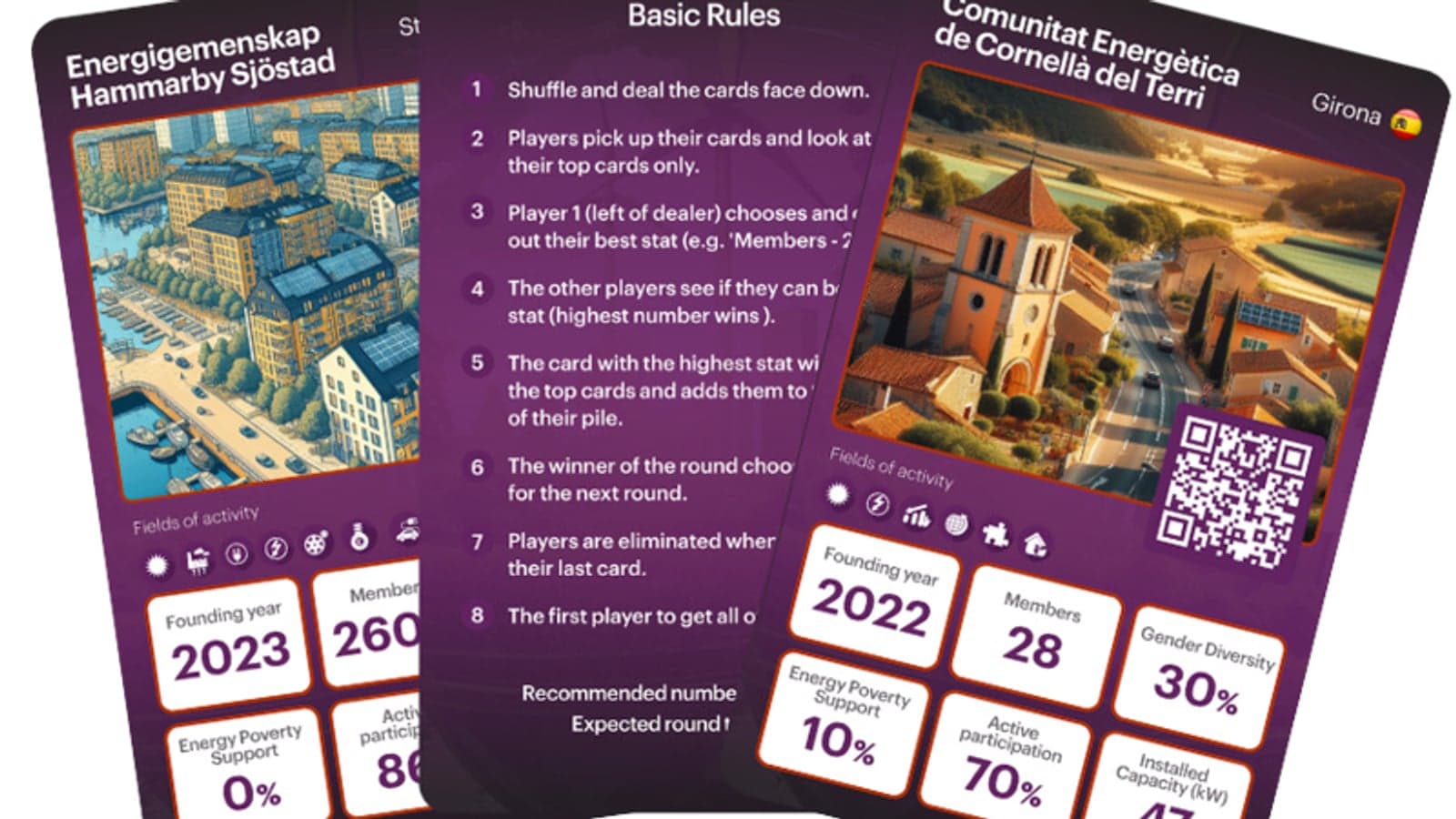
We chose to do this through what we call the ‘Energy community' card game. This ‘top Trumps’ - style card game introduces players to energy communities, their goals, areas of activity and the social and technical aspects involved.
Every energy community card features six attributes and their areas of activity. To win, players strategise, collect cards and in doing so discover the advantages of clean energy.
Players who want a more local touch can even create their own energy community card on the project website. The aim is to foster a sense of community, while encouraging household participation in energy communities.
Modern tech tools
We have also designed an open source community energy management system, based on a pre-existing smart cities IoT open remote platform. The platform can be accessed through a mobile app. The platform helps energy community participants to interact with each other, access their (and the community’s) energy data, and help them decide which individual or community investments in renewable energy systems make sense for them.
A key aspect of energy communities – the flexibility to use energy when it is needed and cheapest – led us to also develop energy and flexibility services. These include services to forecast demand and energy generation from the DSO. From this, users can schedule the optimal time to use their household appliances such as a washing machine, or charging their EV.
We have already found that apps such as these lead to the optimal management of energy within a community. It improves self-sufficiency and autarchy, alongside acting as an energy ‘trading platform’ adapted to the energy community level. We feel this will soon be ready for market interaction.
Real world results
Finally we have been fortunate to work with four energy communities in the Netherlands, Sweden, Greece and Girona in Catalunya. These acted as ‘demo sites’ for our solutions.
To take the Girona pilot as an example, we aimed to go beyond traditional collective self-consumption models. Here participants must first understand and trust the model, so we organised several meetings to first inform citizens.
This open dialogue is always important to show what benefits they could get. Energy communities are still not widely known, so first clarifying what they are is a vital step to them being adopted with any enthusiasm.
Together, these insights show how strong policy, meaningful social engagement and practical digital tools can accelerate Europe’s energy community movement. Pairing top-down support with on-the-ground innovation means we can create communities that are informed, empowered and resilient.
We want to ensure citizens play an active role in shaping a cleaner, fairer energy future.
About the author
Joaquim Meléndez is a professor in the Department of Electrical Engineering, Electronics and Automation at the University of Girona, Spain.
Most popular
Join the community for freeAnd get access to all content
Related projects
RESCHOOL
1 January 2023 - 30 June 2026
View project