Home
/
Safety first – risk-based maintenance evaluation of hydrogen in glass manufacturing within H2GLASS
Safety first – risk-based maintenance evaluation of hydrogen in glass manufacturing within H2GLASS
Guest/partner contributor
Posted on: 12 September 2025
H2GLASS aims to decarbonise the glass industry by enabling 100% hydrogen combustion, focusing on safety, optimal maintenance and high product quality.
H2GLASS aims to decarbonise the glass industry by enabling 100% hydrogen combustion, focusing on safety, optimal maintenance and high product quality.
Decarbonising the energy-intensive industries is crucial for Europe to achieve its climate goals of becoming the first climate-neutral continent by 2050, and the European Union has identified hydrogen – particularly renewable hydrogen – as a key element of its strategy for the energy transition, net zero and sustainable development.
Accordingly, the glass industry will need to be completely decarbonised within the next 30 years to reach these climate goals. The lifetime of a glass furnace is about 12-15 years and the year 2050 is only two furnaces away, so innovation must start now.
This is where H2GLASS comes into play. The project aims to create the technology stack that glass manufacturers need to realise 100% hydrogen combustion in their production facilities, while ensuring the required product quality and managing it safely.
In total, the technology will be tested and validated in five industrial demonstrators from the glass industry and one replicability demonstrator from the aluminium industry.
These transformations come with various challenges, which are being addressed by the consortium. Besides technological developments regarding innovative burner and furnace designs, securing a safe and reliable green hydrogen supply for the on-site demonstrations is an important key challenge in the project. Another core challenge is optimising the hydrogen combustion process (e.g. mitigating NOx emissions and managing high flame propagation speed) while maintaining high product quality at the same time.
Finally, the technology will be transferred to the production of aluminium, where it will tested and validated by a replicability demonstrator. The implementation of a digital twin approach for predictive maintenance, which will improve the overall efficiency and reliability of the manufacturing process, is yet another challenge to be addressed by H2GLASS.
H2GLASS methodology
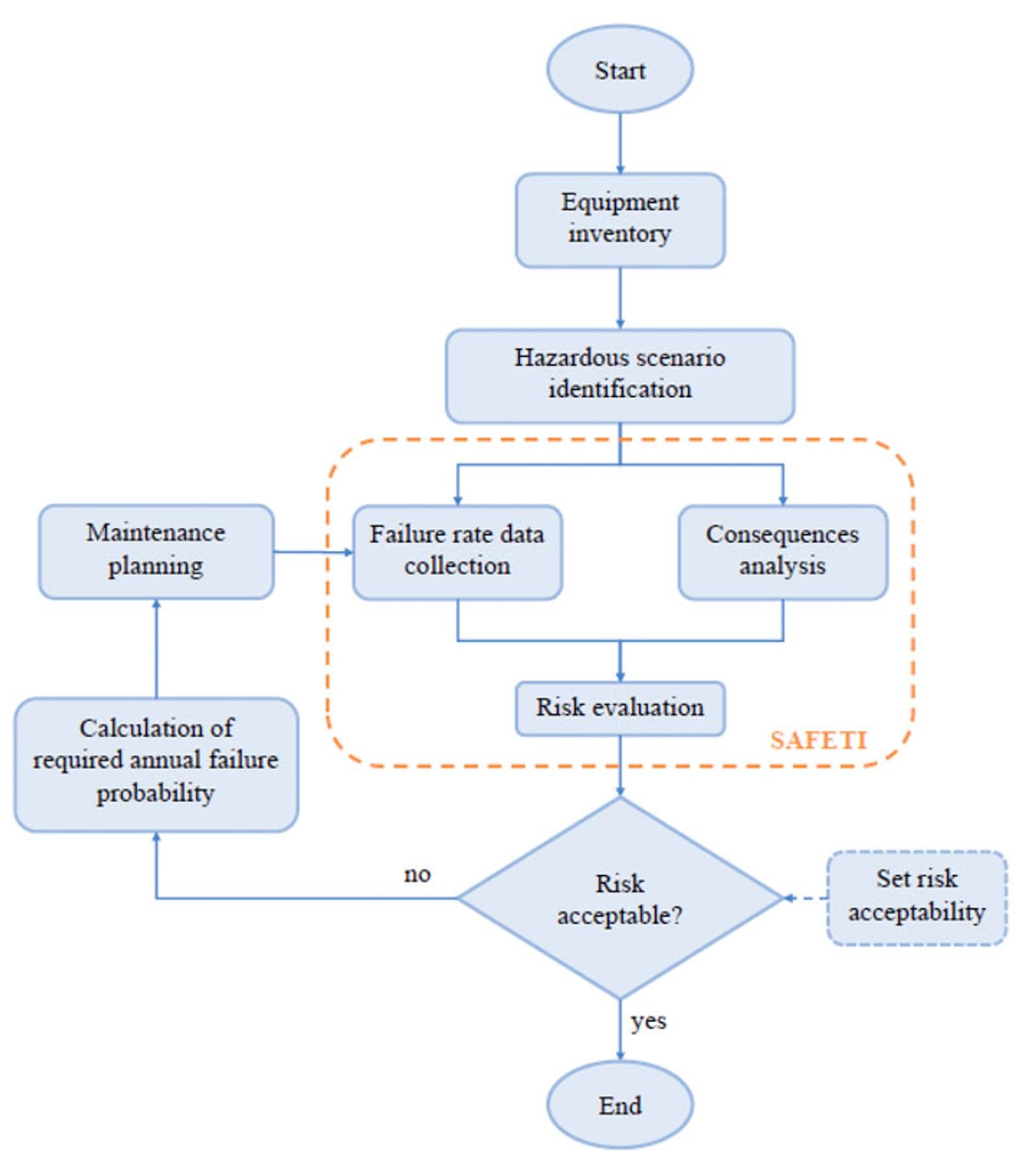
In H2GLASS, a risk-based maintenance approach is used, which starts with the identification of the equipment in the plant and the hazardous scenario identification.
It is then structured into three main modules:
1. Risk evaluation is done by a professional simulator for consequence modeling called Safeti using data from the literature, selected harm criteria and weather conditions.
2. Comparison with risk acceptability is based on criteria established by the UK Health and Safety Executive (HSE), which considers 10-3/year to be an acceptable value for workers (HSE, 2001).
3. For maintenance planning, the probability of failure is calculated based on the failure rate data.
The required annual failure probability to fulfill the risk criteria is obtained through a trial and error procedure, varying the software input. Once the value is obtained for each equipment, the maintenance interval to achieve this target probability is calculated.
Application in a glass production factory
The methodology is applied to the plant section required in a glass production factory, in the event of replacing natural gas with hydrogen.
As of now, there is no hydrogen infrastructure like the one for natural gas. Hydrogen is delivered to the site through bottles and trucks and an appropriate line to reduce the pressure before feeding the furnace is necessary.
Two risk levels, referring to the location-specific individual risk (LSIR) (CCPS, 2009) were evaluated, with only the dangerous phenomena from the two pipes connecting the supplier to the line providing hydrogen to the furnaces involved with a risk level of 10-2/year. The rest of the equipment only appears if the risk level is 10-5/year.
A 10% diameter leak scenario from the hose connecting the truck to the glass plant showed that the maximum peak is 800kW/m2 and it occurs at a downwind distance between 0.4m and 3.5m.
The most critical components are the two flexible hoses, which are the candidates for more frequent maintenance and the corresponding maintenance intervals to ensure an acceptable risk level are 231 and 239 days for the truck and bottle hoses. From a practical perspective, it is more reasonable that the replacement is carried out after the shorter interval, i.e. 231 days, for both sets of equipment, reducing the downtime and the possibility of having undesired events during the maintenance operations (Collina et al., 2023).
Another option is the onsite production of green hydrogen through electrolysis, which is currently being explored within H2GLASS. In this case, the electrolyser would be an additional item of equipment to be considered in the analysis, resulting in an even more interesting application for this methodology.
Conclusion
Risk-based maintenance was applied to a hydrogen facility, marking its first use in this context. By comparing risk assessments and acceptability criteria, the most critical components were identified and optimal maintenance intervals were calculated using a trial and error method.
Results showed that similar failure data could yield different maintenance intervals based on risk consequences. This approach offers a promising strategy for safe hydrogen integration in various industries, although it is limited by the current data availability, which is expected to improve as hydrogen adoption grows.
References
CCPS (2009). Guidelines for Developing Quantitative Safety Risk Criteria. John Wiley & Sons.
Collina, G. et al (2023). Lesson learned from H2-related incidents: Criticality of maintenance operations. Institution of Chemical Engineers Symposium Series, 2023-November(170).
Collina, G. et al (2024). Hydrogen in Glass Sector: A Comparison between Risk-Based Maintenance and Time-Based Maintenance Approaches. IFAC-PapersOnLine, Volume 58, Issue 8, 2024, Pages 109-114.
HSE (2001). Reducing Risks: Protecting People – HSE’s decision making process.
Safeti: Software for Quantitative Risk Analysis (QRA) - DNV
About the author

Giulia Collina is a PhD candidate at the Department of Mechanical and Industrial Engineering at NTNU, Norway and the Department of Civil, Chemical, Environmental and Materials Engineering at the University of Bologna, Italy. Her research interests include the application of safety approaches to the assessment of hydrogen supply for green manufacturing and the adaptation of risk-based maintenance strategies for hydrogen systems.
Most popular
Join the community for freeAnd get access to all content
Related projects
H2GLASS
1 January 2023 - 31 December 2026
View projectLatest content
+1
From nuclear innovation to cross-sector impact: How SNETP and its project portfolio drive the energy transition
Under the umbrella of the Sustainable Nuclear Energy Platform (SNETP), several Euratom-funded projects are now leveraging nuclear research to drive innovation across multiple sectors, improve safety and strengthen industrial competitiveness.
- Guest/partner contributor
- 10/10/2025