Home
/
Empowering grid intelligence: The CABLEGNOSIS approach to cable monitoring and predictive maintenance
Empowering grid intelligence: The CABLEGNOSIS approach to cable monitoring and predictive maintenance
Guest/partner contributor
Posted on: 7 July 2025
The CABLEGNOSIS project introduces a novel framework for monitoring and predicting failures in high voltage cables used in modern energy infrastructure.
The CABLEGNOSIS project introduces a novel framework for monitoring and predicting failures in high voltage cables used in modern energy infrastructure.
The rapid electrification of industry and society, driven by the European Green Deal, places increasing demands on transmission and distribution systems. High voltage alternating current (HVAC) and high voltage direct current (HVDC) cables play a pivotal role in enabling renewable integration and interconnections, as well as cross-border energy exchange.
However, ageing infrastructure coupled with harsh environmental conditions and limited predictive diagnostics, poses serious risks to grid reliability and operational efficiency.
Funded by the European Union under the Horizon Europe programme, the CABLEGNOSIS project seeks to transform cable system monitoring and maintenance by applying state-of-the-art diagnostic techniques paired with advanced sensor technologies and AI-driven predictive analytics.
These challenges are particularly critical in complex environments such as offshore, submarine and island interconnections, where cable failure may lead to long outages and costly repairs.
Methodology
Combining material science, electrical engineering and AI, CABLEGNOSIS addresses key technical challenges in modern cable systems while focusing on:
• Evaluating insulation materials (e.g. XLPE, PP, LDPE) for ageing mechanisms and compatibility in HVAC and HVDC cables.
• Developing advanced distributed sensing systems based on fibre optics (e.g. DTS, DAS) for real-time monitoring.
• Applying partial discharge detection, thermal mapping and vibration analysis to capture early signs of degradation.
• Integrating AI algorithms (machine learning, pattern recognition and digital twins) for predictive maintenance and failure prevention.
• Designing a cloud-based diagnostics and decision-support platform to support grid operators.
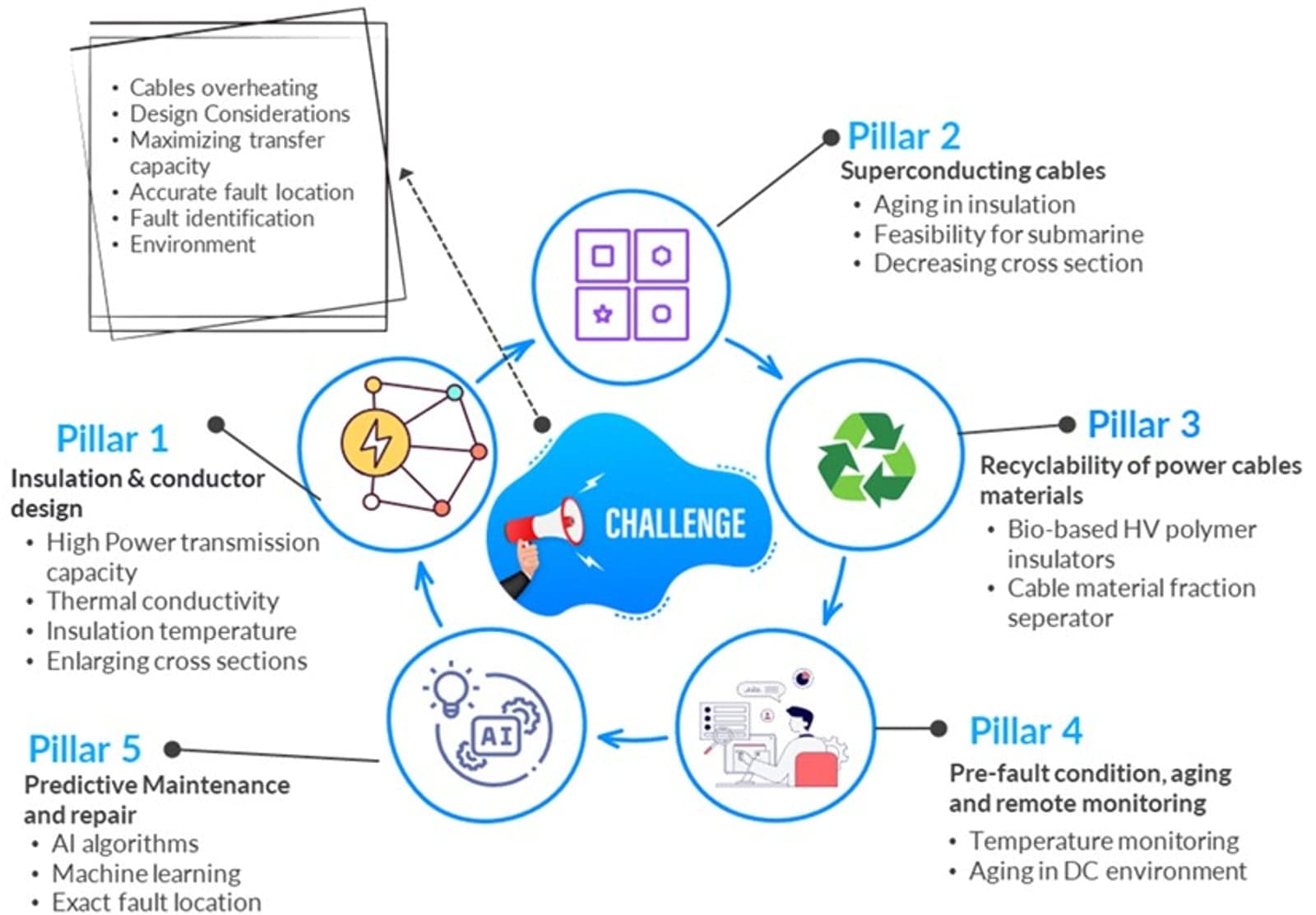
These activities are structured around five core technological pillars, covering insulation and conductor design, superconducting cables, recyclability of power cable materials, pre-fault condition detection and remote monitoring and predictive maintenance with AI algorithms, as illustrated in Figure 1.
The project’s approach is grounded in the principles of modularity and interoperability. By ensuring compatibility with existing infrastructure and compliance with international standards, CABLEGNOSIS enhances the scalability and replicability of its solutions across various energy contexts.
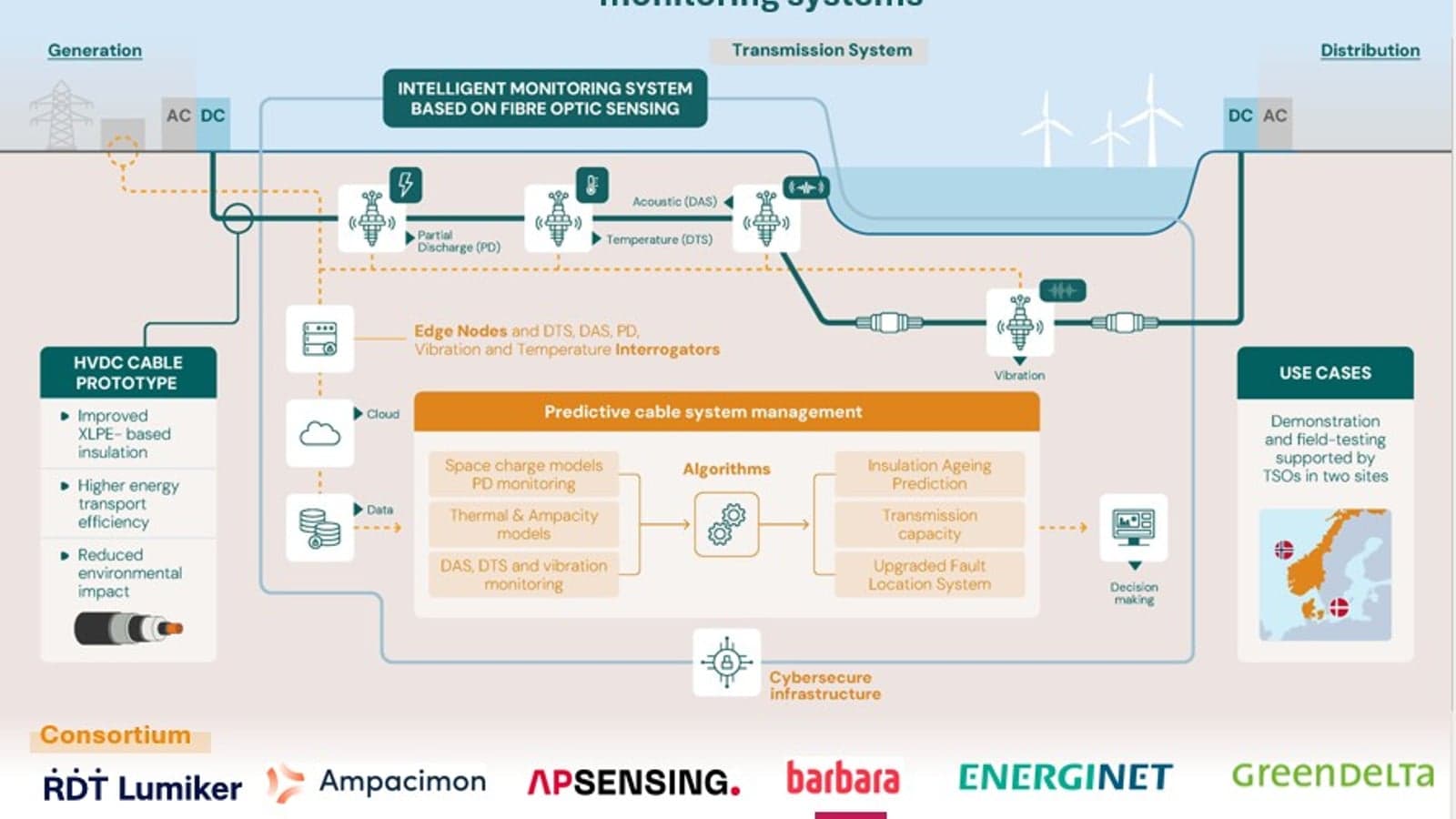
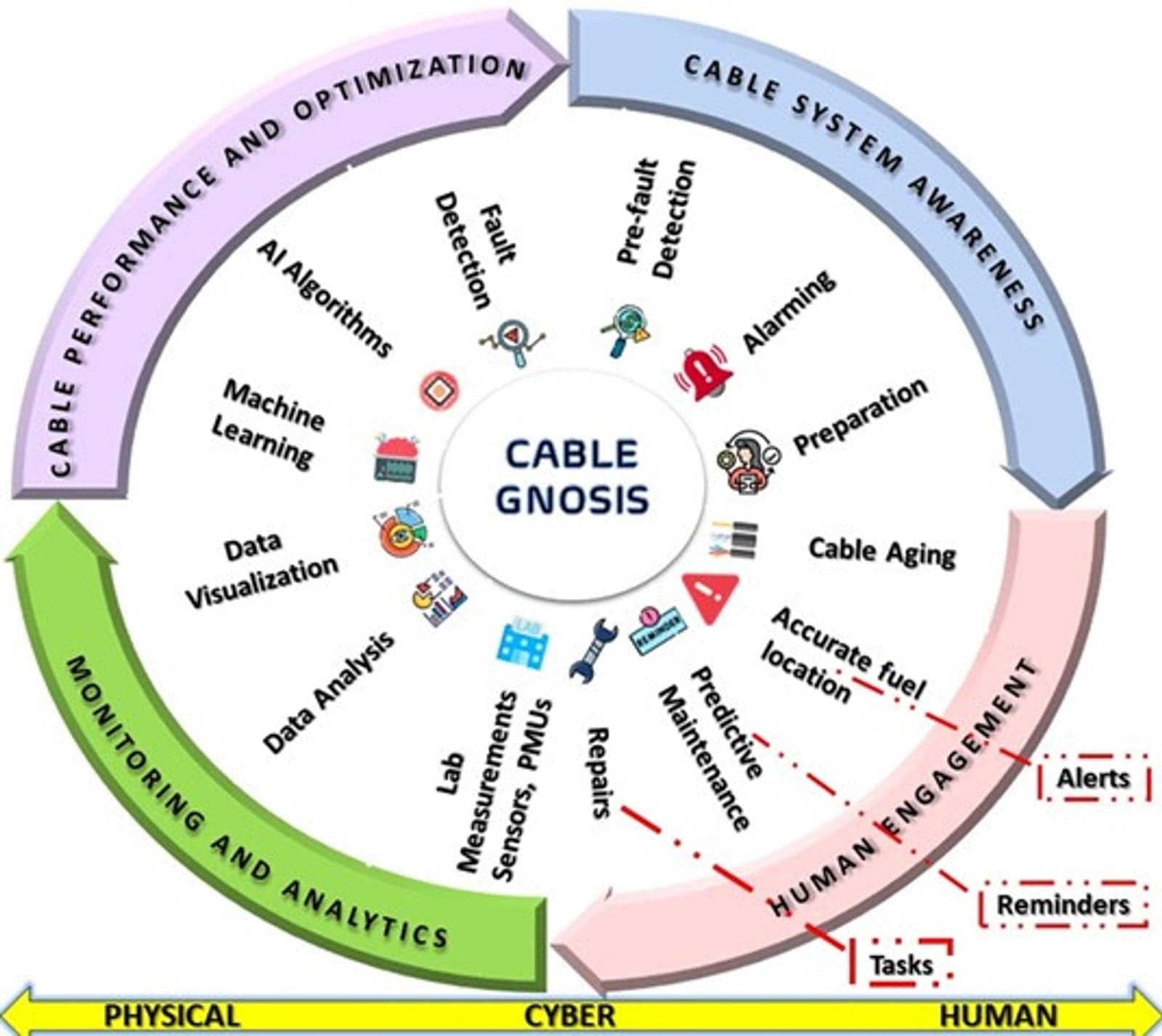
This methodology is operationalised through the CABLEGNOSIS life cycle centre (C-LCC), a modular platform that integrates physical monitoring, cyber analysis and human-level decision support. It incorporates fibre optic sensing, real-time diagnostics and predictive algorithms into a unified cloud-based system, as depicted in Figure 2.
Results and discussion
CABLEGNOSIS is expected to deliver significant impact by enabling predictive maintenance and cost-efficient repairs, thereby minimising downtime and enhancing the availability and reliability of power cable systems.
By developing a modular toolbox of interoperable technologies, the project supports broad deployment across HVAC, HVDC and superconducting cable infrastructures. At the same time, the introduction of recyclable materials and the promotion of circularity in cable design and end-of-life handling contribute to environmental sustainability by reducing the demand for new raw resources.
Furthermore, CABLEGNOSIS ensures compliance with EU and international standards, facilitating faster certification processes and paving the way for wider adoption of its solutions.
This effort is reinforced through close collaboration with standardisation bodies such as IEC and IEEE, helping align technical advancements with evolving regulatory and industrial requirements.
Conclusion
CABLEGNOSIS represents a crucial step towards intelligent and sustainable grid infrastructure. By combining data-driven methods and advanced diagnostics, the project will empower utilities to make informed decisions, reduce environmental impact and ensure grid continuity in the face of growing energy demands.
It highlights the pivotal role of cable systems in the energy transition and offers a replicable model for digital transformation in the electricity sector.
CABLEGNOSIS aims to transform cable technologies into key enablers of a both smarter and greener energy grid, while still maintaining reliability and supporting Europe's goals for decarbonisation and digitalisation.
To learn more, visit https://cablegnosis.eu/
About the author

Dr Christos A. Christodoulou is an Associate Professor at the National Technical University of Athens, expert in high voltages, power systems and advanced computational methods. With extensive academic and industrial experience, he has contributed to over 70 publications and has participated in more than 10 major EU projects focusing on sustainable and intelligent electricity networks.
Related tags
Latest content
Partner content
+2
Innovations to accelerate the decarbonisation journey
ABB’s Marco Tellarini, Senior Vice-President – EMEA Region, Electrification Service, delves into the innovations that are enabling utility and industrial customers to accelerate their decarbonisation.
- Enlit Editorial Team
- 22/10/2024