Siemens expands AI data centre play with partnership trio
Yusuf Latief
Posted on: 18 March 2026
New partnership with EmeraldAI, Fluence and PhysicsAI aims to bridge gap between AI compute demand and grid constraints.

Siemens Smart Infrastructure has announced a three-layered partnership to expand its data centre offering: an investment in Emerald AI, the integration of Fluence battery energy storage solutions and an integration with PhysicsX.
The company calls the partnership an expansion of its data centre ecosystem, bringing compute and power flexibility together to accelerate grid interconnection and time to revenue for AI infrastructure operators.
Specifically, says Siemens, these capabilities create flexibility across compute, energy, and infrastructure systems, helping data centre operators connect to the grid faster, scale efficiently, and operate reliably in a power-constrained world.
Ruth Gratzke, President of Siemens Smart Infrastructure US, said: “Scaling AI infrastructure isn’t just a computing challenge, it is equally an energy and infrastructure challenge.
“As demand for AI processing accelerates, data centre growth is increasingly constrained by grid capacity and interconnection timelines."
According to Gratzke, this is where the new partnerships would come in, enabling complex coordination across the digital and energy domains.
“Siemens is actively investing in key technologies and partnerships to expand the ecosystem required to scale AI responsibly and support the next generation of data centre infrastructure.”
Emerald AI
NVIDIA-backed startup Emerald AI enables artificial intelligence workloads to shift in time and location to align with grid conditions, allowing data centre demand to respond dynamically to available power.
By coordinating when and where AI workloads run alongside dispatching onsite energy resources, this helps smooth peak demand, achieves faster and larger grid connections for data centres, and reduces pressure on constrained power infrastructure.
According to Siemens, the investment in Emerald AI strengthens their ability to introduce flexibility at the compute layer. When combined with Siemens’ expertise in power infrastructure and operational technology, this creates ‘true IT/OT convergence’, they say, between AI workloads and power systems.
Emerald AI has been a rapidly growing name in the power sector, announcing multiple partnerships and initiatives, both in the UK and the US, to manage load from AI.
Two days prior to the announcement from Siemens, the company announced a newly-completed demonstration in Hillsboro, Oregon, in collaboration with NVIDIA, Portland General Electric and EPRI, that shows how AI factories can respond precisely to utility signals, while maximising the performance of priority AI workloads.
According to the company, at scale, power-flexible AI factories could unlock up to 100GW of grid capacity on the existing US power system.
Additionally, earlier this month, Emerald AI, NVIDIA, National Grid, EPRI and Nebius announced the UK’s first live demonstration of grid-responsive AI infrastructure in London. Emerald AI orchestrated a cluster of NVIDIA Blackwell Ultra GPUs and reduced electricity demand by over a third in under a minute, while high-priority workloads continued to run.
More on data centres and AI:
Google firms power sector position after finalising $4.8bn Intersect deal and co-launching Utilize with Tesla
RWE plans gas peaker plants to meet US data centre power demand
National Grid taps startup for connections intelligence as UK tackles ‘speculative’ requests
Fluence’s energy storage solutions
Another key element for Siemens’ expanded ecosystem is the addition of Fluence’s grid-scale energy storage solutions, designed to support the next generation of high-performance AI data centres.
According to Siemens, one of Fluence’s co-parents alongside AES, as compute clusters grow in size and density, Fluence energy storage solutions enable data centres to accelerate grid connection.
It does so by shaping load and coordinating ramp rates, making large AI-scale demand more predictable and easier for utilities to approve. This can turn power-constrained locations into viable data centre sites and accelerate time to power, which can enable deployment of energy storage in months rather than years of grid upgrades, says Siemens.
Fluence’s energy storage solutions can also provide dispatchable, on-site power that aims to enable data centres to operate during grid build-outs, capacity shortfalls, or outages.
Accelerating data centre growth, utility demand and rising industrial loads continue to drive energy storage demand globally, reflected in our pipeline....
Data centres is a key point of strategic interest for the company, who in February announced their results for the three monthes for December 31, 2025: revenue of approximately $475.2 million represented an increase of approximately 154.4% from the same quarter last year.
One of their key demand drivers, said Julian Nebreda, the Company’s President and Chief Executive Officer, was that of the data centre sector:
“Accelerating data centre growth, utility demand and rising industrial loads continue to drive energy storage demand globally, reflected in our pipeline which has grown by approximately 30% to $30 billion since September, 2025.”
Indeed, according to the company in their 2025 white paper, Enabling the AI Revolution with UtilityScale Battery Energy Storage Systems, utility-scale battery energy storage systems will be a critical part of the answer to powering data centre expansion.
The company says that such systems are quick to deploy, have intelligent operational capabilities, and can function as both generation and transmission assets.
Specifically, they list three primary use cases:
- Installed at data centre load – providing reliable firm generation and/or backup power, while also reducing grid connection needs.
- Combined with utility-scale solar and wind in renewable energy power purchase agreements – providing round-the-clock clean power under a PPA.
- Utilized as electricity transmission assets – accelerating data centre deployment in grid-constrained areas.
PhysicsX
The third collaboration, with PhysicsX, will apply physics AI to the design and operation of data centre power distribution systems.
According to PhysicsX in a release, as AI workloads scale rapidly and GPU clusters approach gigawatt-level power demand, the infrastructure required to deliver and manage that power has become a critical challenge.
Busway systems — the backbone of high-density power distribution in modern data centres — need to operate reliably under extreme and dynamically changing electrical loads. Managing the resulting thermal behaviour is essential to ensuring uptime, safety, and operational efficiency.
Traditionally, however, evaluating and optimising busbar thermal performance relies on high-fidelity numerical simulations that can take multiple days to execute and require specialist expertise to operate.
The simulation and validation of a single busway segment under dynamic GPU load conditions can take over 24 hours. Scaling this process up to an entire data centre while keeping to high-fidelity simulation is infeasible, says the company, forcing engineers to make approximations.
By combining high-fidelity simulation with AI, we can give engineers the ability to analyse and optimise these systems in real-time...
This is where their partnership with Siemens comes into play; by using AI models trained on Siemens’ multi-physics simulation data, they companies claim that engineers will be able to predict thermal behaviour in complex busway systems in real time.
According to Siemens, with PhysicsX, simulations that once took days can run in under a second, enabling faster design iteration, optimised infrastructure for dynamic AI workloads, and the foundation for predictive monitoring across entire facilities.
Said Jacomo Corbo, CEO and Co-Founder of PhysicsX: “This collaboration demonstrates how physics AI can transform the way critical infrastructure is designed and operated.”
According to Corbo, as AI workloads scale rapidly, the physical systems powering the world’s data centres are becoming increasingly complex.
“By combining high-fidelity simulation with AI, we can give engineers the ability to analyse and optimise these systems in real-time — unlocking a fundamentally new approach to engineering design and operational decision-making.
“It also underscores the strength of partnership with Siemens. We’re delighted to be building together to accelerate hardware innovation around critical compute infrastructure that the world needs.”
Related tags
Latest content
+3
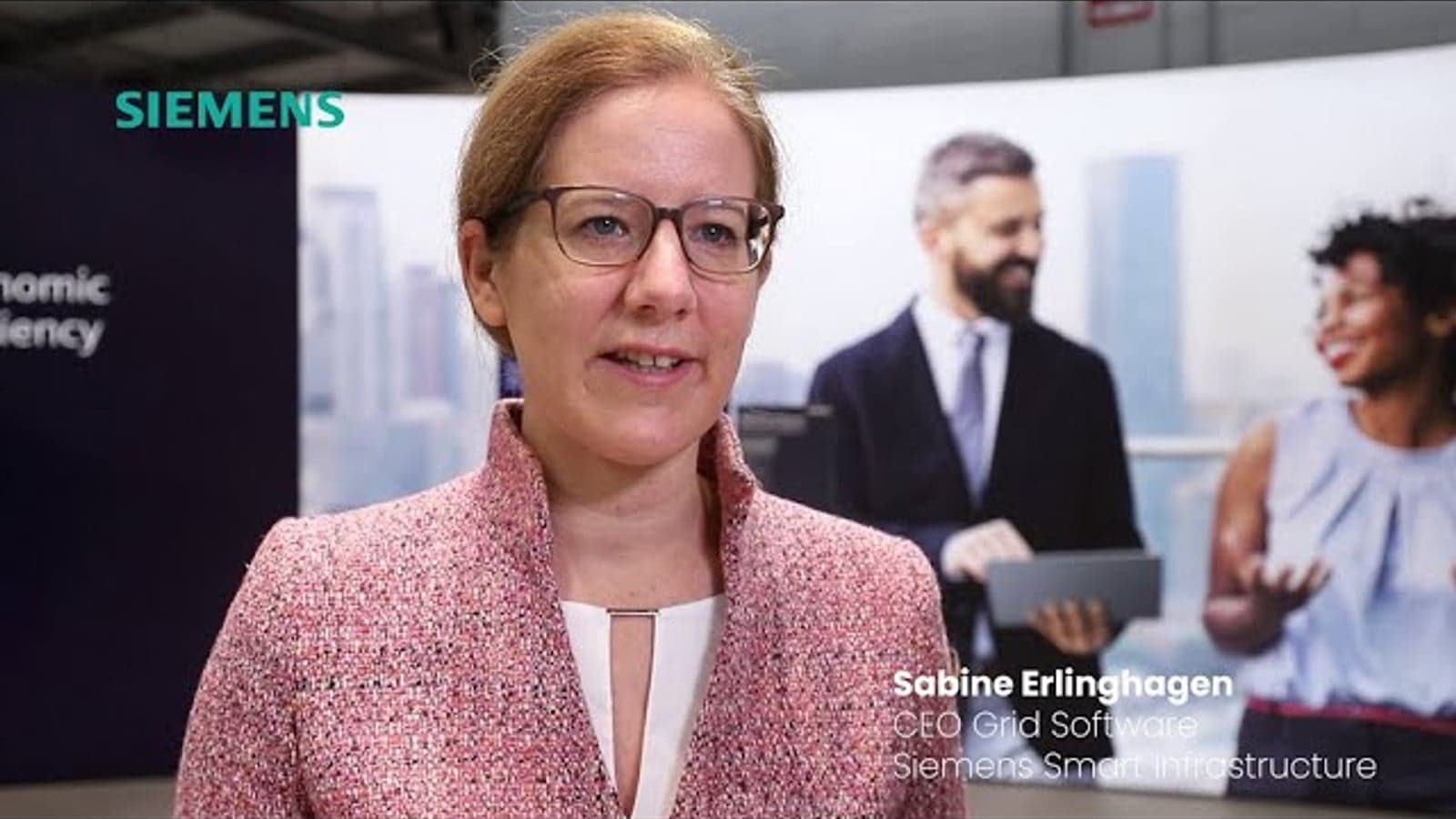
Siemens Smart Infrastructure CEO Grid Software highlights grid operator challenges
Sabine Erlinghagen talks about the challenges grid operators face today, how Siemens can support with digital technologies and highlights one project on the low voltage grid level in Rome, Italy, where Siemens helps to increase transparency.
- Smart Energy International
- 15/02/2022
Latest in Digitalisation
All articlesPartner content
+1
Digital water management: Empowering utilities with scientific decision-making
As urban water distribution networks continue to expand and water resource management becomes increasingly complex, water utilities are facing growing operational challenges.
- Guest/partner contributor
- 03/07/2026