Skeleton opens Europe's largest supercapacitor factory in Germany
Pamela Largue
Posted on: 3 December 2025
The €220 million facility can produce up to 12 million cells, which are graphene-based and free of critical raw materials, and forms part of a fully European value chain.
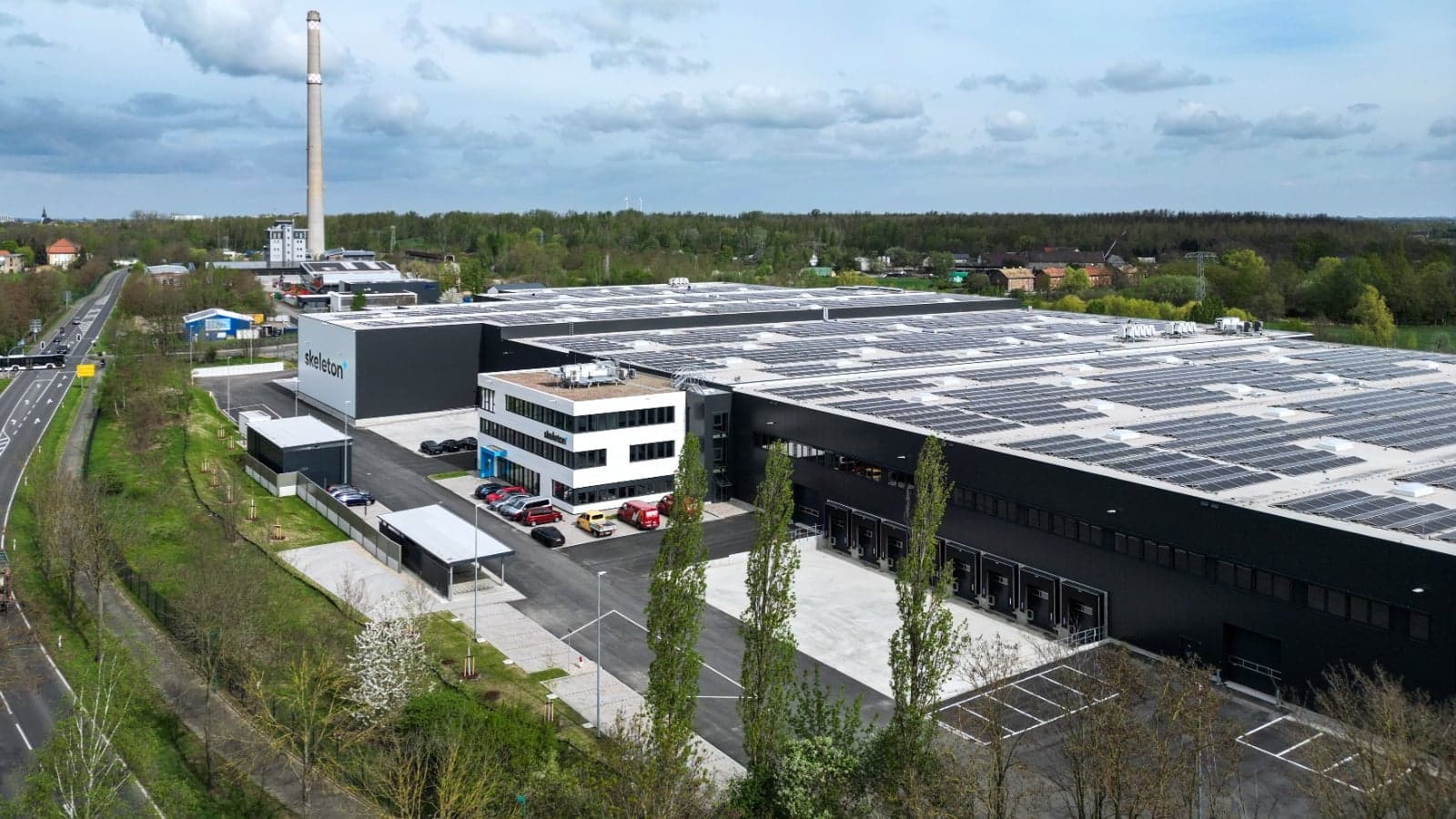
Estonion deep tech company Skeleton Technologies has inaugurated its €220 million ($256m) 'SuperFactory' in Markranstädt, near Leipzig in Germany.
The factory will manufacture the company’s supercapacitors, which make use of a patented Curved Graphene material – a novel, synthetic carbide-based material that enhances the energy density of supercapacitors.
Skeleton sees the facility as an important commitment to and advancement of made-in-Europe, high-power energy-storage technologies.
The site is already shipping supercapacitors to Siemens, General Electric and Hitachi Energy for use in European grids, and to US hyperscalers building out AI infrastructure.
The company stresses that the plant forms part of a fully European value chain, as Skeleton’s supercapacitors rely on its patented Curved Graphene material and require no lithium, cobalt, manganese or other critical raw materials.
That localisation, Skeleton argues, gives Europe both strategic supply-chain security and a chance to capture a greater share of the fast-expanding AI-infrastructure market—an area where the continent needs to grow.
Have you read?
Raw materials in the EU – batteries to benefit
How legislation is reshaping the data centre industry
Skeleton said in a statement that US hyperscalers are forecast to invest roughly $330 billion in AI infrastructure in 2026, and Europe is expected to invest only around $10 billion.
This difference exposes two structural challenges: rising electricity bills as energy intensive AI data centres drive up demand, and Europe’s limited share of global manufacturing for the hardware these facilities require.
“Skeleton’s Leipzig factory addresses both challenges,” said chief executive Taavi Madiberk.
The plant produces the company’s latest graphene-based supercapacitors used in its GrapheneGPU technology, designed to cut AI data-centre electricity consumption by 44% by smoothing power peaks and reducing grid stress.
“At the same time, it keeps a core part of the value chain in Europe,” added Madiberk. By eliminating power peaks and overheating, GrapheneGPU can “unlock 40% more computing power from the same investment in other GPUs”.
The company argues that Europe’s grids, already strained by the rapid rise of renewables, urgently need fast-response storage technologies. Supercapacitors are used for frequency stabilisation and peak-shaving, roles that have gained prominence following recent system shocks such as the 2025 Iberian blackout.
This will become even more critical as Europe’s data centre market develops, with the European Data Centre Association predicting a total of €100 billion ($117 billion) to be invested in the sector between 2023-2030.
Madiberk said: “When it comes to the electrical grid, our mission is simple: keep the lights on in Europe. Skeleton’s systems are already used by German transmission operators as a last line of defence, a real safety belt for a grid increasingly powered by renewables.”
Skeleton positions itself as the only fully integrated European high-power-storage company, covering raw materials through to cells, modules, systems and software.
The Leipzig facility is designed for an annual output of up to 12 million cells and will create 420 jobs in Saxony, says Skeleton. Its opening follows the launch of the company’s SuperBattery plant in Varkaus, Finland, further expanding Europe’s domestic manufacturing footprint for critical energy-storage technologies.