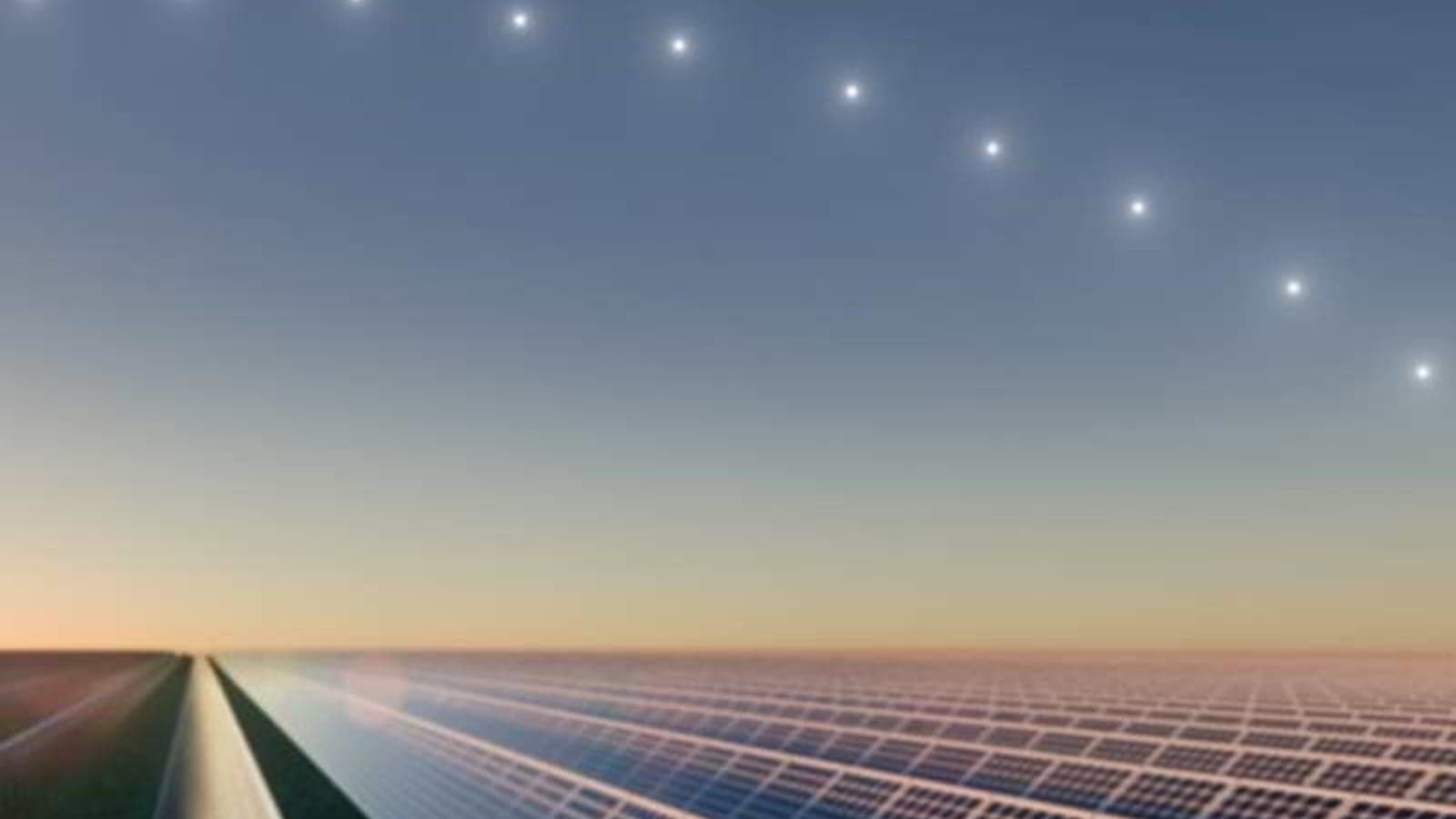
Space-based solar could deliver 80% of Europe's renewable energy needs – study
Jonathan Spencer Jones
Posted on: 1 September 2025
Space-based solar power has the potential to reduce Europe’s need for land-based renewable energy by up to 80%, a new study from King’s College London has found.
Space-based solar power has the potential to reduce Europe’s need for land-based renewable energy by up to 80%, a new study from King’s College London has found.
The study is based on two NASA space-based solar concepts that could be in operation by 2050, with the finding that with a swarm design delivering electricity at six to nine times the projected 2050 cost of ground PV, system costs fall by 7%–15% - up to €35.9 billion ($42 billion) annually.
At that price, space-based solar can displace up to 80% of wind-plus-solar capacity and cut battery needs by more than 70%, although seasonal storage such as hydrogen remains essential, the study finds.
On the other hand, a planar array design remains uneconomic at its 2050 forecast cost.
Broadly the difference between the two designs is that the swarm design is comprised of a large steerable array of mirror like reflectors that continuously focus sunlight on a concentrator from where it is converted to microwave, whereas the planar array design has a single solar PV collection face with microwave transmission on the opposite side and a less continuous power profile.
Have you read?
How space exploration is impacting power generation on Earth
Harnessing the power of the EU’s Space Programme for renewable energy
Of the two, however, the technology readiness level of the heliostat design is low, while that of the planar design is higher.
“Reaching net-zero emissions by 2050 is going to require a significant shift to renewable energy and this emerging technology could play a pivotal role in that transition,” said Professor Wei He, Senior lecturer in the Department of Engineering at King’s College London and lead author of the study, which is published in Joule.
“For the first time we have shown the positive impact this technology could provide for Europe. Although [its] feasibility is still under review, our research highlights its vast economic and environmental potential if adopted."
The concept of space-based solar is being pursued in various parts of the world, including China, which is possibly the most advanced, Japan, UK, US and Europe.
While there have been few publicised advancements in recent months, developments are continuing apace with the prospect of becoming technically viable in the 2030s, if not by 2030.
Key challenges are the in-orbit assembly of the large satellites and the microwave power transmission to Earth.
The authors of the study say that most research focuses on the technical feasibility of space-based solar rather than on integration within a future energy mix dominated by terrestrial renewables and it is intended to fill this gap.
For the study the two design concepts are embedded into a model of the European power system, focusing on meeting electricity demand as defined by ENTSO-E’s 2050 native demand and evaluating its interactions with terrestrial renewables, storage and transmission infrastructure under net zero constraints.
The grid balancing benefits are assessed by quantifying how continuous space-based solar can reduce storage requirements and transmission investments by offsetting the temporal and spatial variability of terrestrial wind and solar.
With the study findings, it is suggested that in the shorter term, the planar design may make an easier candidate for early demonstration but only if its annual fixed costs are reduced sufficiently to remain economically viable alongside terrestrial solar, wind, and energy storage.
Thus, a coordinated development strategy could focus on the planar design demonstrations first to refine the core technologies, such as wireless power transmission and modular in-orbit assembly, while concurrently accelerating R&D for designs with more continuous power generation.
Such a plan balances the practical realisation of a tangible full-scale space-based solar prototype with the longer-term potential for near-baseload space-based solar power to disrupt the broader renewables landscape once its more complex capabilities achieve higher maturity.