The next steps in the evolution of Europe's distribution grid
Jonathan Spencer Jones
Posted on: 26 November 2024
The distribution grid will need to constantly evolve to meet the challenges of the energy transition and what are the key evolutions, panellists were asked in a session at Enlit Europe?
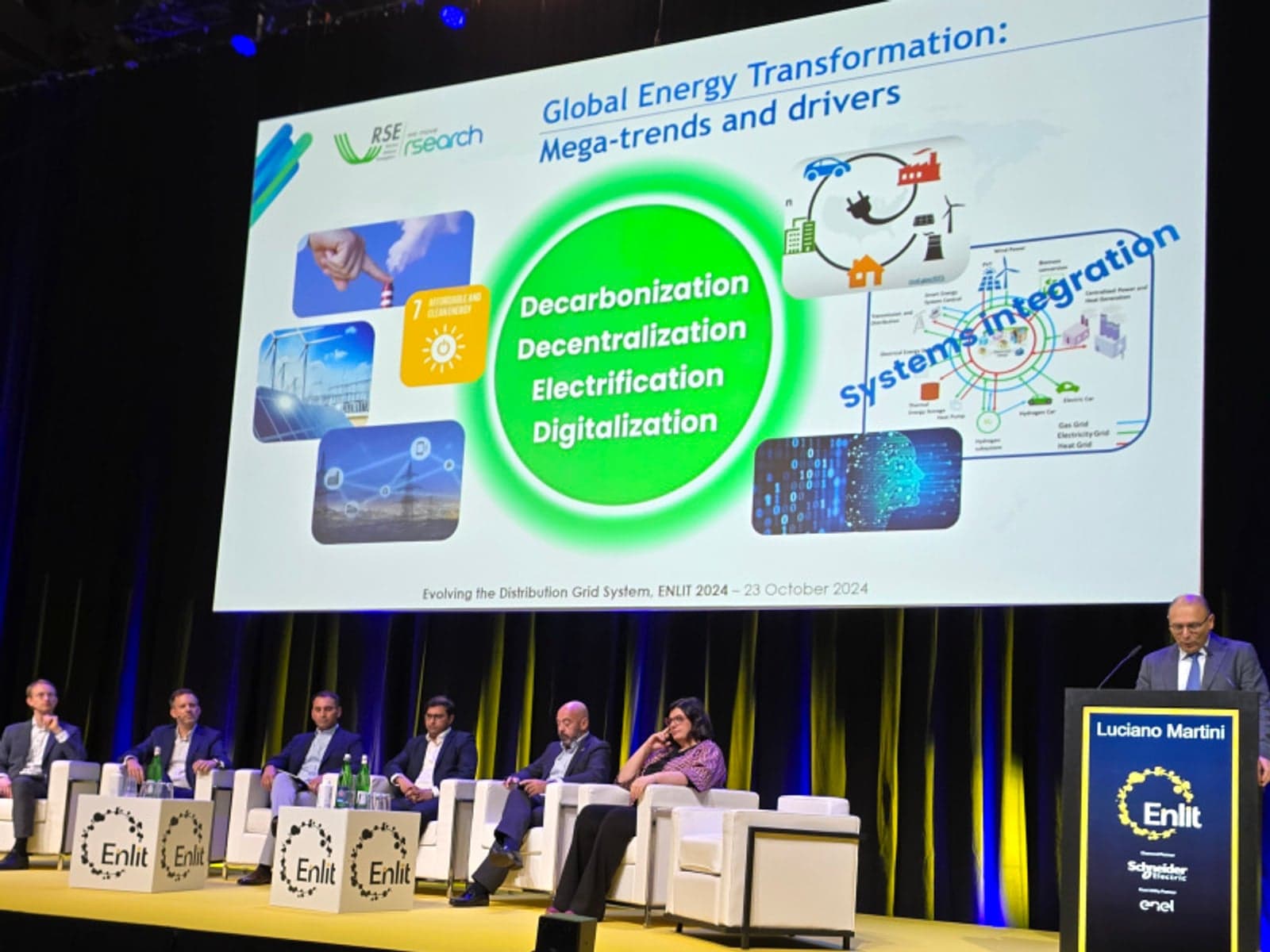
Europe's distribution grid will need to constantly evolve to meet the challenges of the energy transition. Panellists at Enlit Europe discussed the key evolutions.
To set the scene, Chairman Luciano Martini, Director of T&D Technologies at RSE, highlighted the COP28 pledges of tripling the global installed capacity of renewables and doubling energy efficiency by 2030 as significantly impacting the distribution grid, while also with the spread of EVs, heat pumps and other distributed resources, opening up the potential for the needed flexibility.
Europe's distribution grid expansion requires major investment, an almost doubling from the current level to €67 billion annually up to 2050, said Silvia Piana, vice-chair of Eurelectric’s Distribution and Market Facilitation Committee, presenting the organisation’s recent Grids for Speed report.
To put that into perspective, it corresponds to around €150 per capita of the population of Europe, she noted.
Have you seen?
Enel Grids boss says energy transition must kickstart a competitive value chain
How to prioritise financing for the power grid of tomorrow
Europe’s power grid financing conundrum
Commenting in feedback to the report on the evolution of the grid, Martin Braun, director of grid planning and operation at Fraunhofer IEE, said the overall goal is to have secure grid operation and for that, digitalisation is needed to enable full automation of the system.
“This is extremely challenging as it requires the full rollout of automation technology with a quite heterogenic approach from different manufacturers and grid operators and it will require a lot of coordination.”
The other issue, he added, is that the speed of grid reinforcement is slowing due to skills shortages and that needs to be overcome.
Market challenges
Turning to experiences from different markets, Robert Denda, CEO of Gridspertise, said that although the markets may differ, the challenges are similar.
He also highlighted the challenge of the ‘peaks’ in production and demand, with the focus of countries around the world on how to manage these.
“It’s about flexibility and we are familiar with demand flexibility but in the coming months we also will be speaking more and more about topology flexibility and how to dynamically adjust the topology in the distribution grid in real time.”
And that requires edge computing capabilities, he commented, adding their necessity for the large-scale automation of the grid.
Commenting from the North American perspective, Ruben Llanes, CEO of Digital Grid at Schneider Electric, suggested that sizing the capacity of the grid for occasional peaks would in some respects amount to an over-building.
“So making sure that you have a holistic view makes a lot of sense,” he said, noting regulation as one of the “biggest single things that needs to be part of the conversation” going forward.
“Oftentimes we have this capitalisation mentality when looking at hard assets, but now with software and digitalisation how to take more of a totex approach is starting to come to the forefront.”
In his comments, Saqib Saeed, Chief Product Officer at PTR, similarly highlighted the importance of digitalisation of the grid, saying that for him the scale of the challenges could be made tangible with a comparison of the grid as it was originally designed.
“It has to be done or else what is at risk?” he asked.
Electrification
Nico Arcauz, Head of Smart Grids Global and Spain at Iberdrola, addressed the role of the grid in the electrification of the economy, saying this won’t happen without “upgrading, expanding, reinforcing and digitalising”.
But though digitalisation is important, he also cautioned on the focus on it, describing it as a “helper” – one that may help, but may also help to delay some needed investments, such as in old transformers and wires.
“We can talk about the wonderful technical solutions but we also need to invest in the conventional networks and make them smarter, or else the energy transition will not take place.”
Latest content
+6
The energy sector must lead Europe's industrial strategy says head of Enel Grids
"The energy sector is not just another industry within Europe’s industrial strategy; it is the enabler that underpins the entire European economy," says Gianni Vittorio Armani, Head of Enel Grids and Innovability.
- Enlit Editorial Team
- 15/10/2024