Transforming building data into decisions and actions
Guest/partner contributor
Posted on: 2 February 2026
MAPO (monitoring, assessment, prediction, optimisation) functionalities are implemented in an integrated smart energy management system within BuildON.
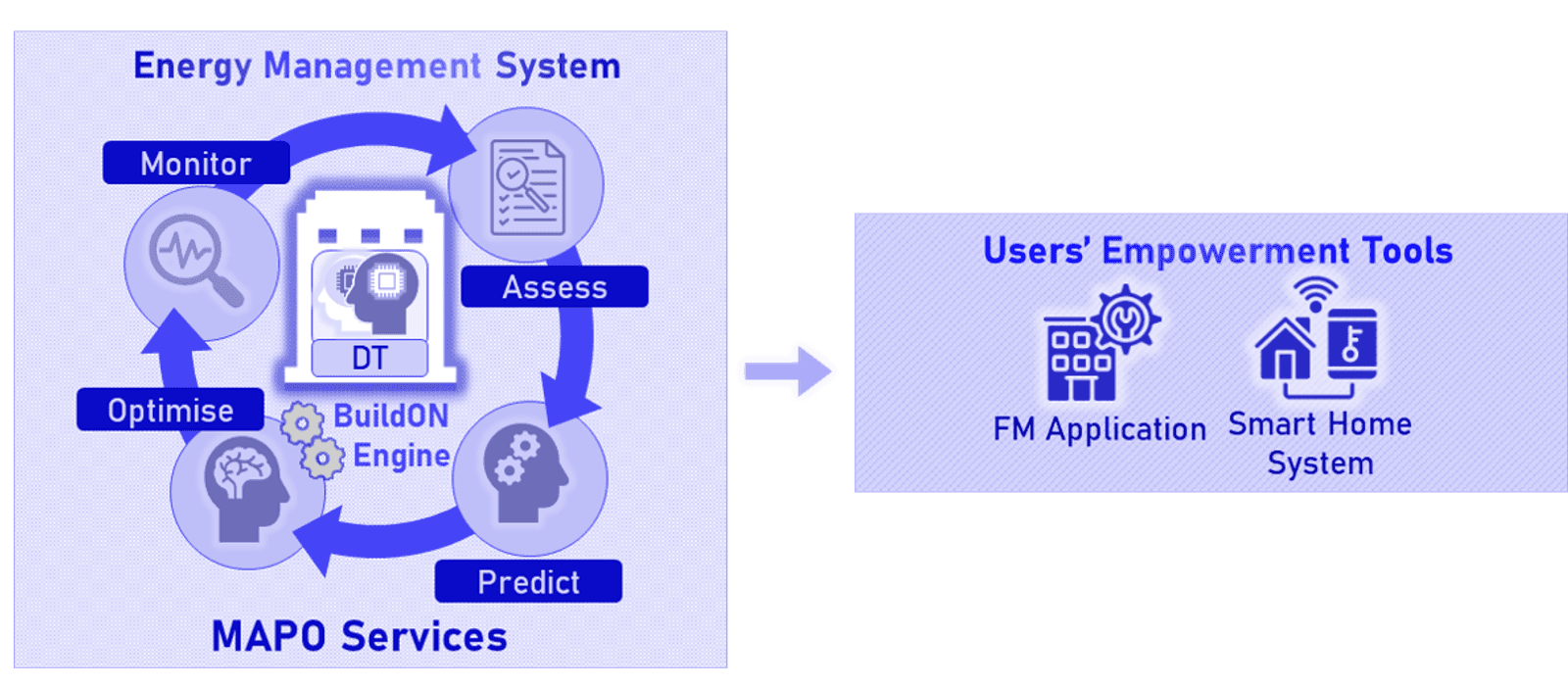
Buildings across Europe are increasingly equipped with sensors, meters and digital platforms capable of monitoring energy use, indoor environmental conditions and system operation. This has led to an unprecedented availability of data that can be exploited through advanced analytics.
However, the presence of data and models alone does not ensure better building performance. In practice, many digital building solutions struggle to deliver value because insights gained remain disconnected from the way buildings are actually operated. Analytics are often complex, fragmented or insufficiently integrated into existing tools, placing the burden of interpretation and action on users.
In the BuildON project, the MAPO services are designed as a continuous, service-oriented framework that transforms building data into decisions and actions. These services connect data collection, interpretation, anticipation and control into a single operational chain, ensuring continuity between insight generation and real-world impact.
A key characteristic of this framework is its progressive nature. These MAPO services can operate at different levels of automation depending on the technical capabilities of the building and user preferences. This enables a gradual transition from human-in-the-loop decision support to closed-loop control, without requiring disruptive changes to existing infrastructures.
Building data as a foundation
Monitoring services provide the basis for the MAPO framework by integrating heterogeneous data sources, including meters, sensors, building management systems and contextual information such as weather or occupancy. The objective is not only to collect data, but to create a clear and interpretable view of the building's operation.
These results are obtained through intuitive visualisations integrated into existing smart home and facility management platforms. This transparency helps users and operators understand system performance over time and builds trust in analytical and optimisation services.
Assessment functionalities rely on monitored data to evaluate building performance through key performance indicators, benchmarking and energy profiling techniques. These services help identify inefficiencies, deviations from expected behaviour and opportunities for improvement across different domains.
The resulting insights contribute to structured documentation such as the digital building logbook and support evaluations related to building smart readiness, enabling users and facility managers to understand not only how a building performs, but also where and why improvements are needed.
Anticipating behaviour and needs
Prediction services extend assessment by anticipating the future behaviour of the building under expected operating conditions. Using historical and real-time data, these services forecast energy demand, indoor environmental conditions and system performance to support both planning and operation.
Forecasts can be used to compare scenarios, prepare control strategies in advance and anticipate potential issues before they occur. These services remain applicable in buildings with different levels of automation.
Optimisation services are designed to close the operational loop. Building on monitoring, assessment and prediction outputs, they translate insights into concrete actions. Where automation is available, BuildON dispatches optimised control commands to building systems through existing interfaces, enabling closed loop operation across domains such as heating and cooling, lighting, ventilation or energy flexibility.
In buildings where full automation is not feasible, the same services provide decision-ready recommendations to users and facility managers. This dual approach ensures that optimisation always translates into action, whether through automated control or informed human intervention, supporting a scalable and realistic path towards smarter building operation.
From passive monitoring to actionable operation
The MAPO framework implemented in BuildON demonstrates how analytical and optimisation services can move beyond passive monitoring to support actionable and scalable smart building operation. Structuring services as a continuous chain avoids the fragmentation often observed in existing digital solutions and ensures that insights generated at one stage can be effectively exploited at the next.
Monitoring and assessment services improve transparency and understanding of building performance, while predictive capabilities allow users and operators to anticipate future needs and test alternative strategies.
However, the most significant impact is achieved through optimisation services, which explicitly bridge the gap between analysis and action. By enabling both decision support and automated control, the MAPO framework adapts to different levels of digital maturity without imposing rigid technical requirements.
The integration of these functionalities into existing end-user platforms in residential and tertiary environments reinforces usability and adoption, facilitating engagement and supporting a gradual transition towards closed-loop operation.
Practical mechanism
This article explores how the MAPO services developed in BuildON respond to a common gap in smart building solutions: the difficulty of turning data and analytics into effective day-to-day operation. By structuring monitoring, assessment, prediction and optimisation as connected services rather than isolated functions, the services provide a practical mechanism to support both informed decision-making and, where possible, automated building control.
The value of this approach lies in its flexibility. MAPO services are designed to adapt to different building contexts, user profiles and levels of technical maturity, allowing smartness to be introduced progressively through user-friendly tools. In this way, BuildON demonstrates how smart services can remain technically robust while staying accessible, actionable and relevant to real buildings and their users.
About the author
Sofía Mulero-Palencia is a researcher at the CARTIF Technology Centre in Spain, specialising in smart building management, digital twins and energy optimisation. She contributes to different EU-funded projects focusing on the digital transformation and decarbonisation of the built environment.
Most popular
Join the community for freeAnd get access to all content
Related projects
BuildON
+1
1 May 2023 - 1 October 2026
View projectLatest content
+7
What will it take to truly digitalise the European power grid?
In this episode of the Energy Transitions podcast, Christiane Mann, Chair of the T&D Europe working group on grid digitalisation and Vice President, Head of Industry Affairs at Siemens Smart Infrastructure, helps unpack what true grid digitalisation really means.
- Yusuf Latief
- 19/02/2026