Turbine makers urge Commission to ‘give us a chance to compete’ for funding
Enlit Editorial Team
Posted on: 12 November 2024
Members of EUTurbines claim 'wrong approach' of EC to funding risks European innovation and competitiveness.
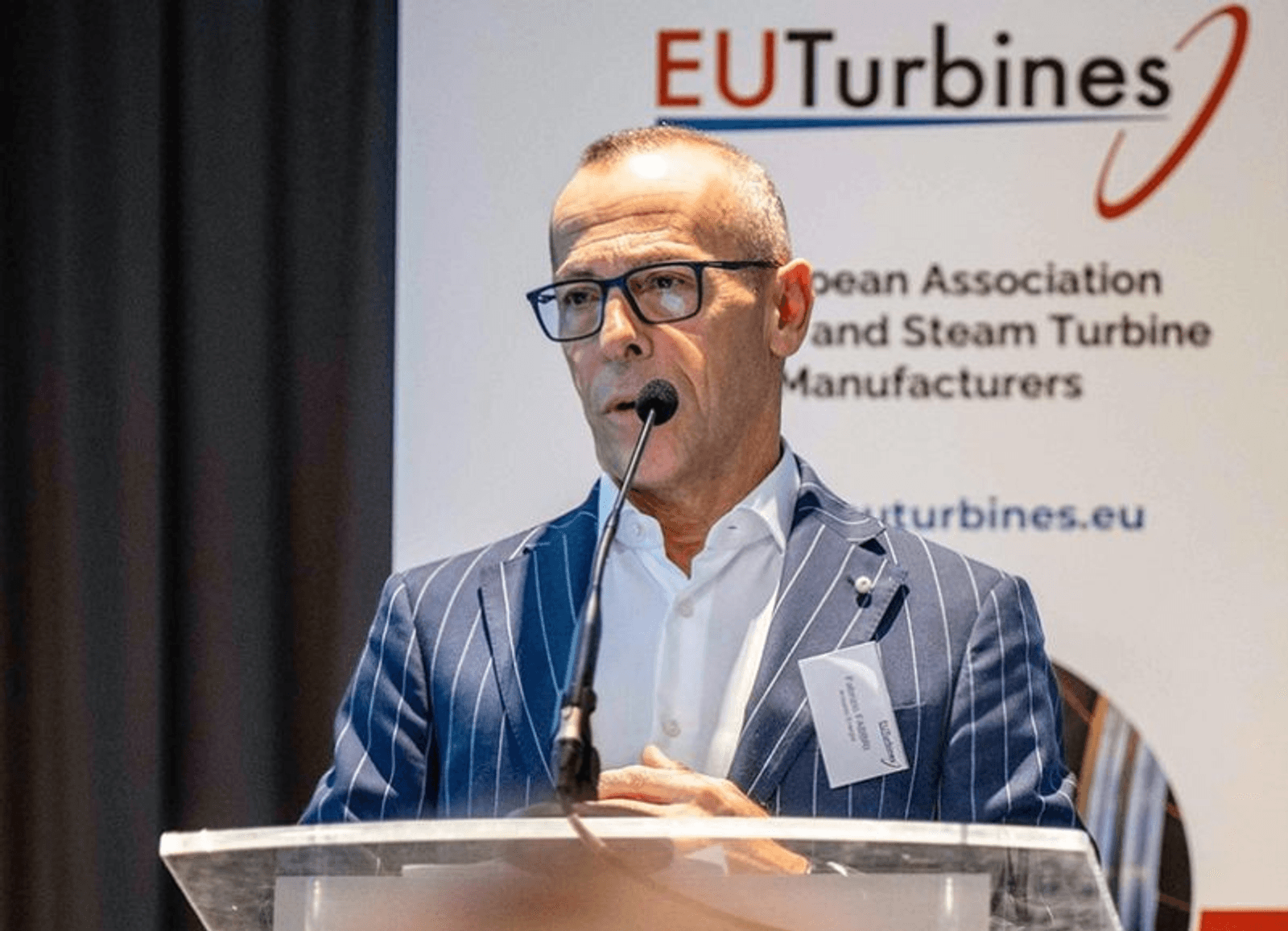
Members of EUTurbines say 'wrong approach' of EC to funding risks European innovation and competitiveness
The role of turbines in the transition to low-carbon energy could be undermined by the EU 'picking winners' for research and development, warned Ralf Wezel, the secretary general of the EUTurbines trade association, writes Vic Wyman in Brussels.
He said there was a big role for gas and steam turbines in energy affordability and reliability and meeting low-carbon targets: "This is where we can contribute considerably."
But he rejected the European Commission's underlying programme of selecting systems and technologies to back rather than relying on winners emerging from the operation of markets and competition.
"I think that is the wrong approach," he told Enlit Media at an EUTurbines 20th anniversary event in Brussels, Belgium. "That's a big concern."
The Commission's tendency to decide what it believes will be winners and losers among competing technologies and its resulting targeting of support was a risk for innovation, said Wezel: "The problem is research funding."
Have you read?
The craftsman who carved a career in gas turbines
Are gas turbines the most important link between the past and future of energy generation?
'Don't pick winners'
EUTurbines members echoed the view. "Give us a chance," said Fabrizio Fabbri, chief executive of the Italian power engineering company Ansaldo Energia. "Don't define up front who is going to be a winner. Give us a chance to compete."
EUTurbines was one of 110 European associations representing research, development and innovation organisations that on 4 July 2024 called for the EU to "significantly increase the current budget" of FP10, the next European Framework Programme for Research and Innovation. The 110 also called for parallel national funding in the EU and a focus on cross-border collaboration.
Wezel's comments came on the day that the European Parliament quizzed the designated new EU Commissioner for Energy and Housing, Dan Jørgensen, to decide whether to approve him. Jørgensen said that his top priority would be to cut energy prices for industry and individuals.
Some industry voices have already perceived a greater European Commission willingness to address energy costs. "I have the feeling that at last the sense of urgency is there," said Nicolai Romanowski, energy manager at the EU chemical industry association Cefic. The sector is the largest single consumer of final energy in the EU.
'Key political topic'
Tatiana Marquez Uriarte, a member of the cabinet of the outgoing energy commissioner, Kadri Simson, told the EUTurbines meeting that energy prices were "a key political topic".
She added that companies would want the next Commissioner to focus on the implementation of legislation to ensure a level playing field.
"At the EU level we need certainty," she said. Jørgensen told the MEPs that cheaper energy did not necessarily mean more rules. He supported a reduction in red tape, especially for permitting.
In a move towards low-carbon targets, the turbine and electricity sectors have embraced hydrogen as a potential alternative to fossil fuels, despite the current lack of hydrogen supply and its high cost. "Hydrogen is happening," claimed Javier Cavada, president and chief executive of Mitsubishi Power Europe, the Middle East and Africa.
Thomas Thiemann, vice-president of EUTurbines and senior vice-president for energy transition technologies at Siemens Energy, claimed that the designs of today's turbines allowed upgrades for burning hydrogen, typically by changing combustion burners. "Everything is prepared. You can utilise existing equipment: this is the trick," he claimed. "It's just a question of availability of fuel."
Thiemann said that a suitable economic supply of hydrogen was "a question of economy of scale".
And despite claiming that substantial investment was needed to prove that hydrogen-based plants were useful, Stefan Becher, vice-president for large gas turbines at Siemens Energy, said: "I don't have any concerns about the technology."
"Ramp up the hydrogen market as quickly as possible," said Viola Rocher, managing director of the EU representation of the BDEW, the German energy and water industries association, which includes utilities and wires companies.

She forecast that hydrogen would be costly for a long time and questioned how the transition from gas to hydrogen would happen.
Cefic's Romanowski was cautious about a rapid switch to hydrogen for power production, stressing the need to cut the fuel's cost, which at a current €9/kg was too high for the chemical sector. "More needs to be done there. The legislative framework is there."
Becher added: "I don't think that hydrogen plants are going to be able to compete with renewables." However, they could be used when renewables were not available, such as when the wind was not blowing or the sun shining, he said.
Originally published on powerengineeringint.com
Related tags
Latest content
+4
Fatih Birol and Dan Jørgensen call for energy efficiency focus in ‘low-trust’ world
EU Commissioner Dan Jørgensen and IEA Executive Director Fatih Birol urge a global audience to put energy efficiency at the heart of Europe's response to competitiveness, affordability, security, and climate challenges.
- Julia Kramer
- 12/06/2025