Using satellite data to accelerate offshore renewable energy
Guest/partner contributor
Posted on: 15 January 2026
By integrating Earth observation data into planning and operational workflows, BLUE-X is enhancing offshore renewable site selection.
Offshore renewable energy is a cornerstone of the European Union’s strategy to achieve climate neutrality by 2050, as outlined in the European Green Deal, REPowerEU, and the Paris Agreement.
With targets of 300GW of offshore wind and 40GW of ocean energy by 2050, the EU faces significant challenges in scaling deployment. [1] Meeting these targets requires overcoming key challenges. Traditional methods, reliant on extensive MetOcean, geophysical and environmental surveys, are time-consuming, costly and often hinder progress.
The BLUE-X project addresses these challenges by leveraging satellite-based Earth observation data to streamline offshore energy development. This article presents the methodology, results and implications of BLUE-X, highlighting its role in supporting the entire lifecycle of offshore wind, floating solar, tidal and wave energy deployment across Europe.
BLUE-X methodology
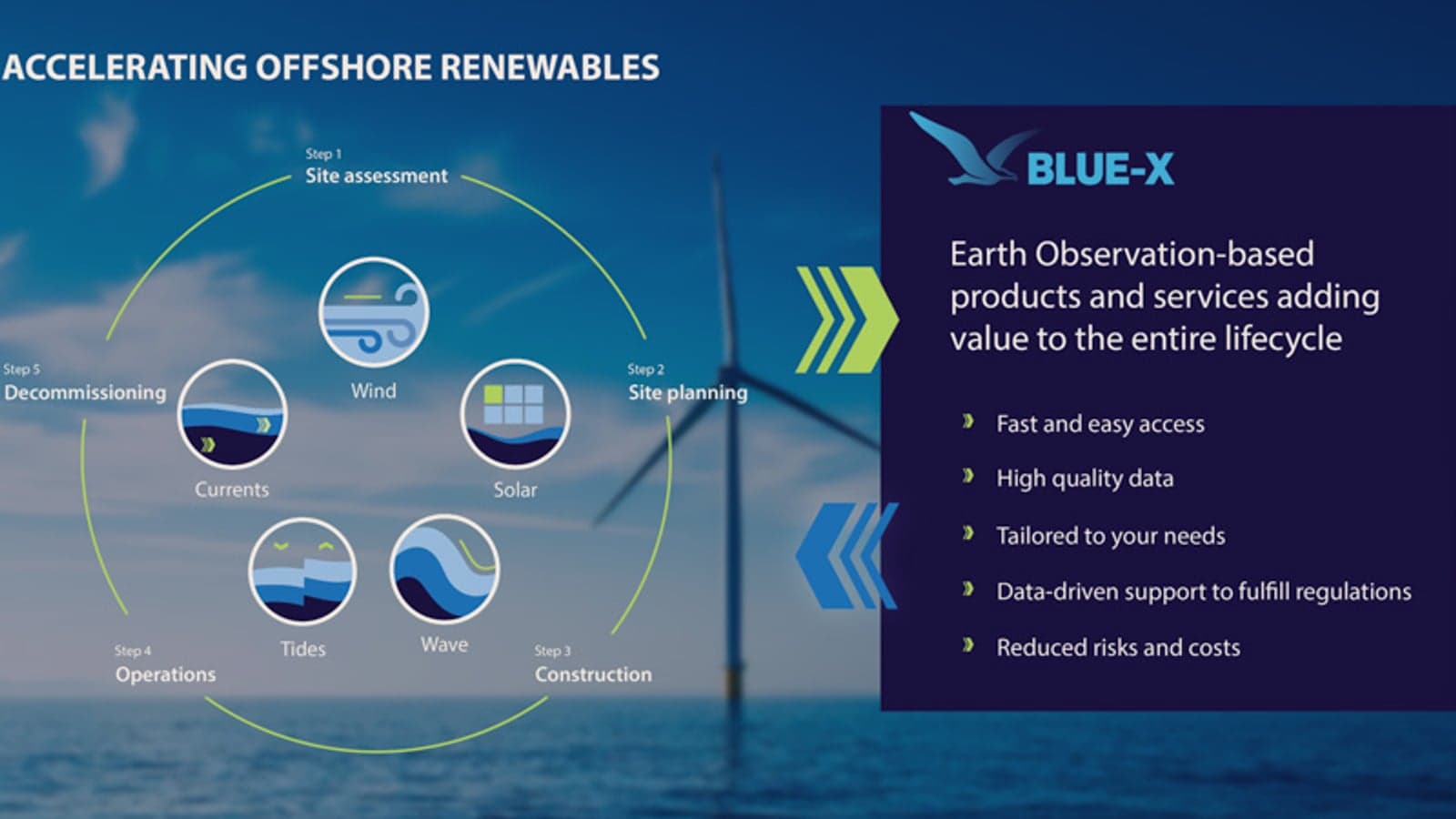
Our solution helps to accelerate planning and operational processes through Earth observation-based environmental information and dedicated data analytics and services adding value to the entire installation lifecycle.
The approach consists of three key components:
- Access to selected Earth observation-based environmental information: By integrating satellite-derived datasets, we provide high resolution insights into critical parameters such as ocean currents, wind speeds, wave heights and seabed characteristics. This data is essential for site selection, design optimisation and risk assessment. Currently, 13 Copernicus datasets with different temporal resolutions in addition to 12 environmental datasets accompanying decision making are integrated into this framework. An automated updating procedure ensures near-real-time data.
- Lifecycle decision support: Offshore renewable projects involve multiple phases from site assessment to construction planning, maintenance and decommissioning. Our methodology supports decision making across this entire lifecycle by offering timely and accurate environmental information. This reduces dependency on costly in-situ surveys and accelerates project timelines.
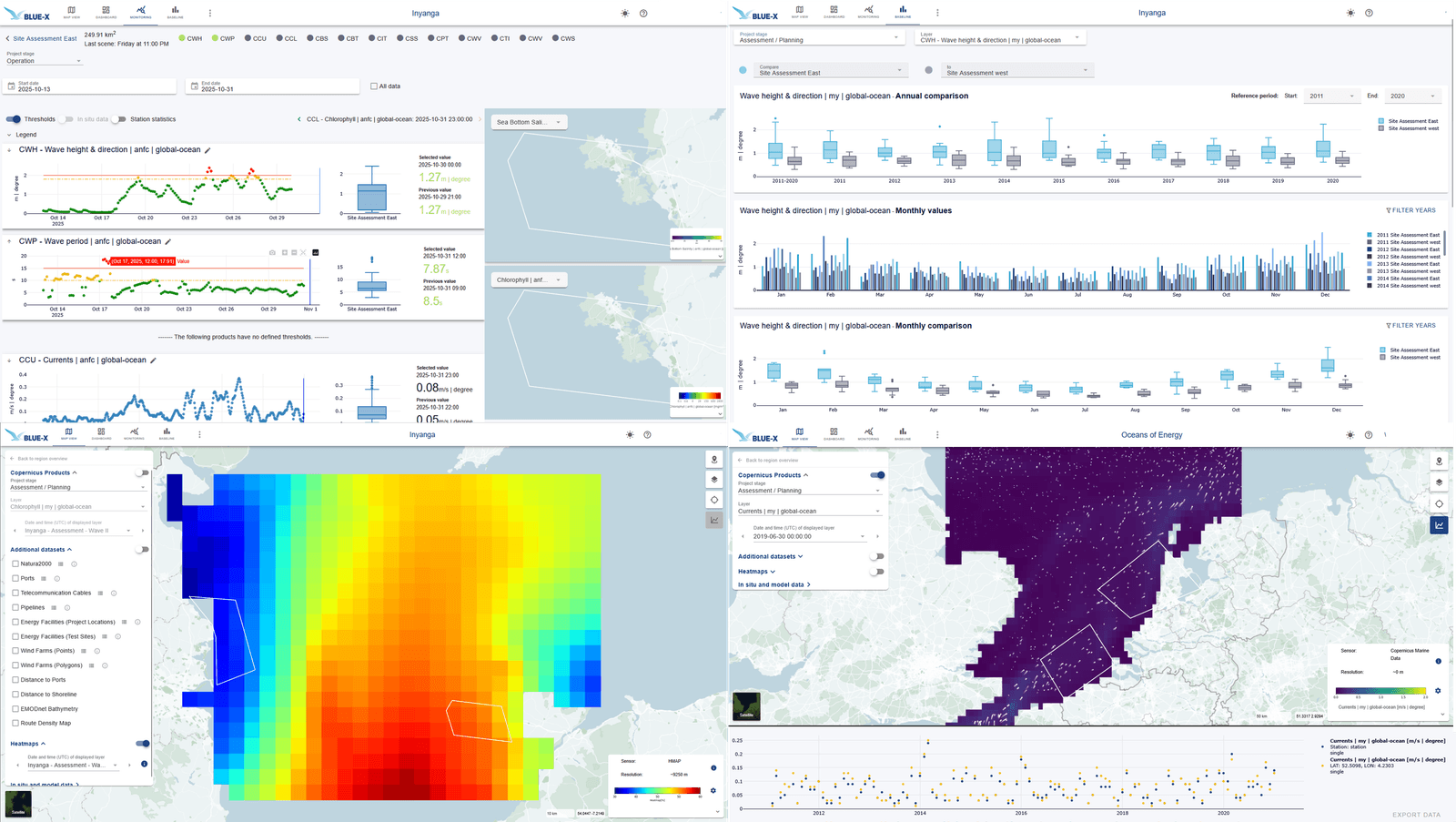
- Development of a web-based decision support tool: To operationalise this approach, we developed a web-based decision support tool that integrates and visualises relevant Earth observation data alongside ancillary environmental information. The tool provides various analytical functionalities such as interactive maps, scenario analysis and compliance tracking, enabling stakeholders to make informed decisions quickly and confidently supporting the targeted energy types across the entire installation lifecycle.
Addressing the offshore renewables gap
While offshore wind capacity is steadily increasing across Europe, the deployment of other offshore energy technologies, such as floating solar, tidal and wave energy, remains comparatively limited. [1]
BLUE-X addresses this gap by offering tailored Earth observation data streams that support decision-making for a broader range of offshore renewable solutions. This targeted support enhances the viability and scalability of emerging technologies, contributing to a more diversified and resilient energy mix.
BLUE-X simplifies complex analyses, and stakeholders can evaluate multiple scenarios or optimise site selection for enhanced decision-making in one combined tool (Figure 1).
In this context, our innovative data-driven approach provides several key outcomes:
- Enhanced decision making processes: The decision support tool merges Earth observation data with environmental and regulatory information, streamlining analytical workflows and improving transparency. This empowers stakeholders to make informed decisions without relying exclusively on traditional, resource-intensive survey methods. Analytical functionalities enable users to better understand the Earth observation-based information.
- Acceleration of offshore renewable upscaling: Continuous access to high resolution environmental and MetOcean data significantly shortens planning cycles and reduces permitting delays. This enables faster deployment of offshore installations, directly contributing to the European Green Deal’s target of climate neutrality by 2050.
- Risk and cost reduction: Traditional surveys are not only expensive but also subject to delays caused by weather conditions and logistical constraints. Our Earth observation-based approach mitigates these risks by providing continuous, reliable data streams. This reduces overall project costs and minimises uncertainties during construction and operation.
Despite its demonstrated benefits, BLUE-X continues to face several challenges and requires further refinement. To address this, a dedicated user testing phase is currently underway, aimed at enhancing the decision support tool’s relevance and effectiveness in accelerating the deployment of offshore renewable energy projects.
Conclusion
The BLUE-X project demonstrates how Earth observation-based technologies can accelerate offshore renewable energy deployment. By providing rapid access to environmental data and streamlining decision-making processes, BLUE-X can support the EU’s ambitious climate goals.
The developed decision support tool empowers stakeholders to reduce costs, shorten project timelines and ensure informed decision-making across a range of energy technologies, including offshore wind, floating solar, tidal and wave energy within the entire lifecycle of installations.
As Europe moves toward climate neutrality, continued investment in Eath observation-based solutions and digital infrastructure will be essential.
To learn more about BLUE-X and explore its tools, visit the project website.
Reference
1. European Commission, 2020. 'An EU Strategy to harness the potential of offshore renewable energy for a climate neutral future', Document 52020DC0741, Brussels.
About the author
Dr Simone Zepp is an expert in remote sensing applications with extensive experience in processing and analysing Earth observation datasets. In her role as a Project Manager at EOMAP, she is responsible for the scientific and operational coordination of multiple national and international projects, focusing on the integration of remote sensing data into the renewable energy sector.