WEF says energy transition has lost pace and calls for system overhaul
Kelvin Ross
Posted on: 20 June 2024
World Economic Forum report finds economic and geopolitical volatility have slowed down the energy transition.

Economic and geopolitical volatility have slowed speed of energy transition
The global energy transition has lost momentum because economic volatility, geopolitical tensions and technological shifts have all impacted its speed and trajectory, according to a new report from the World Economic Forum.
And Roberto Bocca, head of WEF’s Centre for Energy and Materials, has called for urgent action on three key levers: “Reforming the current energy system to reduce its emissions, deploying clean energy solutions at scale, and reducing energy intensity per unit of GDP.”
“Transforming how we produce and consume energy is critical to success,” he added. “We must ensure that the energy transition is equitable, in and across emerging and developed economies.”
Bocca was speaking at the launch of the 14th annual edition of WEF’s report, Fostering Effective Energy Transition 2024, which is published in collaboration with Accenture.
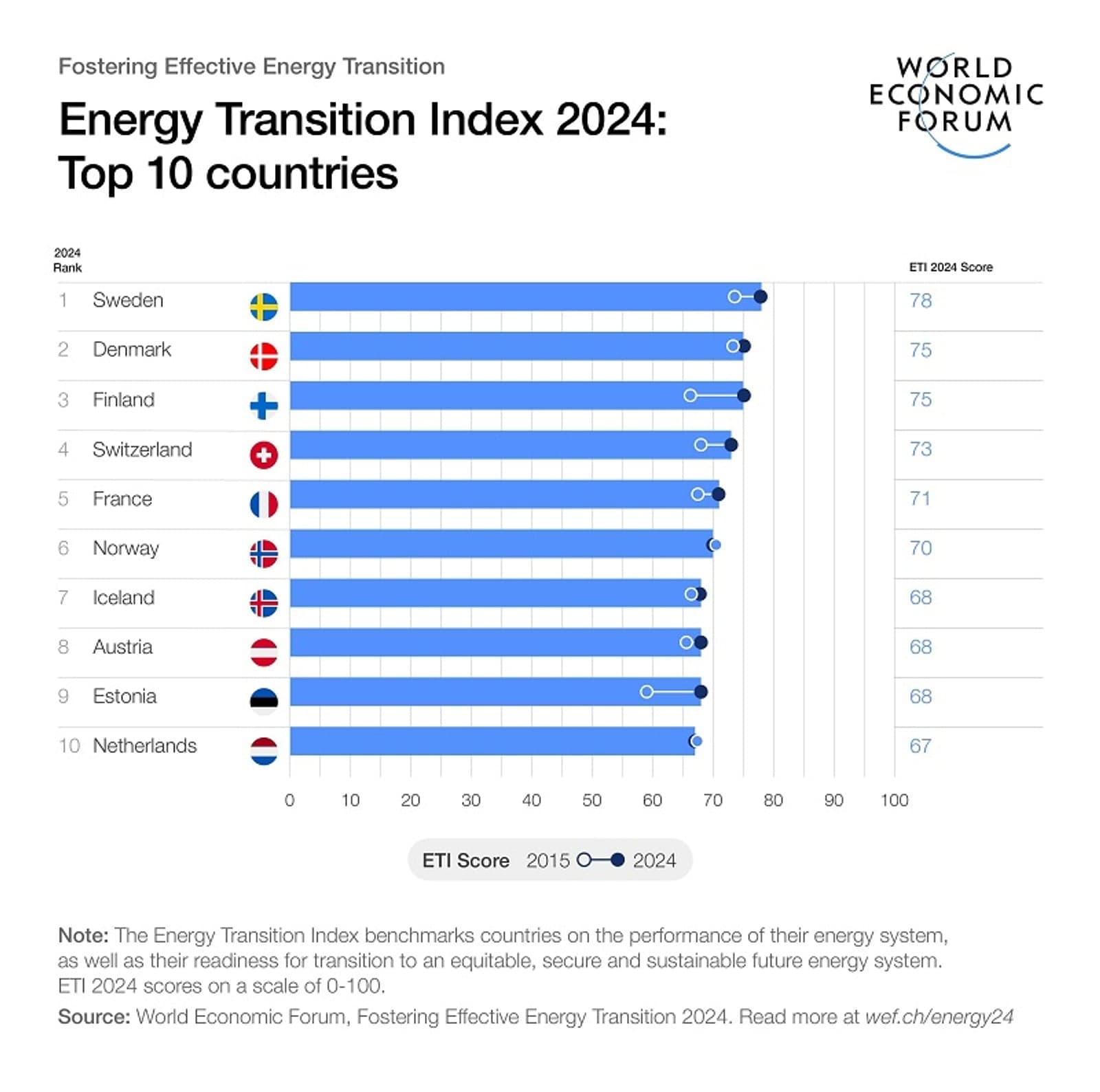
WEF uses its own Energy Transition Index (ETI) to benchmark 120 countries on the performance of their current energy systems, with a focus on balancing equity, environmental sustainability and energy security, and on their transition-readiness.
System performance is equally weighted across equity, security and sustainability. Transition-readiness is split into two groups: core enablers and enabling factors. Core enablers include regulations and political commitment, and finance and investment. Enabling factors include innovation, infrastructure, and education and human capital.
A country’s final ETI score is a composite of its scores on the two sub-indices of system performance and transition-readiness, weighted at 60% and 40% respectively.
Europe leads the ETI rankings, taking all top 10 positions: Sweden is top, Denmark second, and Finland, Switzerland and France making up the rest of the top five.
WEF says these countries benefit from high political commitment, strong investments in research and development, expanded clean energy adoption – accelerated by the regional geopolitical situation, energy-efficiency policies and carbon pricing.
France is a new entrant in the top five, with recent energy-efficiency measures reducing energy intensity in the past year.
Energy transition 'centre of gravity'
The report finds that the gap in overall ETI scores has narrowed between advanced and developing economies and the “centre of gravity” of the transition is moving to developing countries.
However, clean energy investment continues to be concentrated in advanced economies and China. This underscores the need for financial support from advanced nations to facilitate an equitable energy transition in emerging and developing nations and forward-thinking policy-making in all nations to foster truly conducive investment conditions.
Espen Mehlum, Head of Energy Transition Intelligence and Regional Acceleration at WEF, said: “This year’s Energy Transition Index delivers a clear message: urgent action is needed. Global decision-makers must make bold moves to regain momentum in the transition towards an equitable, secure and sustainable energy future.
“This is critical for people, entire economies and the fight against climate change.”
The report finds that while the world remains off-track to meet Paris Agreement commitments, there has been notable progress in energy efficiency and a marked increase in the adoption of clean energy sources.
Generative AI
It adds that innovation is a key enabling factor for the energy transition and can reduce costs, scale key technologies, renew and reskill the workforce and attract investments.
Despite a recent slowdown in innovation progress and a drop in global start-up investments in 2023, there are areas where innovation is accelerating.
WEF says digital innovations, including generative AI, offer significant opportunities to fill this gap and reinvent the energy industry by enhancing productivity.
Generative AI's ability to analyse vast quantities of data can provide innovative forecasts and solutions, or streamline existing operations to increase efficiencies, among other benefits. However, to fully realize this potential, it will be crucial to responsibly and equitably address the risks and challenges posed by these technologies.
Muqsit Ashraf, Group Chief Executive of Accenture Strategy, said: “C-suites consistently tell us a clear business case is a prerequisite for attracting investments in the energy transition, especially in the face of higher interest rates and the emerging talent shortage."
"We believe that a strong digital core, enabled by generative AI, can boost productivity, enhancing returns and talent availability and unlocking a new wave of investments.”
Generative AI has ‘turbocharged the power of the human’ says Octopus Energy founder Greg Jackson
Accenture boss Tinkler urges utilities to ‘reinvent business as usual’