Home
/
TES expedites green gas terminal to secure alternative and sustainable energy for Germany
TES expedites green gas terminal to secure alternative and sustainable energy for Germany
Yusuf Latief
Posted on: 4 March 2022
Tree Energy Solutions (TES) is accelerating the German port Wilhelmshaven into a world-scale hub for importing green gas.
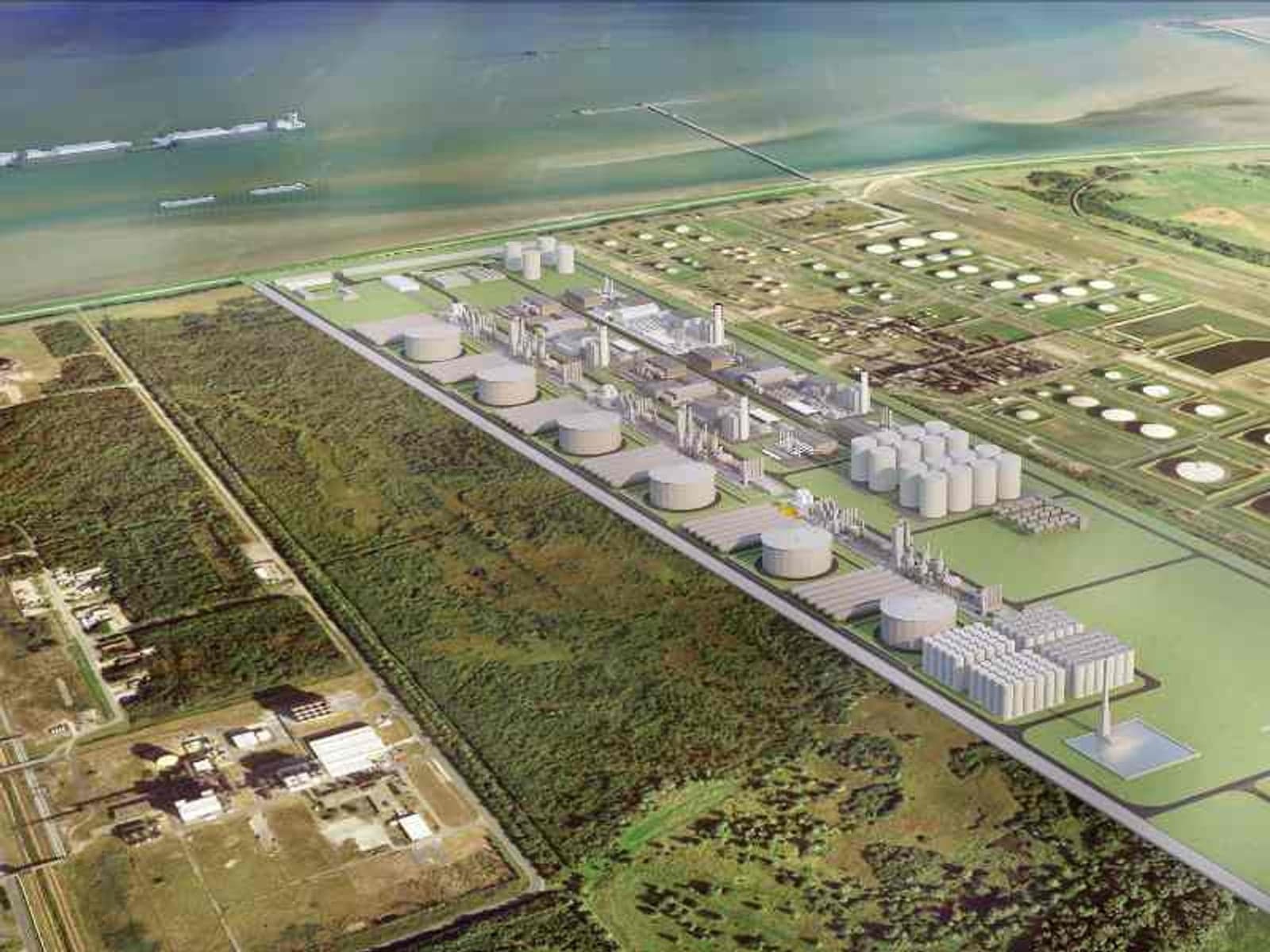
Hydrogen company Tree Energy Solutions (TES) announced the acceleration of the development of the German port Wilhelmshaven into an international hub for importing green gas, which should provide alternative energy security for Germany and Europe and drive the growth of green gas imports.
The new green energy hub, initially started in 2019, will accommodate liquified natural gas (LNG) as an intermediate source of energy and its acceleration will account for the handling of gas imports alongside green gas imports.
The project will include six independent tanks combined with six ship-berths.
“We are now planning further work to ensure an operational start of phase 1 by winter 2025 at scale. In view of our planned full scale (...), we are also willing to constructively accommodate any alternative gas importers and ensure third party access in line with current DG Energy regulations and practices,” said Paul van Poecke, Founder and Managing Director at TES.
Energy security as a priority
The acceleration aims to advance Europe’s energy strategy in a sustainable way, support the strategic priorities of energy supply sustainability and diversification and stimulate material economic growth for the regional economy. In addition to meeting Germany’s sustainability goals, it also aims to prevent future stranded assets.
Van Poecke emphasised the importance of the project to make Germany’s energy supply CO2-neutral while not interfering with energy targets to be met by 2045.
Otto Waterlander, Chief Commercial Officer at TES, goes on to relate this to the EU’s strategies and policies, “With only 28% of the EU’s Primary Energy Consumption of 17,407TWh coming from electrons, we must focus on the other 72% to achieve our net-zero ambitions.
The Wilhelmshaven project, according to Waterlander, "will account for 10% of the total annual primary energy demand of Germany by 2045, approximately the annual energy consumption of 43 million households in the country.”
Have you read?
Majority of Germans want to reduce reliance on Russian gas – survey
Karim Amin: Managing change to reach a decarbonised energy system
IRENA: How to future-proof economies against fossil fuel volatility
Green hydrogen focus
The new terminal places TES green hydrogen at its core, which will be produced using solar, wind and hydropower in countries with abundant renewable energy sources, after which CO2 will be added to make green CH4, which will be used as the ‘energy carrier’.
This will be transported to Wilhelmshaven and converted back into green hydrogen, with the resulting CO2 captured and returned to the producing countries in a continuous closed-loop system, thereby ensuring the CO2 never leaves the cycle and mitigating GHG emissions.
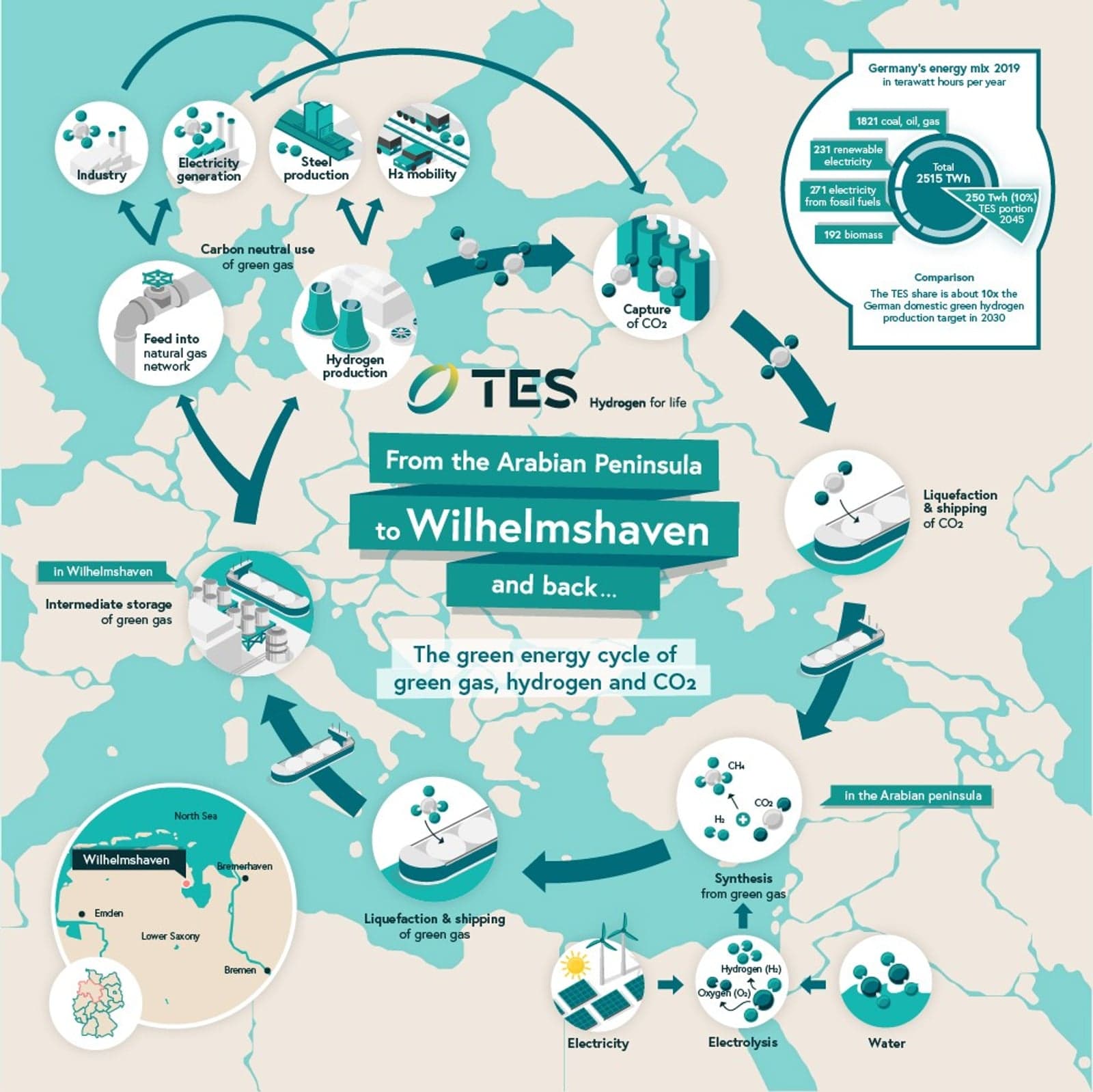
In its initial phase of 25TWh per year of green gas import, more than half a million tonnes of hydrogen can be produced and imported in Wilhelmshaven. This will rise to 250TWh per year and more than 5 million tonnes of hydrogen in the final stage.
This corresponds to 10% of Germany’s total annual primary energy demands, achieving an essential milestone of the German and European hydrogen and climate protection strategy.
Germany's energy crisis
The project's acceleration comes during a time of energy uncertainty across Europe. Last week, the German chancellor Olaf Scholtz announced what is seen as a 'u-turn' in the German energy policy.
In order to become energy secure, Germany will significantly speed up their renewable energy push. However, the country also considers to allow an extension of the operations of the country’s nuclear and coal power stations beyond 2030 or the import of LNG.
Besides Wilhelmshaven, an LNG terminal is currently planned to be located in Brunsbüttel.