Putting ESG performance in perspective
Guest/partner contributor
Posted on: 31 January 2023
ESG is now firmly a boardroom issue – yet many boards still struggle to understand it, says Georgina Hayden, who also explains how this year’s events will change the ESG landscape.

ESG is now firmly a boardroom issue – yet many boards still struggle to understand it, says Georgina Hayden, who also explains how the events in 2022 will change the ESG landscape.
The more I speak to clients and industry insiders, the more I am convinced that ESG is becoming a core concern of corporate strategy, having previously been a fringe issue.
But I also see significant uncertainty over the ‘how?’ and ‘why?’ ESG matters. While businesses feel a need to better understand ESG, the use case for this information is often unclear.
At North Shore Analysis, we have been helping firms address this challenge, particularly energy companies that are increasingly in the spotlight given their high carbon footprint and the potential role they can play in global decarbonisation efforts.
ESG is not all about climate change. While the environment, and decarbonisation specifically, is the aspect of ESG that typically receives the most attention, ESG criteria encapsulate a number of different factors across Environment, Social & Governance.
Aside from decarbonisation, factors such as eco-system protection, labour conditions, corruption, rule of law, gender equality, and human rights are all critical aspects of an ESG profile. The majority of ESG analysis and commentary is focused on the performance of individual companies.
At North Shore, we have been promoting an additional lens through which to consider ESG, namely the country-level perspective.
Assessing ESG performance at the country level can be an extremely useful tool in understanding these risks, for both companies and countries alike:
- At the company level, firms do not uniformly report ESG performance metrics. Using ESG scores for the countries that a multinational firm operates in can help to fill this information gap. Ultimately, countrylevel scores can highlight the main ESG risks inherent in the cross-border supply chains of multinational firms.
- At the country level, a country’s ESG performance can have a significant impact on the economy’s long-term economic growth prospects. While traditional economic analysis is well placed to focus on a 10-year horizon, ESG analysis can help to identify factors that will impact the economy on a longer-term horizon. For instance, increased social unrest, endemic corruption and stranded carbon resources will weaken economic growth potential in the long term.
North Shore Analysis’ team provides ESG scores and analysis at the country level.
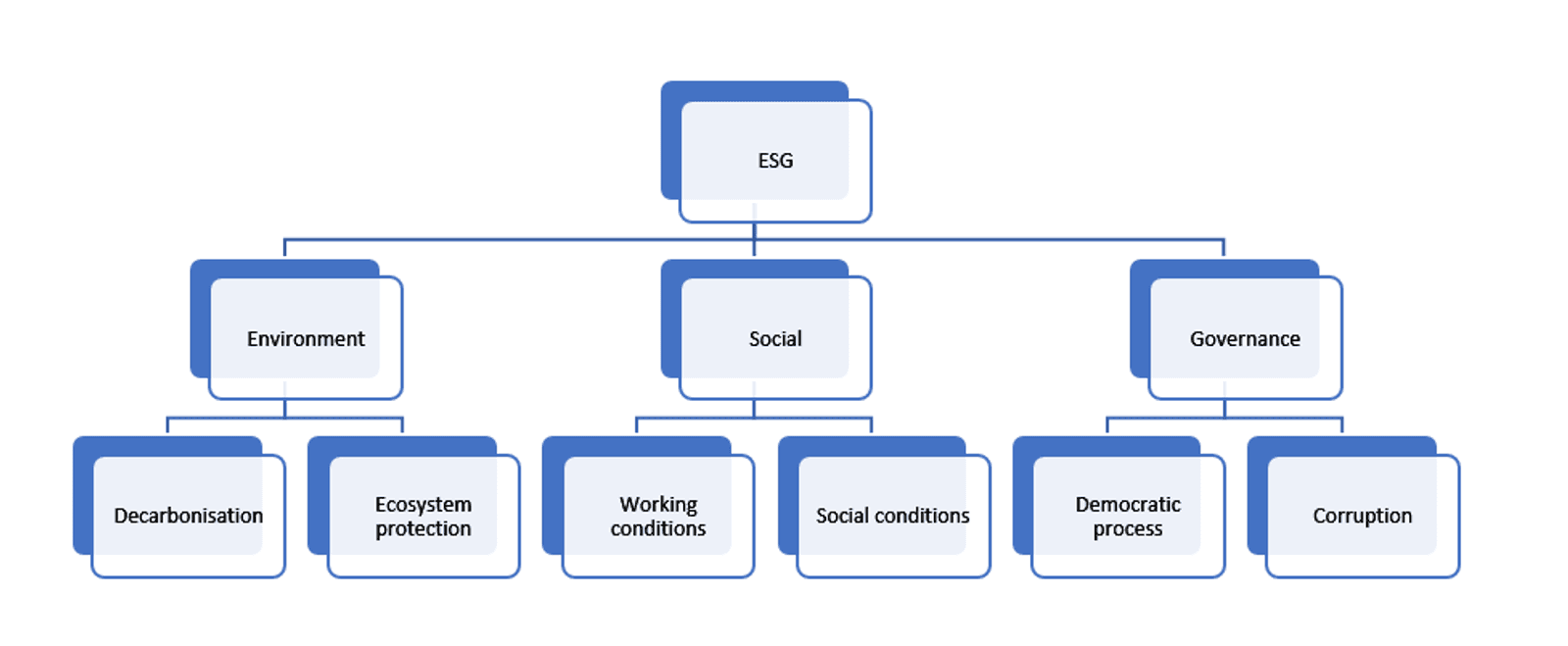
The North Shore ESG scoring system is split into Environment, Social and Government categories, which are each comprised of two sub-categories.
For instance, the Environment category comprises the Decarbonisation and Ecosystem protection sub-categories.
The last six months have seen a huge shake-up in the global energy landscape, catalysed by Russia’s invasion of Ukraine.
Disruption to Russia’s energy exports combined with a rebound in demand following reduced lockdowns has turbocharged global energy prices.
Having already doubled from their pandemic lows by the end of 2021, both Brent Crude and thermal coal prices doubled again in the six months following Russia’s February invasion. Prices for natural gas, for which Russia is the dominant supplier to Europe, rose even more rapidly.
Have you read?
Is the energy transition immune to Covid?
Poland’s energy transition: Two steps forward, one step back
For instance, Dutch natural gas futures increased four-fold over February-August to smash through previous record highs. Elevated prices, and a renewed focus on energy security from governments across the world, will have a knock-on impact on global ESG performance. This will be most prominent in European markets, where there is the strongest reliance on Russian energy supplies.
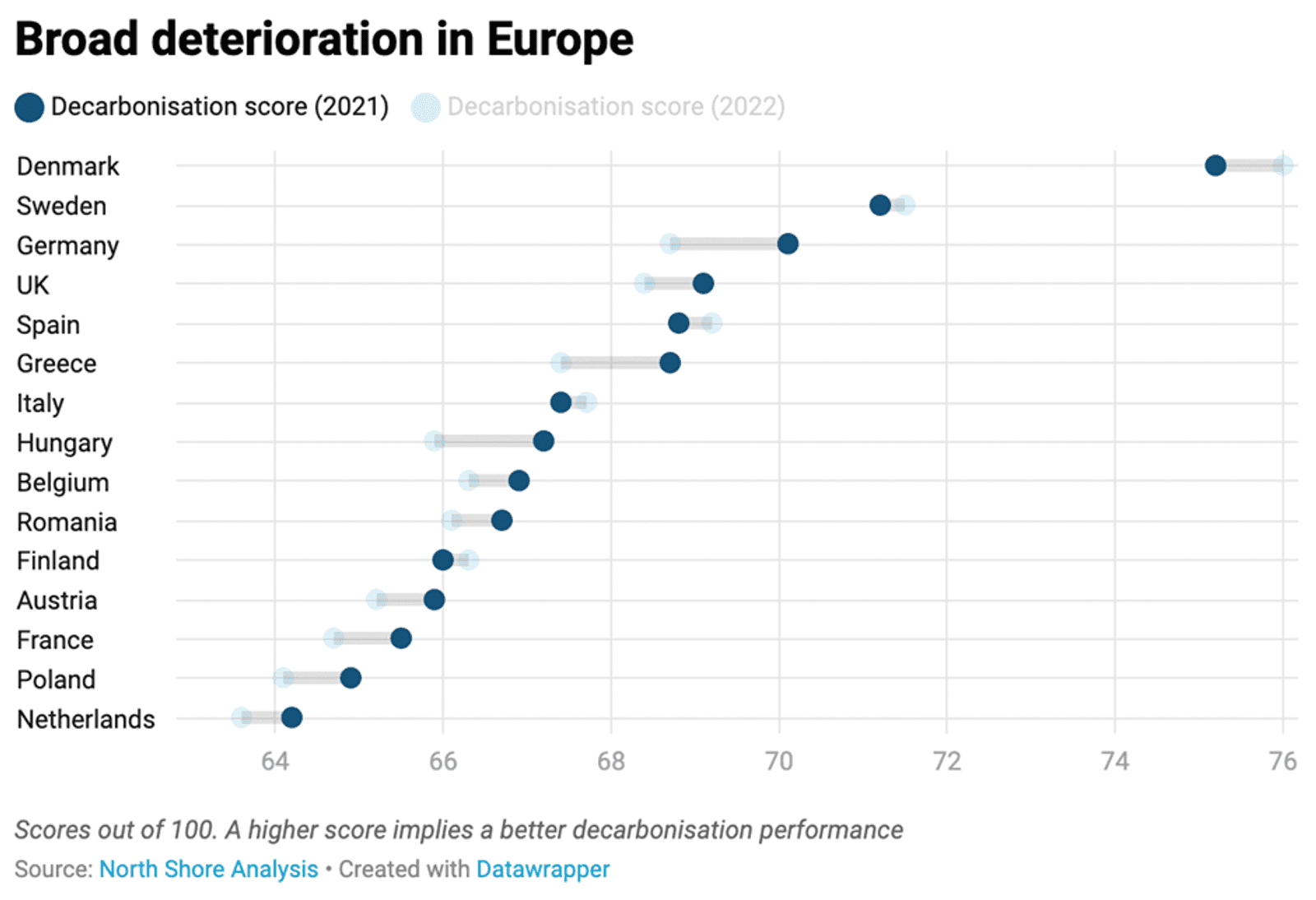
At North Shore Analysis, we have factored these dynamics into our ESG coverage, and the most notable theme that has emerged has been a general deterioration in decarbonisation scores in the index.
European markets have seen the largest weakening of scores in our index, as numerous countries in the region turn their focus to coal once again, delaying coal phase-out plans and pushing up emissions over the near-term (GHG emissions per capita forms a component of North Shore Analysis’ ESG index).
Coal rebound
Surging global gas prices and the ongoing uncertainty of Russian gas supply to Europe has forced many European countries to focus on supply diversification to reduce reliance on Russian gas imports. This has led to a resurgence in coal use in Europe as governments turn to the readily available baseload fuel in order to make up for the shortfall in gas supply.
Germany, Austria, Italy, France and Italy have all announced plans since February 2022 to reactivate old coal power facilities. To align with the UN Paris Climate Agreement, European countries need to be coal-power free by 2030, with many EU countries stating this goal for 2025.
However, the Ukraine conflict has jeopardised the phase-out of coal in Europe and the near-term resurgence in coal is likely to result in a rebound in greenhouse gas emissions given that coal has a higher carbon-emitting profile than gas.
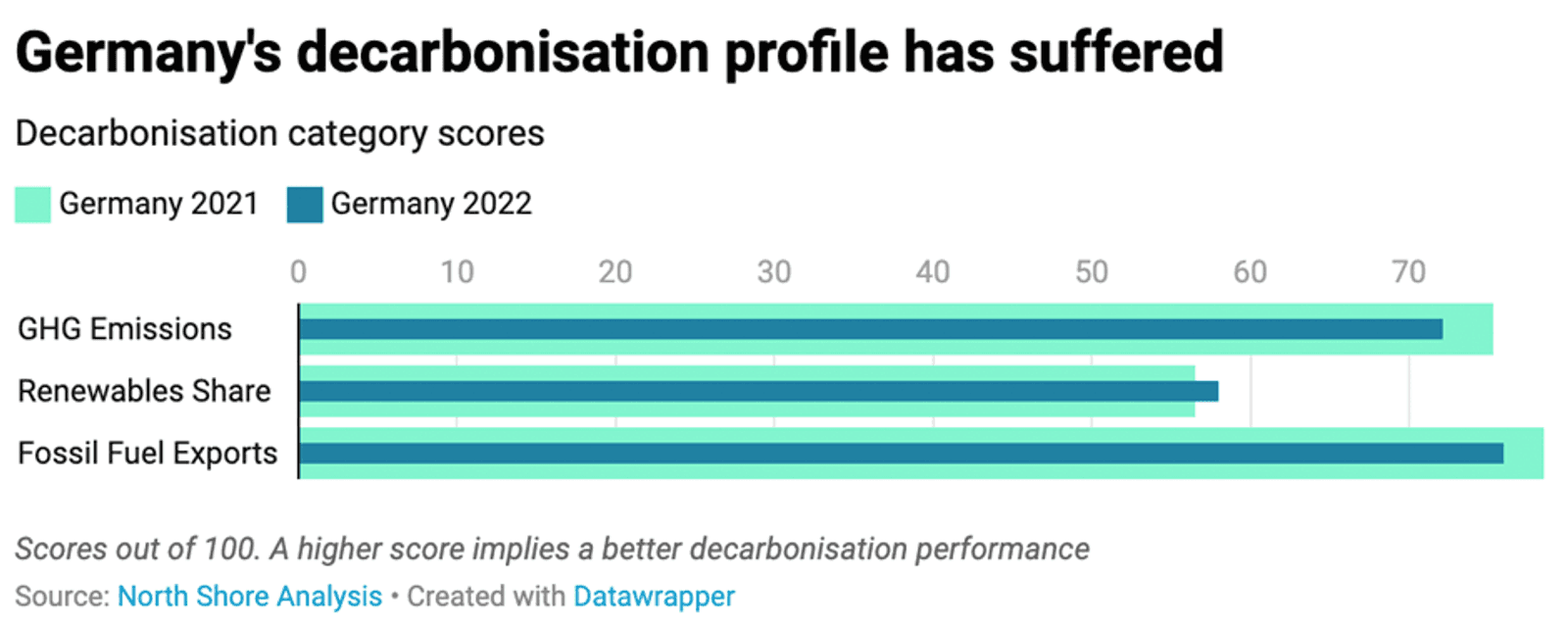
Germany in particular is facing a significant slippage in its ESG profile given its renewed focus on coal as a way to reduce natural gas consumption, a move that marks a major U-turn in the government’s ‘Energiewende’ decarbonisation policy.
According to media reports, Germany is set to allow 21 coal plants to restart or work past planned closing dates for the next two winters.
Fossil fuel exporters are cashing in
Alongside the general deterioration in decarbonisation scores for European countries, major fossil fuel producers that are ramping up exports in order to capitalise on high prices and rising demand are also seeing a weakening of their ESG profile.
Fossil fuel exports form another component of the decarbonisation category in our ESG index. Australia and South Africa, for example, are both benefiting from increased demand from Europe for their domestic coal, as Russian coal exports are banned and coal demand rises across the continent. Coal sales from South Africa to Europe rose eight-fold during the first six months of 2022 compared with H1 2021.
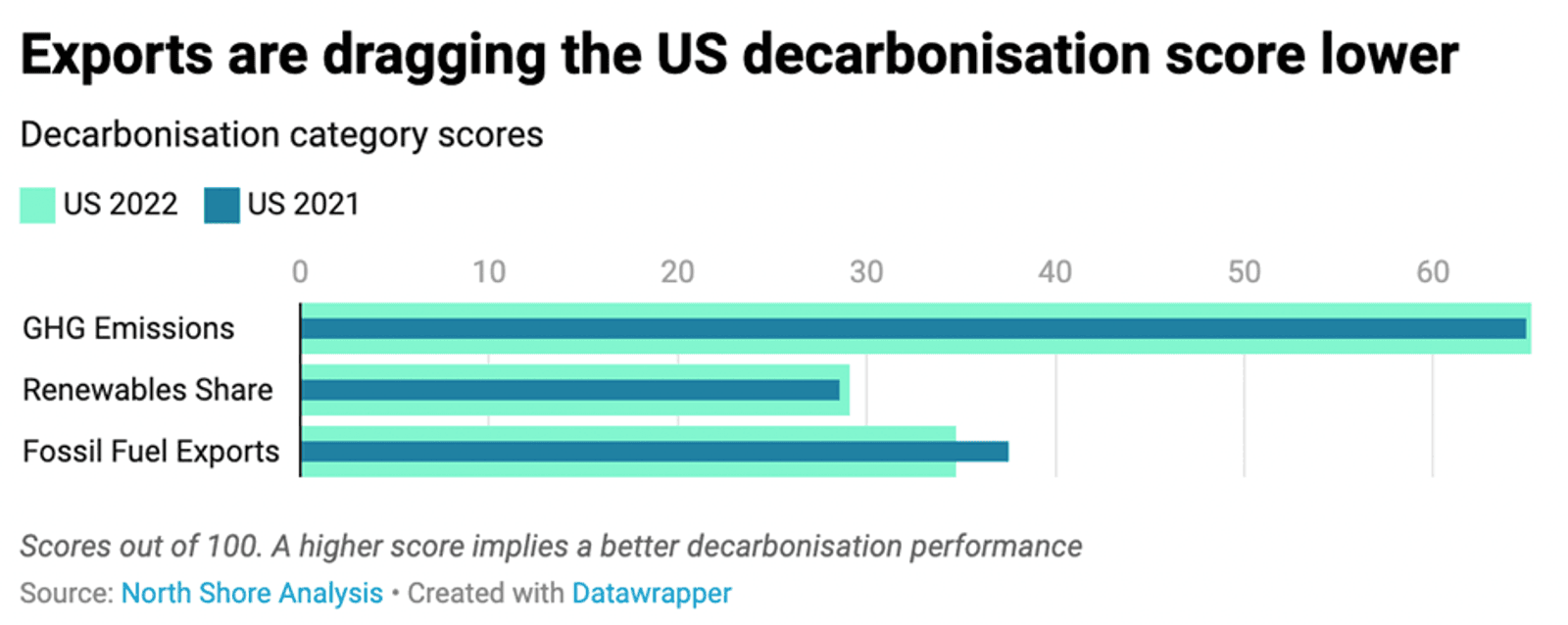
Meanwhile, US exports of oil, gas and coal have accelerated since the energy price rally: US crude oil exports reached an all-time high in July 2022, underpinned by the big discount for US crude when compared with international benchmark Brent.
Have you read?
What is more, drilling activity in the upstream oil sector has also picked up as breakeven prices improve. US hydrocarbon exports will remain elevated, particularly to Europe, which will dent the US’ ESG credentials over the near-term.
In March, the US and European Commission established a Joint Task Force on Energy Security to reduce Europe’s dependency on Russia energy, which will involve increased LNG exports from the US to the continent.
Accelerated efforts
While it appears that global ESG progress has taken a step back since the Russia-Ukraine conflict, largely in terms of decarbonisation efforts, we think that the longer-term impact of the crisis will be accelerated decarbonisation.
Germany provides a pertinent example of this. Whilst simultaneously bringing old coal power plants back online, the government is also strengthening its longerterm low carbon commitments.
The government has committed to a new target of 80% of renewable energy share by 2030 and 100% share by 2035, compared to a previous 100% target of ‘well before 2040’. The EU, more widely, is also accelerating energy diversification and decarbonisation efforts through increasing its renewable growth targets.
In May, the EU presented its REPowerEU plan, which aims to rapidly reduce dependence on Russian fossil fuels and accelerate the green transition. New targets have been proposed as part of the plan, which calls for an increase in renewables’ share to 45% by 2030, from a previous target of 40%.
ABOUT THE AUTHOR
Georgina Hayden is an energy consultant and co-founder and director of North Shore Analysis.