Partner contentDecarbonisation
Innovations to accelerate the decarbonisation journey
Enlit Editorial Team
Posted on: 22 October 2024
ABB’s Marco Tellarini, Senior Vice-President – EMEA Region, Electrification Service, delves into the innovations that are enabling utility and industrial customers to accelerate their decarbonisation.

ABB’s Marco Tellarini, Senior Vice-President – EMEA Region, Electrification Service, delves into the innovations that are enabling utility and industrial customers to accelerate their decarbonisation.
Please start with an overview of industrial decarbonisation strategies.
To operate in the ever changing and volatile environment of today, utilities need to develop effective resilience strategies, with greater system flexibility, delivered through digital and emerging technologies.
The electric grids need to become more robust and allow a quicker response to outages through better use of fault detection, isolation and restoration.
By leveraging new technologies and adopting a circular approach, utilities can achieve improved grid resilience with greater ease, speed and regularity, as well as helping deliver performance improvements, investment optimisation and new levels of sustainable efficiency.
In a circular economy, extending the lifespan of products, minimising material consumption and promoting the reuse and recycling of goods are the main priorities. Resources are used for as long as possible in this economic framework, ensuring maximum value extraction.
This has the potential to maximise customer efficiency, reduce costs and lower carbon emissions to deliver new levels of sustainable operations.
Our goal is to help utilities close the loop on circularity and decarbonise their operations through a range of products, digital solutions and services, from preventive and predictive maintenance to upgrading and retrofitting solutions to responsible end-of-life asset management.
How can asset management and monitoring drive competitive advantage?
The world of asset management is rapidly evolving. Smart sensors embedded into assets provide massive quantities of data that can be used to fine-tune performance, measure utilisation, determine return on investment and help plan maintenance actions.
Rather than running a piece of equipment to the point of failure, customers can deploy a proactive, predictive maintenance approach that uses real-time data analytics to monitor and evaluate when a piece of equipment might need upgrading before it happens, reducing downtime and total cost of ownership and extending asset life.
With our digital solutions, we enable customers to remotely monitor asset and electrical-system behaviour to optimise energy consumption, detect potential issues early and reduce the CO2 footprint, ensuring maximum safety, performance and sustainability.
How does asset modernisation reduce energy consumption and boost decarbonisation?
One of the greatest opportunities for carbon and cost savings is upgrading outdated components so that existing electrical equipment lasts longer, uses minimal energy in production and prevents downtime from breakdowns.
Upgrading outdated components can reduce the cost of operating equipment by a third and extend its life cycle by as much as 30 years, as well as resulting in enormous energy savings for businesses.
Our smart service strategy promotes a circular economy, preserves finite resources and regenerates the environmental ecosystems by focusing on repair, retrofit, reuse and recycle.
In terms of best practice, early adopters are taking a preventative approach, replacing older, non-digital circuit breakers with more intelligent, sensor-enabled breakers linked to cloud-computing platforms.
These can provide real-time data and analysis on asset condition, performance and potential safety issues, helping operators prevent potential hazards before they arise and minimising disruptions to production.
By leveraging new technologies and retrofitting dated components with digital upgrades, utilities can achieve improved grid resilience with greater ease, speed and regularity, as well as helping deliver performance improvements, investment optimisation and new levels of sustainable efficiency.
Can you mention some customer case studies?
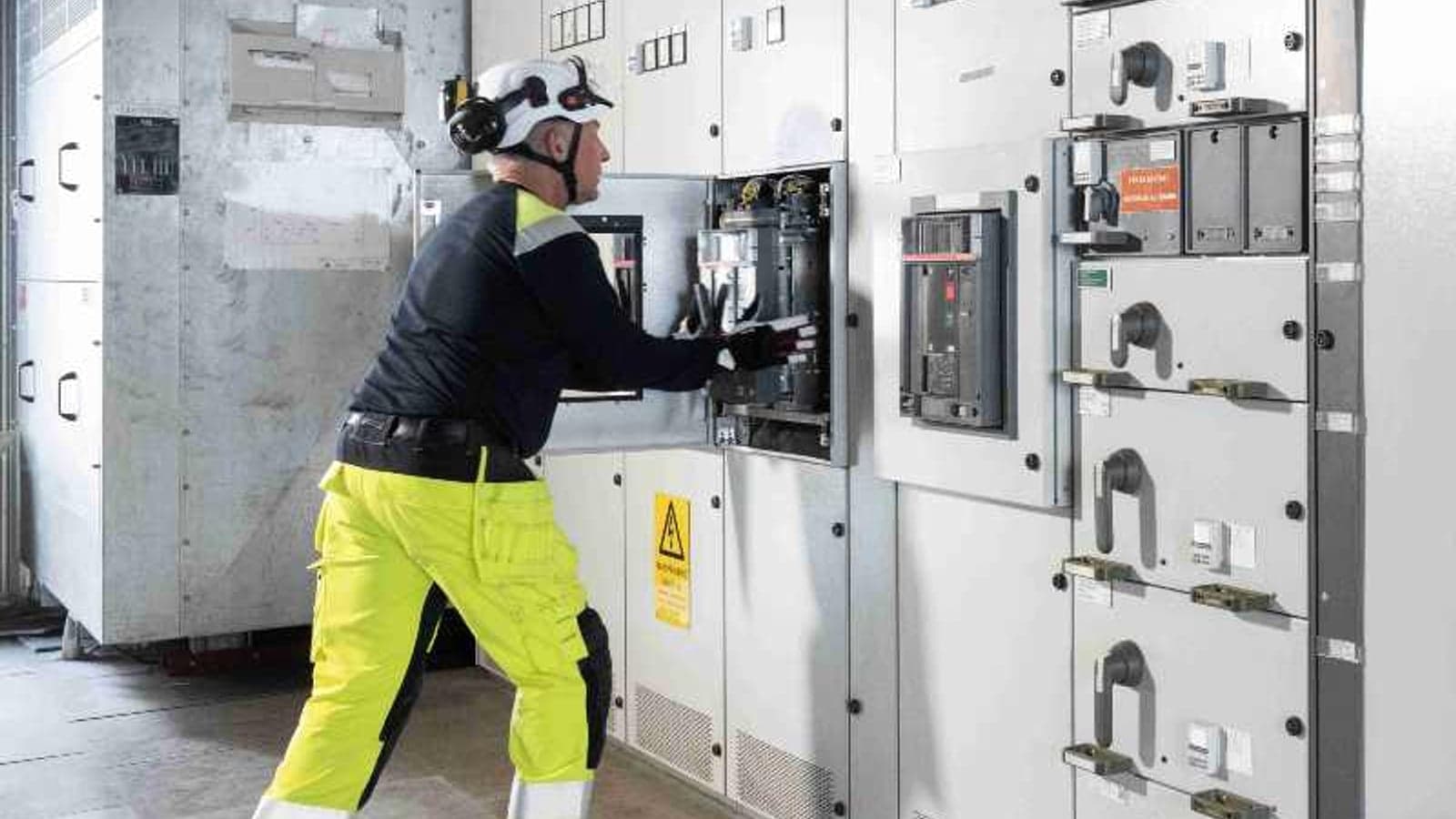
Nordværk in Aalborg, Denmark, operator of one of Europe’s major waste-to-energy plants, successfully modernised its ageing circuit breaker with minimal downtime, thanks to ABB’s innovative direct replacement solution.
Providing renewable energy to thousands of households in northern Denmark, the efficient replacement of the breakers ensured continued, safe and sustainable operations of Nordværk’s 42MW district heating plant.
Mälarenergi, an electric power and district heating provider in Västerås, Sweden, had its cogeneration plant future-proofed with a retrofit solution from ABB. The upgrade has not only reduced downtime and improved reliability, but also reduced Mälarenergi’s CO2 emissions.
With regular maintenance and monitoring of the new components, the life of the plant's switchgear can now be multiplied indefinitely without the need for replacement.
Engie, a Belgian energy supplier, has embraced the circular economy with a retrofit switchgear upgrade that also reduces total cost of ownership. Modernisation of ageing circuit breakers with the latest vacuum technology delivers a more efficient and reliable energy supply, guaranteeing safer and future-proofed energy power plants.
Can you summarise the role of digitalisation in data-driven asset management?
From the analytical power of data through to the introduction of AI and machine learning, digitalisation is becoming paramount in enabling the insights needed to make better decisions in all areas of the evolving energy landscape.
But while the associated cost advantage and flexibility might be more than welcome, taking the digital leap does come with some challenges – predominantly in embracing a new mindset, new ways of working and tackling the evolving threat of cybersecurity.
In today’s rapidly evolving energy landscape, digitalisation has emerged as a crucial tool in unlocking valuable insights and facilitating better decision-making. From harnessing the analytical power of data to leveraging artificial intelligence (AI) and machine learning, digitalisation has transformed the way we understand, manage and optimise energy systems.
While the journey towards digitalisation has been underway for some time, the recent geopolitical climate has accelerated progress, particularly in relation to renewable energy where one of the critical challenges is integrating renewable energy sources into the existing grid infrastructure.
Digitalisation plays a vital role in addressing this challenge. Advanced data analytics and AI can assess factors like weather patterns, solar irradiance and wind speed to accurately forecast renewable energy generation. Technology such as ‘digital twins’ can also forecast customer demand patterns, allowing grid operators to efficiently balance supply and demand, minimise curtailment and enhance grid stability.
By collecting and analysing vast amounts of data, companies can gain deep insights into their operations, customer behaviour and overall energy consumption patterns. Decision-makers can make evidence-based choices that maximize energy efficiency, minimise waste and reduce environmental impact.
Machine learning algorithms can also optimise energy storage and distribution systems, ensuring efficient utilisation of renewable energy sources. Through continuous learning and adaptation, AI and machine learning solutions help streamline operations, increase reliability and reduce costs.
Modern energy management systems can monitor and optimise energy consumption in buildings, factories, and transportation too. Smart sensors and Internet of Things (IoT) devices enable real-time monitoring of energy usage, facilitating proactive energy management and identifying energy-saving opportunities.
What solutions does ABB offer for digitalisation in the energy transition?
Through our digital solutions, we are driving a shift from reactive to proactive, predictive, preventative and data-driven operations and asset management. Cloud solutions and data analytics are a game changer for accurately alerting when a piece of equipment might need upgrading or when it will develop a safety fault. Using these systems, customers can monitor and evaluate the condition and reliability of their assets in real-time to mitigate risks and optimise the allocation of operational and investment budgets.
Digital solutions, such as ABB Ability™ Asset Manager, which have monitoring and diagnostic capabilities, offer companies the potential to shift to a new, predictive, proactive model of maintaining their equipment. With condition-based maintenance, the equipment itself identifies if something is outside of normal parameters so issues can be addressed before they become failures. Such an ‘intelligent’ approach not only makes financial sense, but also ensures that the lifetime of machinery is optimised, with equipment failures and production stoppages minimalised.
We enable smarter maintenance through the power of AR technology for remote assistance and servicing. This technology enables the presentation of operational information in an entirely new way, augmenting a person's view of their real environment and acting as a digital assistant.
We are accelerating the development and adoption of digital solutions through partnerships with innovative start-ups. This is the only way to tackle the energy sector’s most pressing issues and generate a widespread shift in the way industries generate, distribute and consume energy.
Winning startups can have a positive impact on the world’s energy and climate challenges, with their digital innovations commercialized on the ABB Ability Marketplace, reaching customers in over 100 countries.
As Platinum partner of Enlit Europe 2024, ABB showcased pioneering technologies and services it has developed to connect variable energy sources to the grid, transmit electricity to where and when it is needed and do so reliably, safely and efficiently.
Leaders who shared their insights on technologies and strategies available to accelerate the journey to net zero included:
- Marco Tellarini, Senior Vice President – EMEA, ABB Electrification Service
- Adrian Guggisberg, Division President, ABB Electrification Distribution Solutions
- Alberto Carini, Global Product Manager, ABB Electrification Service
- Antonio Martinez-Reina, Utilities & Renewables Segment Leader, Electrification Distribution Solutions
- Paolo Catapane, Global Product Manager, ABB Smart Power
- Antonello Antoniazzi, Corporate Executive Engineer, ABB Smart Power
Latest content
Partner content
+2
The four key integrations powering the energy industry: An exploration
Technology is changing our energy system and the power utilities that operate within it. Utilities are digitally transforming and adopting software solutions to manage core operational processes.
- Guest/partner contributor
- 08/05/2023