How to boost AI, digitalisation and competitiveness
Jonathan Spencer Jones
Posted on: 22 July 2026
EU Young Energy Ambassador Raúl Berganza Gómez talks about AI, digitalisation and competitiveness in Europe’s energy sector.

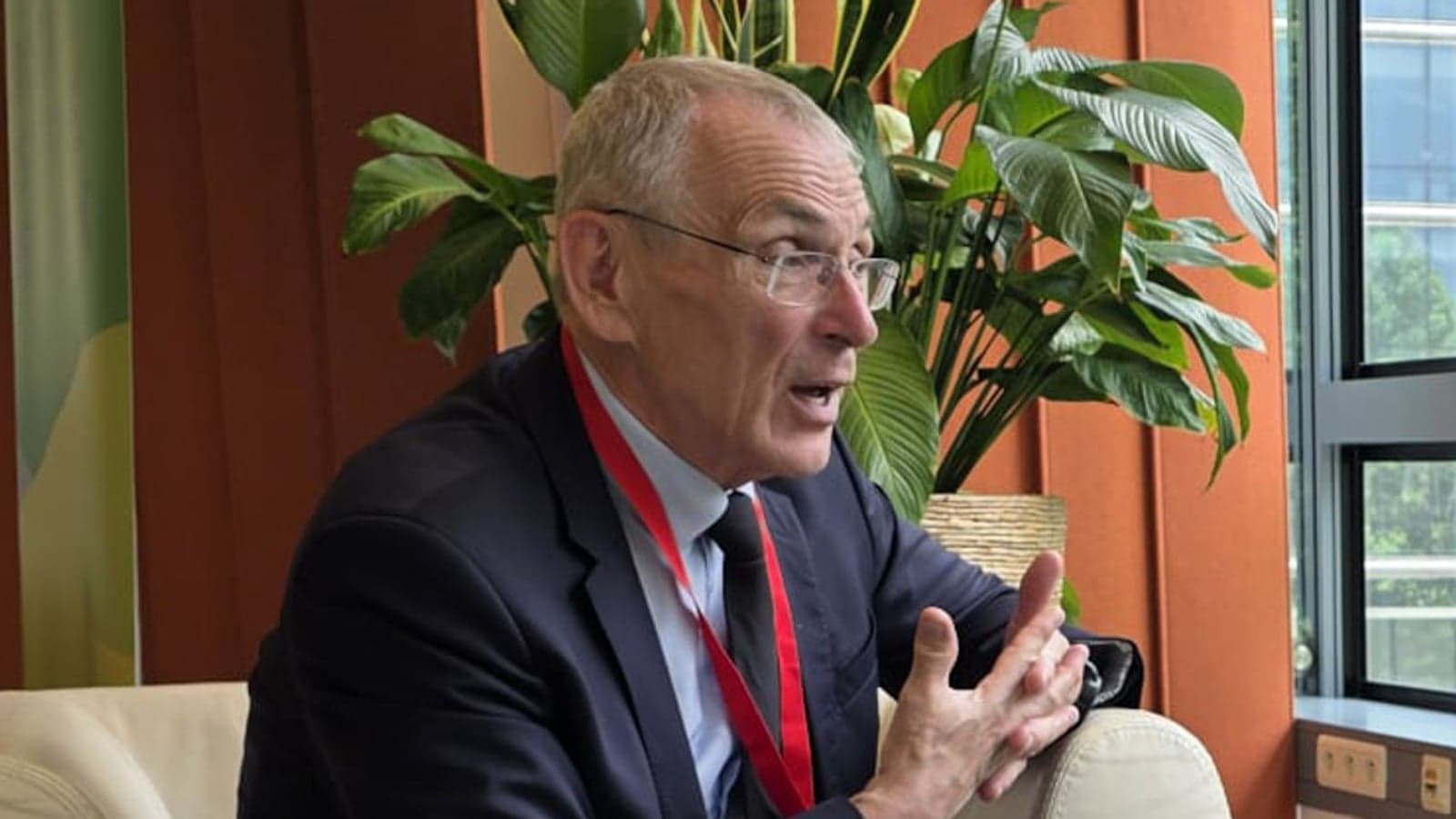
Raúl Berganza Gómez, GenAI lead at E.ON Digital Technology, has a heritage in Europe’s energy sector.
His grandparents were involved in building some of Spain’s early hydropower plants in the post-second world war years to deliver electricity to communities that were without. The prosperity that followed shaped his family and his conviction that energy transforms societies and encouraged his own entry to the sector.
But he, more interested in IT than engineering, pursued a path starting in computation and working on quantum algorithms at the Technical University of Munich. At the time AI was scaling and Gómez says he kept seeing the same underlying constraint: that compute is an energy problem given that the needed hardware is there.
That took him on to E.ON, where after working as an artificial intelligence engineer across the energy value chain, he now leads the Agentic Accelerator team exploring how AI agents can be used to accelerate the energy transition.
In parallel, he researches international data centre energy policy, identifying regulations that can accelerate clean compute growth.
“Today, a growing share of the world’s economy depends on AI. Providing our citizens with clean, affordable intelligence is not optional,” he says.
“In a world where rules alone no longer hold, preserving European values takes more than treaties and good intentions. It takes power, literally.”
Digitalisation challenges
Gómez says his determination is to unlock a comparable level of prosperity to that of those early hydropower plants via clean-powered compute – and this time for the whole of Europe.
To that end, some of his recent work has focused on foundational AI models for the grid and in particular how to make these work at the distribution level.
Commenting that the beauty in language models is that they can be trained once and then used to help in applications from writing code to making a grocery list, he says that AI grid models bring the same extrapolation capabilities to the grid.
“Train once and then predict blackouts, congestions or power flows with a single, extremely powerful AI model,” he says.
“But they’re still in early development, yet I believe they’ll have a key role in stabilising the grid in almost real time.”
He adds that on the more pragmatic side, his team at E.ON is exploring domains where agents can already add tangible value.
“Across different industries, we’ve seen agents deliver productivity gains in customer support, software development and internal IT processes, and we’re seeing similar gains materialise in the energy sector. These use cases are operationally intensive, and
highly benefit from the pattern matching capabilities of AI.”
AI roadmap
The EU’s digitalisation and AI roadmap is a key document for advancing AI in Europe’s energy sector and Raúl says that first and foremost it shares a vocabulary and a mental model to bring colleagues along the grid AI journey.
“The roadmap builds on the natural lifecycle of building AI models: To train AI, you need data. To collect data, you need sensors, in this case smart meters. The roadmap makes this explicit and highlights the importance of the smart meter rollout and grid smartification as pre-requirements for AI.”
Secondly, he says, the roadmap doesn’t only address AI for energy, e.g. for the grid models described above, but also energy for AI with a template agreement to speed up data centre permitting
“Mistral, EU’s most promising frontier AI lab, has repeatedly highlighted access to large-scale computing capacity as a constraint on European AI development. Closing this compute gap is essential for EU labs to compete at the frontier.”
And last but not least, he mentions that the roadmap reminds of the need to protect the decades-long progress towards the energy transition in the face of the pressing AI race with the commitment to an EU rating scheme for data centres covering energy and water efficiency, clean energy use, waste heat reuse and flexibility.
“Although its direct impact may be harder to quantify in my work, it aligns with my core beliefs: AI should remain in service of people and the planet.”
In a world where rules alone no longer hold, preserving European values takes more than treaties and good intentions. It takes power, literally.
Powering data centres
When it comes to powering industrial loads such as data centres, Raúl says there is no single answer as different industries can have very different needs.
“In most cases, I would recommend a portfolio: a strong grid connection as the backbone, long-term contracts for competitively priced clean power, storage and demand flexibility where possible, and on-site generation for resilience or useful heat.”
He adds that renewables can provide affordable energy, but they need firming.
“Batteries are excellent for short duration balancing and backup, while gas, nuclear, hydro or geothermal can deliver firm power. Factories that need both electricity and continuous process heat may benefit from combined heat and power, which captures heat normally wasted during generation.”
Ultimately, he says, it’s about balancing cost, reliability, time-to-power and emissions.
“For data centres especially, power that is slightly more expensive but available quickly can be far more valuable than cheaper power that takes years to connect.”
Competitiveness
Underlying the drive for data centres, and a topic of concern to the European Commission in current energy policy, is competitiveness.
Gómez says that how an industrial power portfolio is built affects competitiveness in four ways: cost, reliability, speed and exposure to future risks.
“Cost is the most obvious as the same power technology can be cheap in one place and expensive in another,” he says.
“Long-term contracts can make electricity costs more predictable, while batteries and flexible operations can reduce expensive peaks. Combined heat and power can also lower a factory’s total energy bill when both the electricity and heat are useful.”
Reliability and speed are just as important, he continues.
“Batteries, backup generation and redundant grid connections may cost more, but still be far cheaper than a major disruption, while, especially relevant for data centres as computing hardware ages quickly, a more expensive solution available now may be more competitive than a cheaper connection that takes years to build.”
Finally, the power mix determines exposure to future risks.
“Gas brings fuel price and carbon risk, while clean power can offer greater price certainty and help meet future regulation and customer expectations. The right mix depends on a project’s priority: lowest cost, uninterrupted power, speed to connect, or protection from future fuel and carbon risks. There is no absolute winner.”
Competitiveness recommendations
Given the importance of competitiveness, how can this be enhanced?
Europe’s industrial competitiveness depends on whether companies can secure the power they need on workable timelines and predictable terms, says Gómez, offering three recommendations for reform.
“First, Europe should extend its proposed data centre acceleration zones to factories and other large industrial loads. Second, industrial loads that accept a flexible connection or an incremental capacity plan should be connected sooner. Third, Europe should make long-term power contracts easier to secure through an EU-backed industrial power contract.”
For example, a partial European guarantee against buyer default could help credible industrial projects sign agreements lasting 15 to 20 years without transferring the full risk to taxpayers.
“Together, these reforms would give industrial projects a clearer path from choosing a site to , securing a connection to managing long-term electricity costs,” he concludes.
The European Commission’s ‘Young energy ambassador’ programme involving 30 young people for a one-year mandate is aimed to increase the involvement of young people in the European policy-making process related to sustainable energy, boost their interest and impact in clean energy and recognise and reward their contributions to the energy transition.
Data, AI and digital tools are transforming how energy is generated, distributed and consumed. This hub tracks the technologies and strategies driving the digital transformation of the energy sector.