A sales lag is threatening EU and US clean tech targets - here's what you need to know
Yusuf Latief
Posted on: 30 August 2024
The Power Playbook discusses a sales lag and the 'reality gap' for decarbonisation projects, as outlined by McKinsey & company.
In this week’s edition of the Power Playbook, Yusuf Latief discusses an observed sales lag for key electrification tech such as EVs and heat pumps both in Europe and the US as McKinsey & Company highlight a ‘reality gap’ for decarbonisation projects in reaching final investment decision (FID).
A few days ago, McKinsey & Company released a new analysis on the progress of decarbonisation projects across a range of clean tech, including EVs and heat pumps.
The global consulting firm’s analysis aimed to answer its titular question: The energy transition: Where are we, really?
Long story short: we’re not as far as we might think.
What’s the hold up?
According to the McKinsey report, which looks into both the US and EU, decarbonisation projects have been experiencing a ‘reality gap’ – that is, the gap between expected deployment numbers and those projects that reach final investment decision (FID).
Specifically, corporate, public and private equity investors are hesitating about deploying capital for clean tech projects for three key reasons:
- Business cases often remain weak.
- Technologies are increasingly but not yet cost-competitive for consumers, given the lack of at-scale manufacturing capacity or learning rate driven by deployment.
- Several technologies have not been tested at scale and need a multiyear product, project and supply chain development, creating uncertainty about their effectiveness and efficiency.
To be precise, invested capital is behind where it needs to be to ensure deployment targets are met and, as it stands, a significant proportion of announced projects have not yet reached the FID stage at which projects are greenlit.
In other words, there is a continuing risk of cancellation or leakage for these projects.
More from Smart Energy's Power Playbook:
Inflation Reduction Act: Two years on, to whom has the clean tech money gone?
Europe’s system operators’ profits are up – let’s break it down
Electrification tech
Looking into the segments, for electrified replacements of fossil fuel tech in heating and transportation, the key issue has been a sales slump, especially when comparing with their historical growth.
Since the Paris Agreement, the adoption of both EVs and heat pump technologies has surged in both the European Union and the United States; however, particularly for EVs, this momentum has slowed at a time when momentum is needed.
Electric vehicles
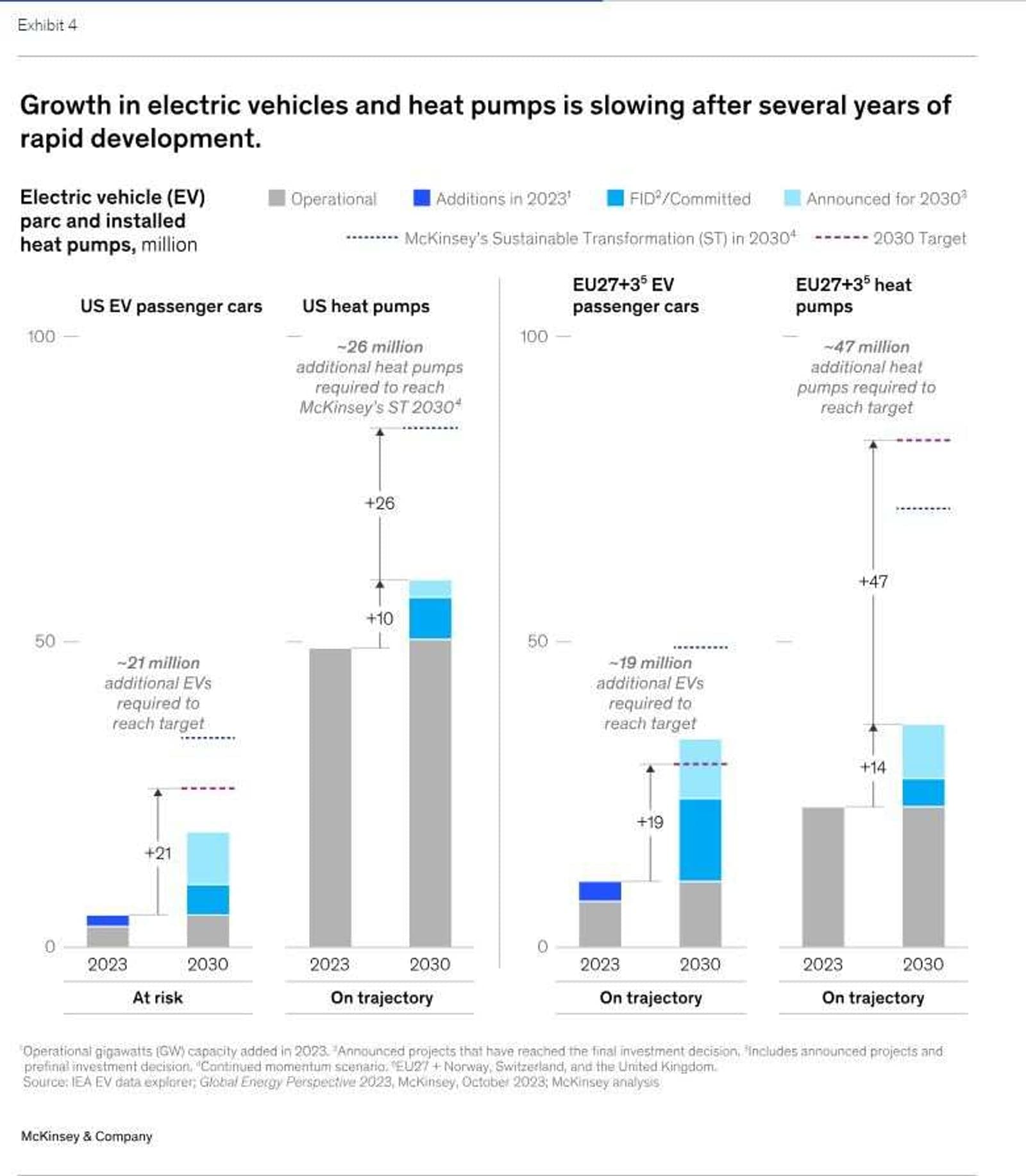
In numbers, for the EU to meet its target of 30 million EVs by 2030, it would need to add almost twice as many EVs as it currently has on the road (around 11 million) over the next five years.
A similar scale-up rate, says McKinsey, is required in the US, which is targeting 26 million EVs by 2030, but has only 5 million EVs on the road today.
Even with the ground still to be made up, based on FID commitments, the momentum in Europe is stronger than that in the US.
According to McKinsey's findings, despite optimistic forecasts for EV deployment, lackluster sales figures over the past two years suggest a continued US slowdown in EV growth to 2030.
However, worth noting here is that although this slowdown is the case in the US, a recent announcement from the country’s Department of Transportation (USDOT) suggests a potential shift.
On the same day as McKinsey’s report, USDOT announced $521 million in grants to continue the expansion of the country’s national EV charging network.
The grants will be allocated to continue building out EV charging and alternative-fuelling infrastructure across 29 states, eight Federally Recognized Tribes, and the District of Columbia, including the deployment of more than 9,200 EV charging ports.
According to McKinsey, a lack of charging infrastructure continues to be a key hindering challenge, meaning that the USDOT grant may just prove a turn around.
Commenting in a release was US Department of Energy Secretary Jennifer Granholm:
“President Biden and Vice President Harris believe in building infrastructure from the bottom up and the middle out. This investment puts public dollars in the hands of states, tribes and communities to build a more accessible national charging network.”
Heat pumps
McKinsey’s analysis paints a similarly mixed picture for heat pumps in both regions, with continued growth since 2016 due in part to policy action such as the EU Green Deal, which targets a 55% reduction in natural gas imports by 2030, and financial incentives in the US to lower the upfront costs of heat pump installation.
While European heat pump sales are still on a positive trajectory, the high cost of capital, among other factors, may impact this progress.
In the US, heat pump sales declined in 2023, and, if this trend continues, the United States could see a marked slowdown in heat pump additions before 2030.
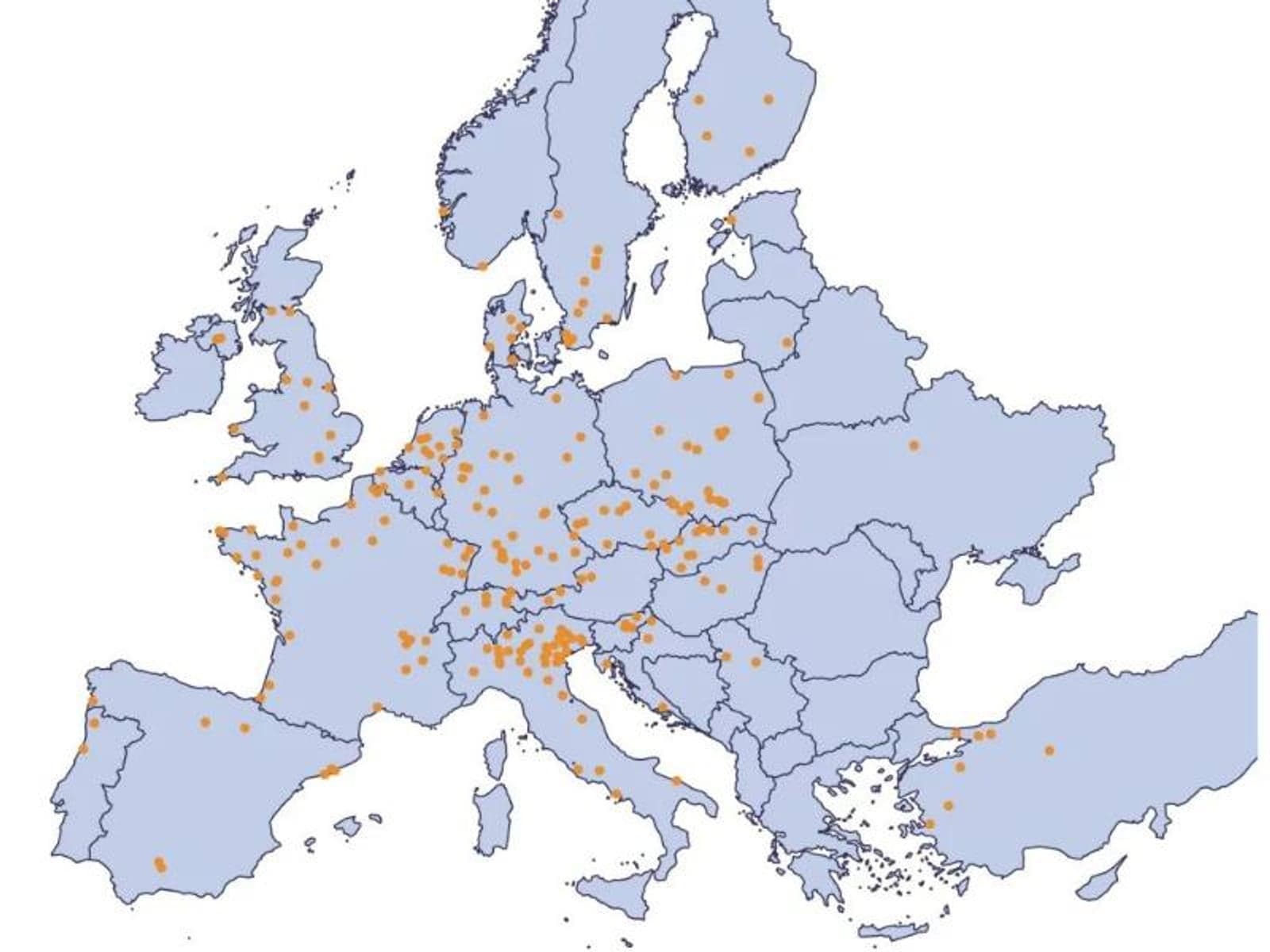
Five days before McKinsey released its findings on the decarbonisation projects research, the EU’s Heat Pump Association (EHPA) published a map and a call to action to boost competitiveness in the sector, citing a 6.5% heat pump sales contraction in 2023, posing a risk to installation target.
The EU by 2030 aims to install a total of 60 million heat pumps, which needs an average annual growth of 7% in the tech's uptake.
The EHPA argues in a report that competitiveness will be key to an upturn, enabling European manufacturers to not only meet domestic demand but also to gain a larger share of the global market.
To boost competitiveness, the heat pump sector needs the following measures, explains EHPA in its report:
- A long-term and consistent policy framework, to bring confidence to the sector, investors and consumers.
- A fairer electricity to gas price ratio, to make heat pumps a more financially worthwhile investment.
- Reduced production costs in EU.
- A centralised collection of market data to monitor installations and market trends.
- Discouragement of re-location by setting up funds to target specific industrial needs.
- Investment in skills and communication campaigns.
Compounding factors
Going back to McKinsey’s analysis, several interrelated technologies, not only heat pumps and EVs, were evaluated.
These include renewable energy sources (RES)-such as wind, solar and battery storage, and less mature technologies, such as carbon capture, utilisation and storage (CCUS), green and blue hydrogen, and sustainable fuels.
Across the board, the firm says that several compounding factors have been seen hindering investment, including:
- Grid reform challenges;
- A challenging macroeconomic environment where rising inflation and interest rates have made capital expenditure-intensive projects even more expensive;
- Fluctuating investment climates post-COVID;
- Long permitting procedures;
- Carbon pricing fluctuations;
- Raw material shortages, and
- Geopolitical uncertainty.
However, McKinsey adds a note reminding us to keep in mind the progress we have made since the Paris 2015 Agreement, with new policy initiatives and progressive corporate attitudes moving the world in the right direction.
The risk of missing targets for the US and EU, outlined by McKinsey in their decarbonisation reality gap, is still there and to meet the narrowing window of opportunity, the firm calls for companies to adjust their portfolio focuses.
In the report, McKinsey recommends companies to form industrial partnerships, engage actively as policies and subsidies become more complex, address offtakes and infrastructure needs and stay on top of developments as the market landscape only continues to change.
But what do you think? As someone with experience trying to get these types of clean tech projects to FID, with a view of the shifting energy landscape, what is your experience?
Reach out and let us know so we can feature your thoughts in our weekly Power Playbook.
Cheers,
Yusuf Latief
Cotent Producer
Smart Energy International

Follow me on Linkedin