Baltic Sea set to be major player in European clean energy
Jonathan Spencer Jones
Posted on: 25 January 2026
A new report shows the region could become a clean energy hub with the addition of up to 50GW of offshore wind by 2040.
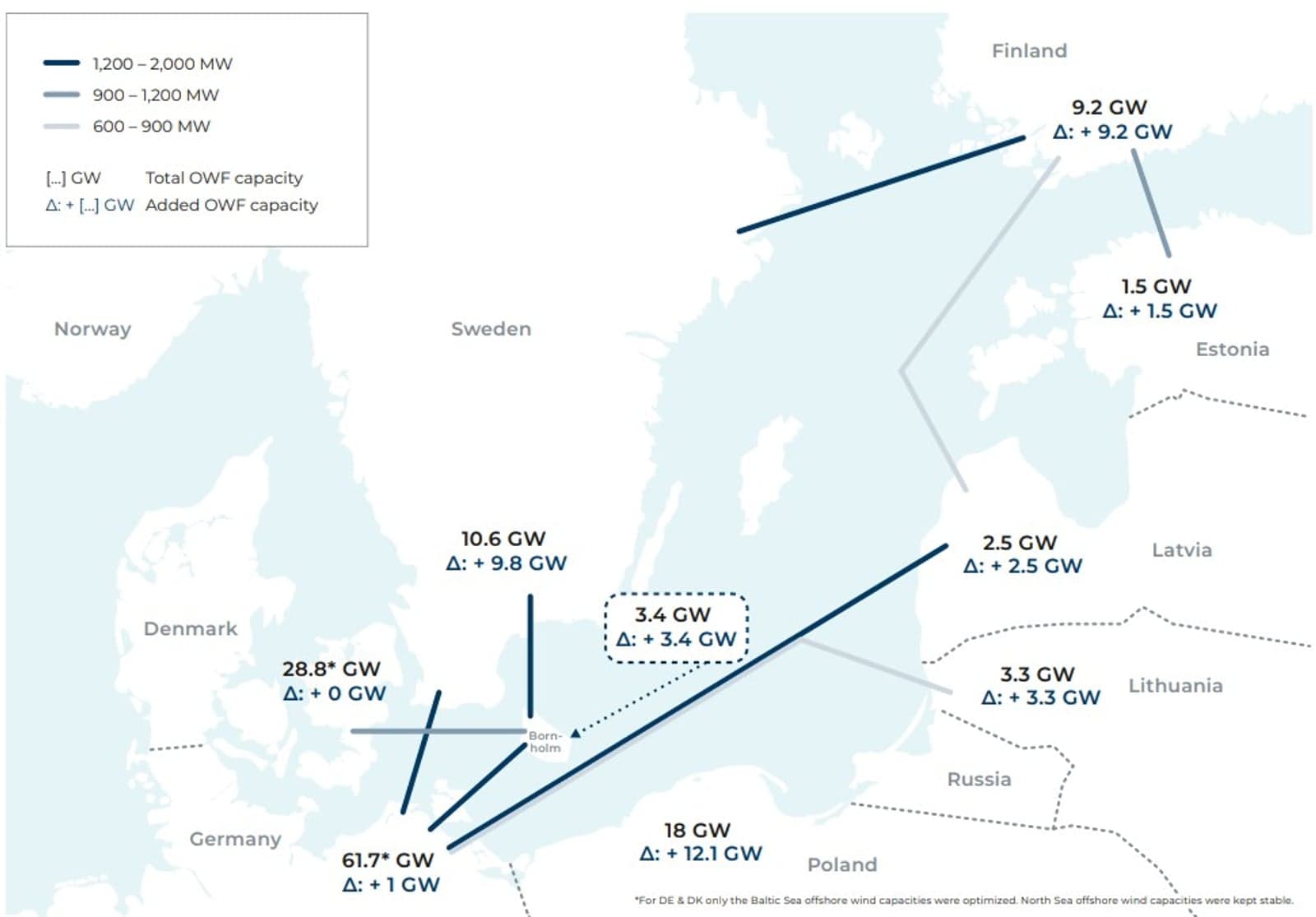
The new study from the Baltic Offshore Grid Initiative identifies new interconnections between the Baltic Sea countries and offshore wind hubs with capacities ranging from 600MW up to 2,000MW and a total capacity of approximately 13GW.
This would allow 50GW of additional offshore wind to be connected, providing high utilisation rates year-round and enabling the Baltic Sea region to become a net exporter of electricity.
The study identifies the island of Bornholm as a strategic hub linking Denmark, Germany and Sweden – and both for additional offshore wind integration and for facilitating flows between different countries without the need for additional expensive offshore infrastructure.
Also of interest
Decarbonisation slows in Europe due to less wind and hydro
Further the modelling suggests a connection to Germany, an additional Estonia-Finland link and a potential Finland-Latvia line. Other projects include a potential Sweden-Germany connection and a Finland-Sweden link.
The scenario sees significant electricity export potential in Finland. This leads to the interconnection buildout towards the south, via Sweden and the Baltics.
The interconnection between Germany and the Baltics seems to serve a dual role. Although the main purpose is the transmission of electricity from Finland and the Baltics to the rest of Europe via Germany, notable flows also are in the opposite direction, mainly in the summer when Germany has an excess of PV generation.
In actuality, all of the identified interconnectors show at least some bidirectionality in their flows, helping smooth price peaks throughout the region, the study report notes.
The study report states that the additional large scale renewable sources such as offshore wind would let the region contribute to Europe’s clean energy needs, although the amount varies depending on external conditions.
Part of the wind generation would be used to cover electricity demand directly, while a growing share is used for hydrogen production via electrolysis. This would strengthen the regional energy system by allowing flexible use of wind power and reducing reliance on global hydrogen imports.
However, the offshore wind, electricity interconnection and hydrogen infrastructure need to be developed in a coordinated manner.
The study draws on the ten year and national network development plans and marks a key step for the planning for the Baltic Sea basin.
It is based on a linear modelling approach for investment optimisation with 2040 as the time horizon as preparations would need to be imminent for a project to be completed by then.
The findings also show the advantages of regional cooperation according to the report. These include lower system costs – a reduction by an estimated €2 billion per year by 2040 – greater energy security and better integration of renewables.
It concludes that the identified infrastructure would require long lead times, thus stable frameworks, early investment decisions, continued collaboration among governments, TSOs and developers would be essential to fully capture the region’s potential.
The Baltic Offshore Grid Initiative is a consortium of eight TSOs from the Baltic Sea 50Hertz (Germany), AST (Latvia), Elering (Estonia), Energinet (Denmark), Fingrid (Finland), Litgrid (Lithuania), PSE (Poland) and Svenska kraftnät (Sweden).