Designing neutral incentive frameworks for efficient electricity distribution
Guest/partner contributor
Posted on: 17 February 2026
The integration of renewables, electric vehicles and data centres intensifies distribution network planning challenges.

The BeFlexible project, funded by the European Union’s Horizon 2020 research and innovation programme, aims to enhance prosumer participation in providing flexibility to the electricity system. To achieve this, the project focuses on four key areas: markets and regulation, services ecosystem, platforms and architecture, and customer engagement.
One regulatory aspect studied during the project is the remuneration schemes for the distribution system operators. The decarbonisation of the energy sector requires the widespread deployment of decentralised renewable energy generation and the electrification of transportation, heating and industrial processes. This transformation demands significant investment in electricity distribution networks and the integration of smart grid solutions to ensure cost-effective and efficient system operation.
The increasing penetration of distributed energy resources and digital technologies introduces both challenges and opportunities for network planning. Flexibility services – such as demand response, local flexibility markets and dynamic network management – can complement or defer traditional grid reinforcements, enabling faster and more efficient integration of new users.
Electricity distribution is a regulated natural monopoly. Thus, DSOs respond to incentives embedded in regulatory remuneration schemes. These schemes must evolve to promote optimal planning that balances capital expenditures and operational expenditures. Flexibility solutions, typically categorised as opex, often face regulatory disincentives compared to capex intensive solutions such as grid investments [1].
This paper presents an assessment of the incentives under a revenue cap scheme with a profit sharing incentive, evaluating how this remuneration affects the planning decisions of a profit maximising DSO. Through a case study, we demonstrate that this remuneration scheme promotes efficiency while mitigating the bias toward capex solutions.
BeFlexible methodology
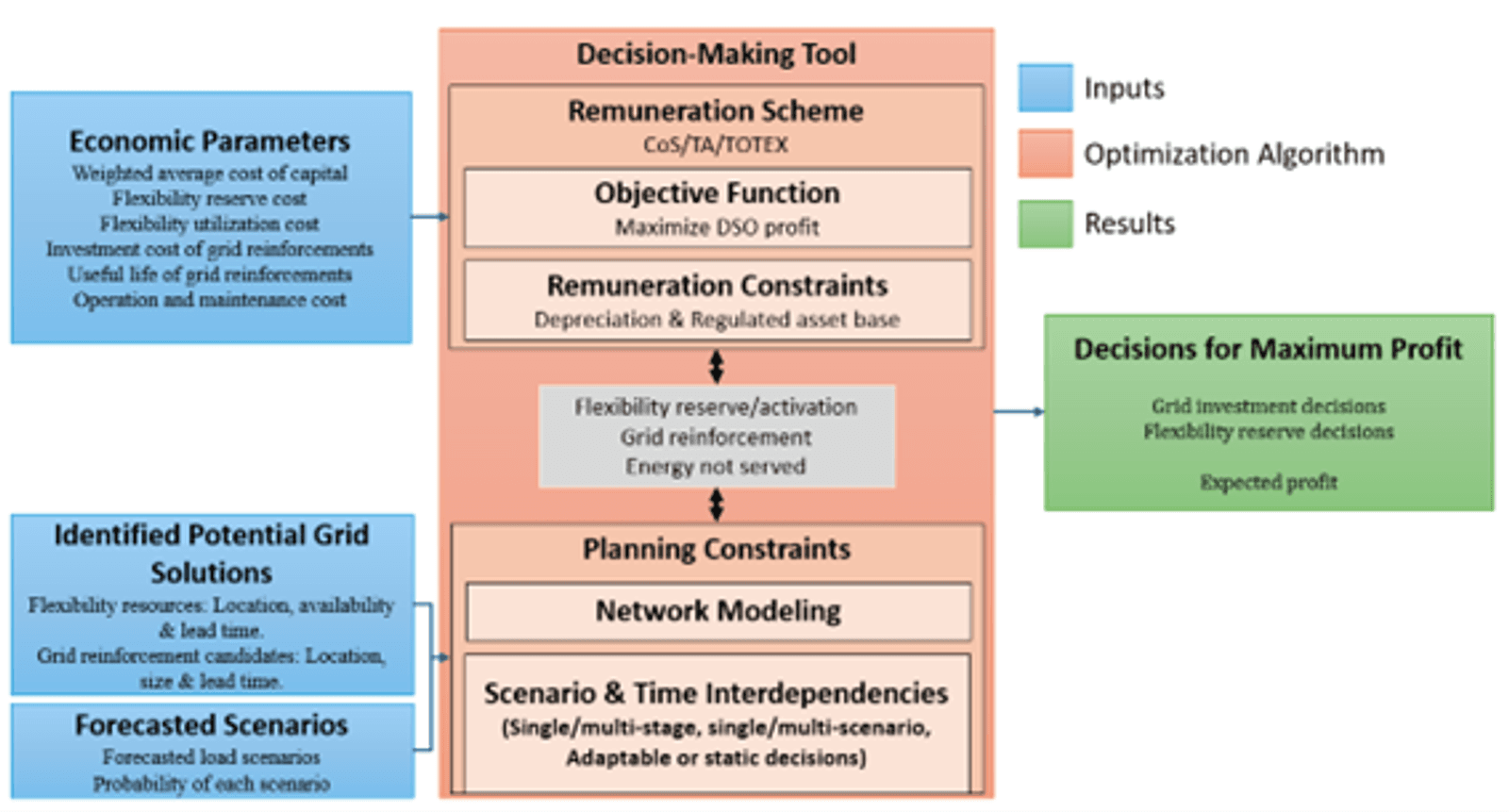
This paper presents a methodology for evaluating the network planning decisions of a profit maximising DSO under a revenue cap remuneration scheme with a profit sharing incentive. The DSO can choose between traditional grid reinforcements, e.g. new feeders or transformers, flexibility-based solutions, e.g., contracts with providers to reduce load upon request, or a combination of both.
The remuneration scheme is a key input for calculating the revenues generated by the DSO through mechanisms such as allowed return rates, depreciation rules and the treatment of capex and opex. The scheme includes incentives for quality of service and a profit sharing mechanism, which directly influence the DSO’s profit and, consequently, its investment decisions.
The model incorporates economic parameters, e.g. cost of capital, investment and flexibility costs, asset lifetimes, O&M costs, and candidate solutions, e.g. location, cost, lead time of reinforcements and flexibility resources.
Forecasted load scenarios introduce uncertainty, allowing the model to compare static versus adaptable planning strategies.
The decision making tool maximises the DSO’s profit under each scheme, accounting for how capex and opex are remunerated and how incentives affect decision making. Regulatory constraints simulate how decisions impact the regulated asset base, depreciation and revenue streams. Planning constraints reflect technical feasibility, lead times and the irreversibility of investment.
The methodology, detailed with mathematical formulations in [2], is applied to a revenue cap remuneration scheme; however, it can be applied to any other remuneration scheme. The resulting network plan includes investment timing, flexibility use, expected profits and service quality indicators, providing a comprehensive view of how regulatory design shapes DSO behaviour. The figure below summarises this methodology.
Case study
The case study analyses a congested substation with a 60MW capacity, exploring two investment options:
- Building a new feeder to offload up to 20MW at a cost of €432,000 with a 3-year lead time and 40-year lifespan.
- Contracting up to 4MW/year of flexibility, with reservation and activation costs of €33.35/MWh and €200.68/MWh respectively and a 1-year lead time, based on [3].
The regulator sets a 5.58% allowed rate of return, equal to the DSO’s cost of capital, and the value of lost load is €4,500/MWh.
Four long-term peak load scenarios, adapted from National Grid’s Future Energy Scenarios 2023, serve as the basis for this analysis. To capture short-term uncertainty, each scenario is expanded into 40 Monte Carlo simulations, resulting in a total of 160 scenarios.
The case study evaluates the DSO’s planning decisions over a 10-year horizon under a revenue cap remuneration scheme with a 50% profit-sharing incentive. The results in Table 1 show that the network plan under the revenue cap scheme aligns with the minimum system cost plan, delaying investment to year 3, and with a similar flexibility use (75MWh expected activation of flexibility).
This shows that well designed incentive structures can guide DSOs toward cost efficient planning decisions.
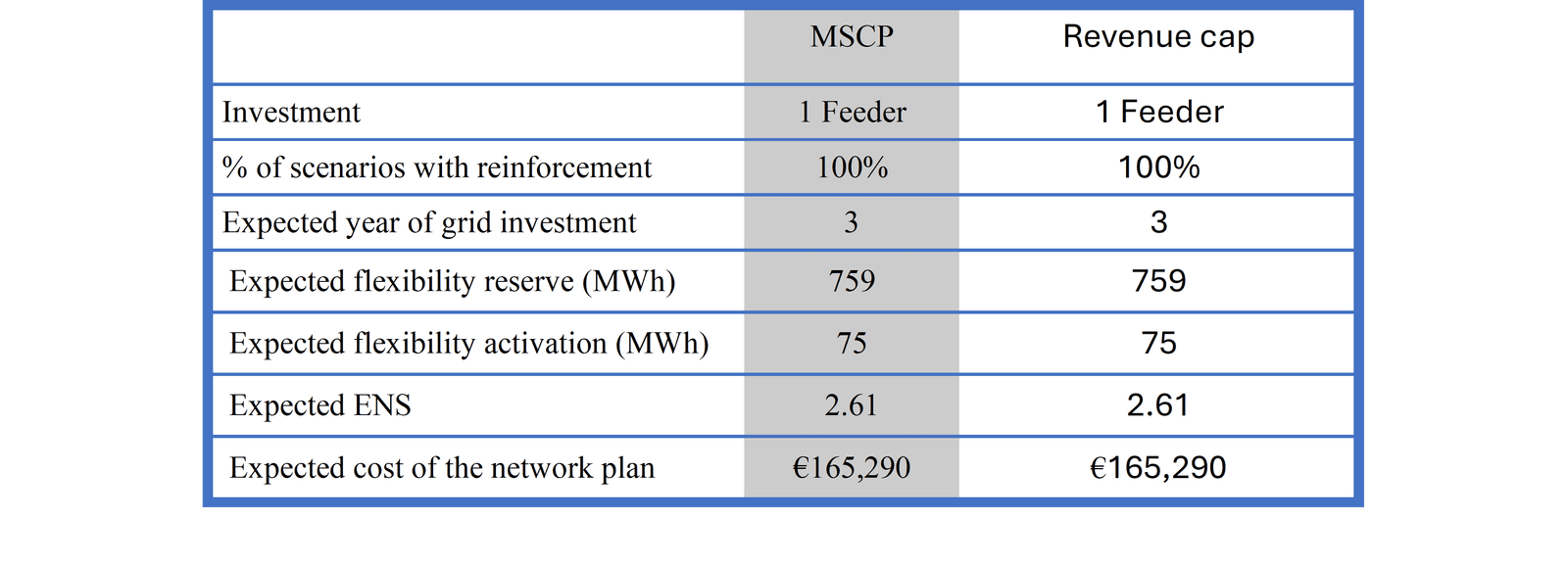
These results constitute a preliminary analysis. A more detailed discussion, including a comparison of different remuneration schemes, i.e. cost-of-service and totex, sensitivity analysis and consideration of the capex advantage, i.e. a regulated rate of return higher than DSO's cost of capital, is available in reference 2.
Conclusion
This study assessed the planning investment decisions of a profit maximising DSO under a revenue cap remuneration scheme. These preliminary findings suggest that revenue cap schemes may incentivise cost efficient planning solutions by combining grid investment and flexibility solutions, mitigating the capex bias present in traditional regulatory frameworks.
A more in-depth analysis performed in [2] confirmed these initial results, suggesting revenue cap as the preferred regulatory approach rather than cost-of-service and totex approaches.
References
1. CEER, 2025. Paper on incentives in regulatory frameworks with a focus on opex/capex neutrality.
2. M. A. Ruiz, T. Gómez, y J. P. Chaves-Avila, 2025. Promoting efficiency with neutral operational/capital incentives under large uncertainty: A comparison of electricity distribution remuneration schemes, IIT Work. Paper, under review in the International Journal of Electrical Power & Energy Systems.
3. Aurora energy research, 2021. Local Flexibility Markets Analysis.
About the authors
Miguel Ángel Ruiz Hernández is a PhD researcher at the Instituto de Investigación Tecnológica (IIT), Universidad Pontificia Comillas. He holds a Master’s in Engineering from the University of Puerto Rico and has experience in the healthcare and banking industries. He specialises in optimisation techniques, clustering and electricity distribution regulation.
José Pablo Chaves Ávila is Associate Director of the Instituto de Investigación Tecnológica (IIT) at Universidad Pontificia Comillas. He holds a PhD in energy economics and specialises in electricity markets, smart grids and regulation. He has published over 80 works and collaborates with international institutions, regulatory bodies and the European Commission.
Tomás Gómez San Román is Professor of Electrical Engineering at Universidad Pontificia Comillas. He holds a PhD from Universidad Politécnica de Madrid and has led over 80 power system research projects. His expertise includes distribution planning, regulation and service quality. He is an IEEE Senior Member with over 100 publications.
Related tags
Latest content
+6
RECreation: A digital platform to manage energy communities with support for flexibility markets
In the context of the BeFlexible project, the RECreation renewable energy communities management digital platform has been enhanced to participate in local flexibility markets.
- Guest/partner contributor
- 18/09/2025
+4
BeFlexible: Empowering energy flexibility through DERMS integration
The BeFlexible project demonstrates scalable, interoperable solutions for grid congestion management, facilitating the integration of renewable energy and advancing digital transformation for a decarbonised future.
- Guest/partner contributor
- 19/08/2025
+3
EU Energy Projects Podcast: How the 2Cool2Waste cluster is turning waste heat into an opportunity
In this episode of the EU Energy Projects Podcast, I had the pleasure of welcoming Mohaddeseh Maktabifard and José Luis Corrales Ciganda, both representing the inspiring 2Cool2Waste cluster; an initiative uniting EU-funded projects that transform waste heat from an overlooked by-product into a practical, clean-energy resource.
- Areti Ntaradimou
- 03/12/2025