Home
/
RECreation: A digital platform to manage energy communities with support for flexibility markets
RECreation: A digital platform to manage energy communities with support for flexibility markets
Guest/partner contributor
Posted on: 18 September 2025
In the context of the BeFlexible project, the RECreation renewable energy communities management digital platform has been enhanced to participate in local flexibility markets.

In the context of the BeFlexible project, the RECreation renewable energy communities management digital platform has been enhanced to participate in local flexibility markets.
With the decentralisation and digitalisation of the energy system, renewable energy communities (RECs) are emerging as a powerful driver to engage final customers in their energy activities, becoming market participants and potential providers of flexibility to improve power system operation.
During the last years, INESC TEC has developed RECreation, a digital platform for the planning and operation of collective self-consumption structures and RECs [1, 2].
RECreation architecture
RECreation integrates the tools and energy services needed to plan and operate RECs in two modes: basic, i.e. energy sharing, and advanced, i.e. management of distributed energy resources (DERs) and energy sharing.
In the BeFlexible project, the advanced running mode was enhanced with the support to participate in local flexibility markets by building the corresponding flexibility bids.
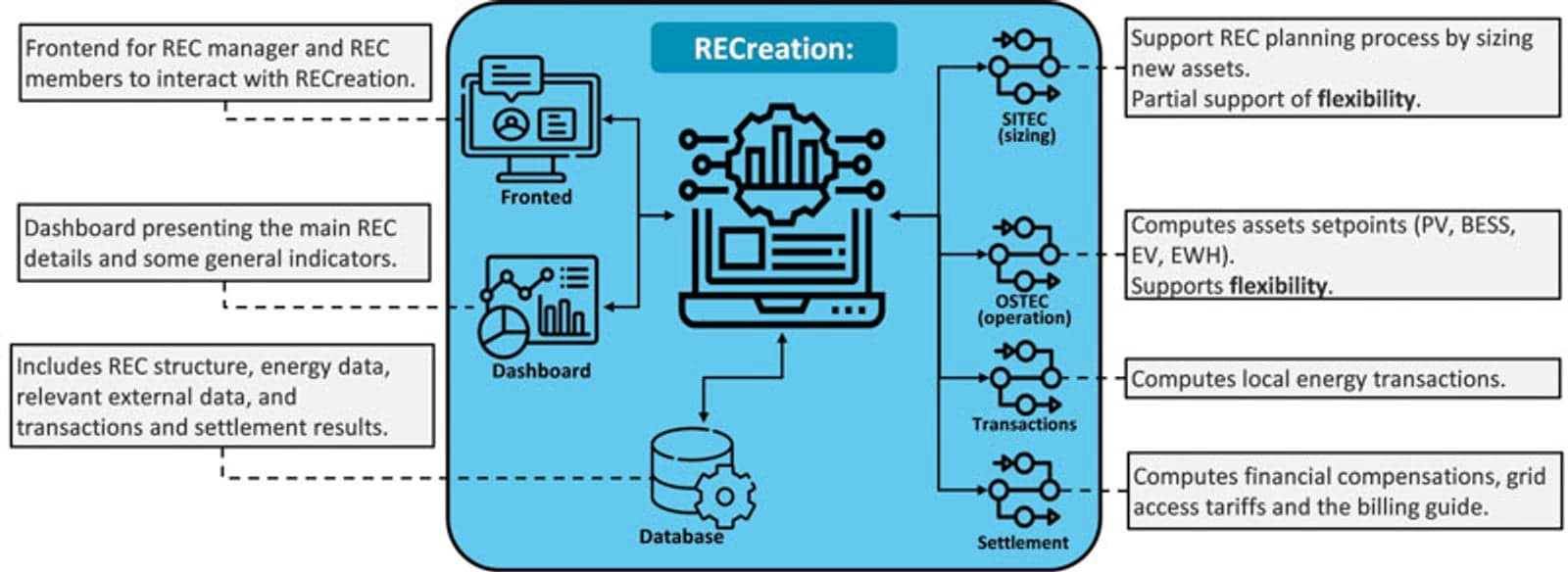
The main modules of RECreation are shown in Figure 1 and include:
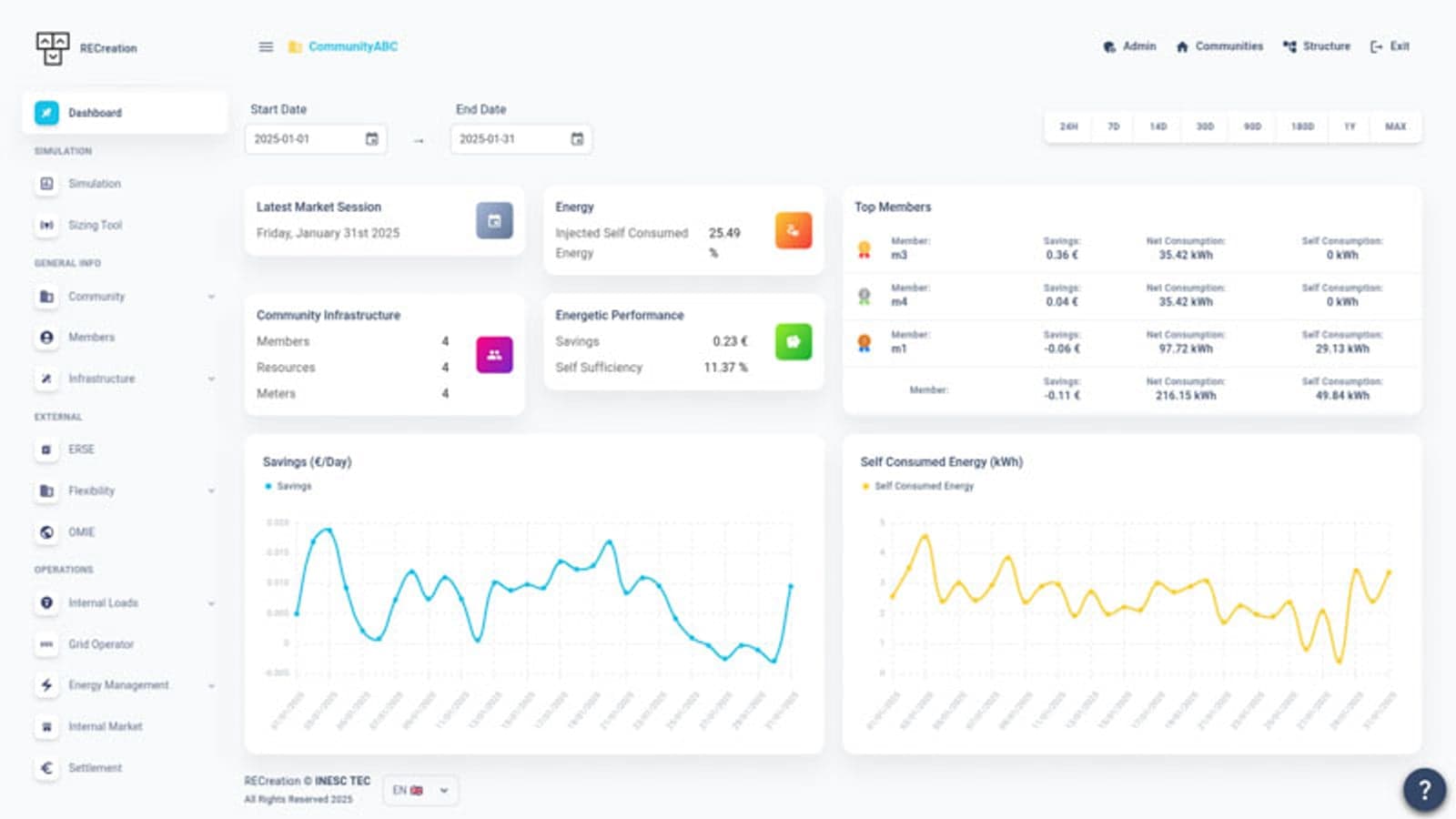
• A frontend the REC manager uses to configure the REC structure and main parameters, and a dashboard (Figure 2) with basic aggregated energy and economic indicators that help the REC manager and REC members to monitor the REC operation.
• A database that supports the REC structural data, and the energy and economic data that result from its operation.
• A transactions module that computes the local energy transactions that are used for the settlement of the REC energy sharing among its members.
• A settlement module that computes the financial compensations from the local transactions, the grid access tariffs due to the energy shared and generates a billing guide to be used by an external billing system to invoice the REC members.
• An energy management system (EMS) named OSTEC that schedules the flexible DERs to minimise the REC costs (pre-delivery optimisation), and the baseline (optimal schedule without flexibility) and the flexibility bidding curves according to the flexibility needs when the support to local flexibility markets is activated [3].
• Finally, the sizing module (SITEC) supports the planning process by optimally sizing new DERs for the REC, with partial support to sizing with flexibility due to the algorithmic complexity this process entails.
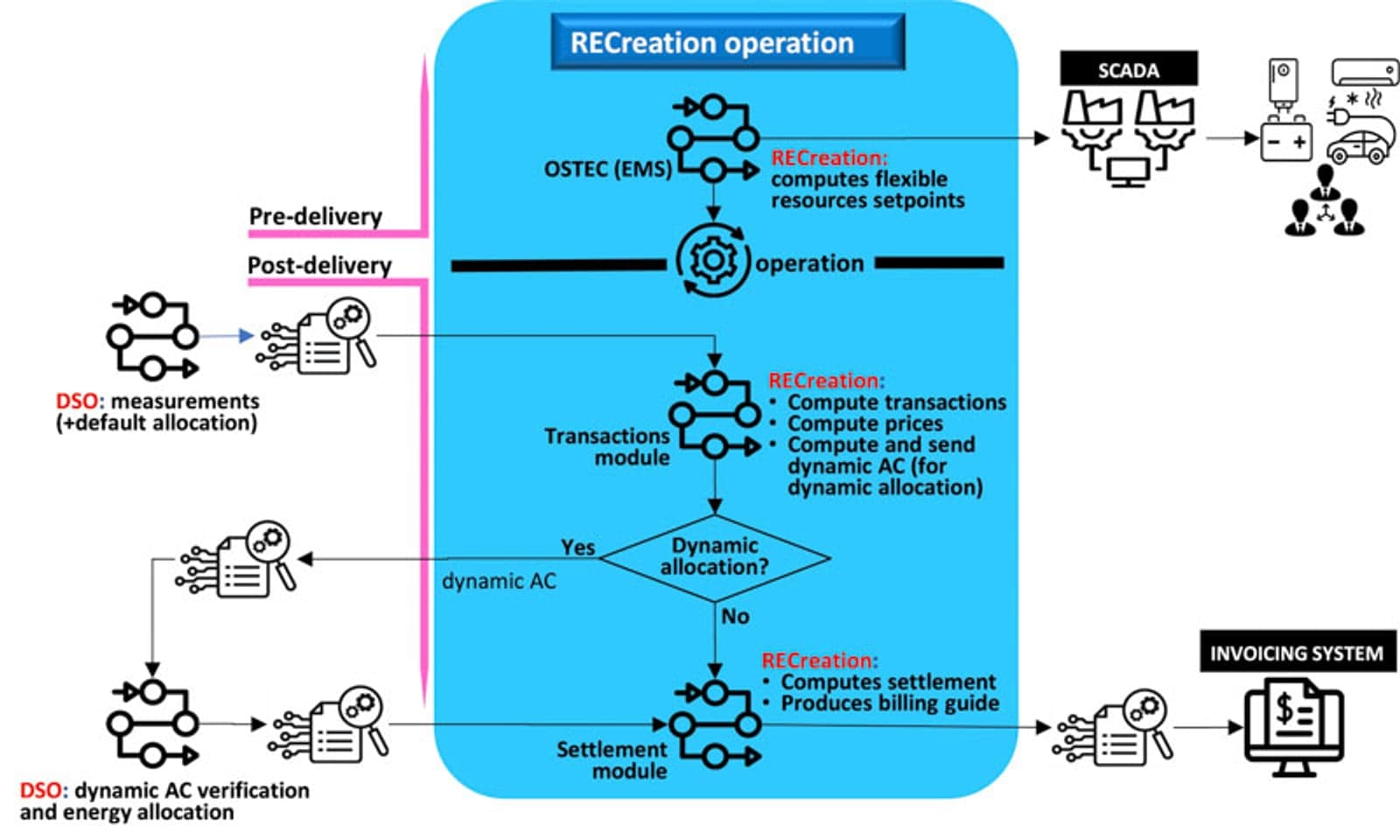
RECreation operation is depicted in Figure 3. Before delivery, i.e. the pre-delivery phase, flexible DERs can be scheduled according to the business model selected for the REC. After delivery, i.e. the post-delivery phase, local transactions and settlement take place.
RECreation supports several allocation mechanisms that can be explained by the allocation coefficients used [4], including:
• Fixed allocation coefficients, implemented in Portugal, Spain or France, among others, and defined at pre-delivery time.
• Proportional-to-consumption allocation coefficients, implemented in Portugal or France, among others, computed post-delivery by the DSO when the verified smart meter measurements become available.
• Dynamic allocation coefficients, implemented in Portugal, Spain or France, among others, where the REC decides the energy allocations among the DSO smart meters, for example based a local post-delivery pool market built with the energy measurements and the opportunity costs of the REC members [5].
RECreation support to participate in flexibility markets
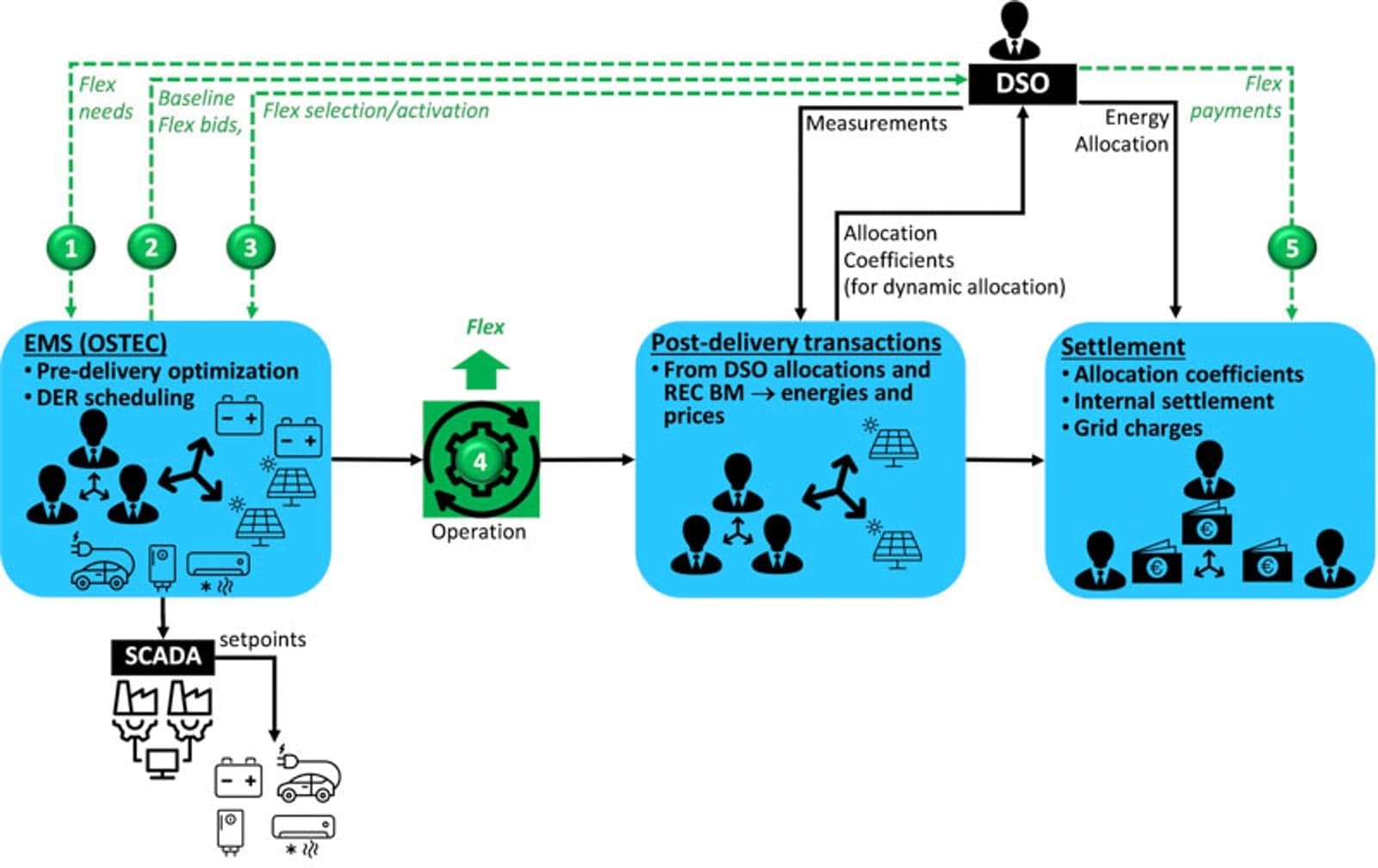
When RECreation operates with flexibility provision, the EMS has a central role to compute, at pre-delivery time, the baseline, the flexibility bids and the dispatch of the flexible DERs to provide the flexibility finally committed and activated by the flexibility requesting parties, such as a DSO or TSO.
The end-to-end process of flexibility provision using the RECreation platform is depicted in Figure 4:
• Under this framework, the REC can behave directly as an aggregator of its members' DERs, operating them in a centralised manner. From the flexibility needs published by the flexibility requesting party, the RECreation EMS follows a two-step process: 1. An initial optimisation is computed to determine the REC baseline, defined as its optimal behaviour when no flexibility is provided, and 2. Additional optimisations allow to compute the flexibility bidding curves by iterating on the expected flexibility price. Both baseline and flexibility bids are submitted to the local flexibility market.
• Once the local flexibility market is cleared, the selected flexibility is communicated for activation.
• RECreation’s EMS computes the final setpoints of the flexible DERs to ensure the optimal delivery of the finally selected and activated flexibility.
• Following flexibility delivery, the local energy transactions must be computed to reflect the final energy allocation and the revenues from the flexibility provided and proceed to the correspondent financial compensations.
RECreation integration with the GDBN and SAP ecosystem
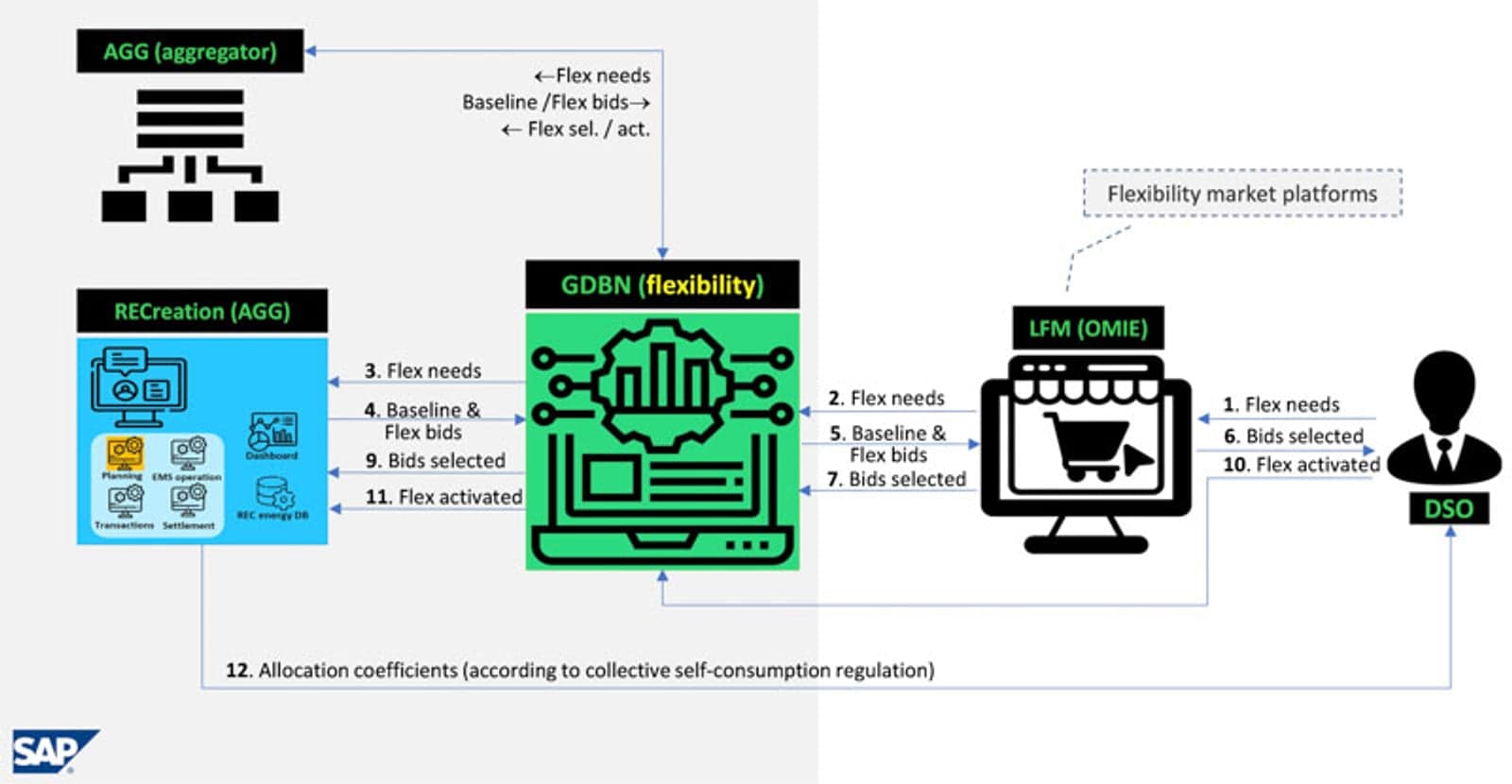
To smooth the participation in local flexibility markets, the Grid Data and Business Network (GDBN) digital platform, also developed by INESC TEC, enables the participation of the main stakeholder along the flexibility-centric value chain according to their behavioural profile, streamlining the technical integration processes and setting contractual agreements required for flexibility provision.
Among other functionalities, and as shown in Figure 5, the GDBN can integrate third party services and digital platforms, including existing commercial flexibility market platforms or aggregator platforms to aggregate DERs and participate in local flexibility markets. In this way, aggregators only need to interact with the GDBN independently on the local flexibility market platform they want to operate, as it is the GDBN that makes the interoperable link with the existing local flexibility market platforms.
In the BeFlexible project, the OMIE local flexibility market platform has been integrated.
Main achievements and conclusions
The BeFlexible project has allowed to exploit the potential of RECs for flexibility provision through the integration of RECreation into the flexibility-centric value chain, enabled by the GDBN platform. This integration includes the development of advanced procedures within RECreation’s EMS to generate flexibility bids and submit them seamlessly to local flexibility markets via the GDBN, which acts as an interoperable gateway.
Key improvements involved adapting RECreation’s database and workflows to manage flexibility related data and optimising REC operation by computing the optimal setpoints for flexible DERs in response to flexibility activation signals. In addition, RECreation’s integration with the GDBN and with robust ecosystems like SAP strengthens scalability, operational efficiency, and interoperability, improving its alignment with industry standards and readiness for widespread adoption.
To learn more about BeFlexible and how it’s shaping the future of energy flexibility, visit our website and explore the full project details.
References
1. T. Tavares et al., ‘Operation and simulation of a renewable energy community based on a local post-delivery pool market’, in 2023 19th International Conference on the European Energy Market (EEM), 2023, pp. 1–6. doi: 10.1109/EEM58374.2023.10161761.
2. L. Rodrigues, F. Coelho, J. Mello, and J. Villar, ‘Digital platforms to support the flexibility value chain, run flexibility markets, and manage energy communities’, Curr. Sustain. Energy Rep., vol. 12, no. 1, p. 15, May 2025, doi: 10.1007/s40518-025-00264-x.
3. L. Rodrigues, J. Mello, K. Ganesan, R. Silva, and J. Villar, ‘Building Flexibility Bidding Curves for Energy Communities’, in 2024 20th International Conference on the European Energy Market (EEM), June 2024, pp. 1–6. doi: 10.1109/EEM60825.2024.10608874.
4. J. Mello, J. Villar, R. J. Bessa, A. R. Antunes, and M. M. Sequeira, ‘Decarbonized and Inclusive Energy: A Two-Fold Strategy for Renewable Energy Communities’, IEEE Power Energy Mag., vol. 22, no. 4, pp. 49–63, 2024, doi: 10.1109/MPE.2024.3396442.
5. J. Mello and J. Villar, ‘Integrating flexibility and energy local markets with wholesale balancing responsibilities in the context of renewable energy communities', presented at the ICEE – Energy & Environment: Bringing together Economics and Engineering, June 2022. https://icee2022.fep.up.pt/
About the authors
José Villar is senior researcher at INESC TEC, leading the Electricity Markets area at its Centre for Power and Energy Systems. With a PhD from ICAI–Comillas, he has over 25 years of experience in power systems and market modelling. His work focuses on electricity markets, regulation and strategic planning for the energy transition.
Luís Rodrigues is a researcher at INESC TEC, working in the Centre for Power and Energy Systems. With a master’s degree from Porto Engineering Faculty, his work focuses on electricity markets and energy communities, with contributions to several national and European projects.
Fábio Coello is senior researcher at the HASLab, one of INESC TEC's research units. He holds a PhD in Computer Science, in the context of the MAP-i Doctoral Programme, from the universities of Minho, Aveiro and Porto. His research focuses on cloud HTAP databases, cloud computing, distributed systems, P2P/ledger-based systems and benchmarking.
Related tags
Latest content
+4
BeFlexible: Empowering energy flexibility through DERMS integration
The BeFlexible project demonstrates scalable, interoperable solutions for grid congestion management, facilitating the integration of renewable energy and advancing digital transformation for a decarbonised future.
- Guest/partner contributor
- 19/08/2025