Distributed energy storage innovations, challenges and opportunities in Europe
Guest/partner contributor
Posted on: 30 January 2026
Distributed energy storage represents a cornerstone for Europe’s energy transition, enabling flexible management of variable renewable energy.

The European Union’s commitment to decarbonisation and energy security is accelerating solutions that balance production and consumption. Distributed energy storage, i.e. storage at smaller scales and nearer to where energy is produced and used such as residential areas, industrial facilities and microgrids, adds grid flexibility, increases resilience to shocks and empowers consumers and communities to participate in energy markets.
Yet distributed energy storage adoption is slowed by high upfront costs and limited financing; integration complexity and the need for advanced control systems; fragmented, sometimes inconsistent regulation; and interoperability gaps that complicate connecting heterogeneous assets.
These challenges are compounded by an awareness and information deficit that obscures viable business cases, particularly for smaller actors.
In response, EU-funded projects such as TRINEFLEX are developing digital platforms, business models and advanced tools to catalyse collaboration and investment, accelerating distributed energy storage integration across Europe’s evolving energy landscape.
TRINEFLEX methodology
The study of distributed energy storage within TRINEFLEX uses a multidisciplinary, modular approach combining digital innovation, process governance and market intelligence.
Key methodologies include:
- Energy actors observatory and community empowerment: An online toolkit surfacing Europe-wide signals for distributed energy storage adoption. It monitors and integrates trends in storage-related news, initiatives, research and communities, offering data-driven insights for policymakers, researchers and investors.
- Recommendation systems: A matchmaking platform using machine learning to suggest collaborations and services among different energy actors, enhancing user engagement in distributed energy storage ecosystems.
- Business process management: Orchestration of actor negotiation and matchmaking end-to-end, including agreement finalisation for distributed energy storage partnerships, ensuring smooth operations.
- Distributed ledger technologies: Blockchain-inspired proofing to ensure transparency, trust and decentralisation in distributed energy storage schemes such as smart grids and virtual power plants.
- Data lakes and open APIs: A dedicated data management layer enabling large-scale analytics and interoperability for seamless integration and uptake by third-parties.
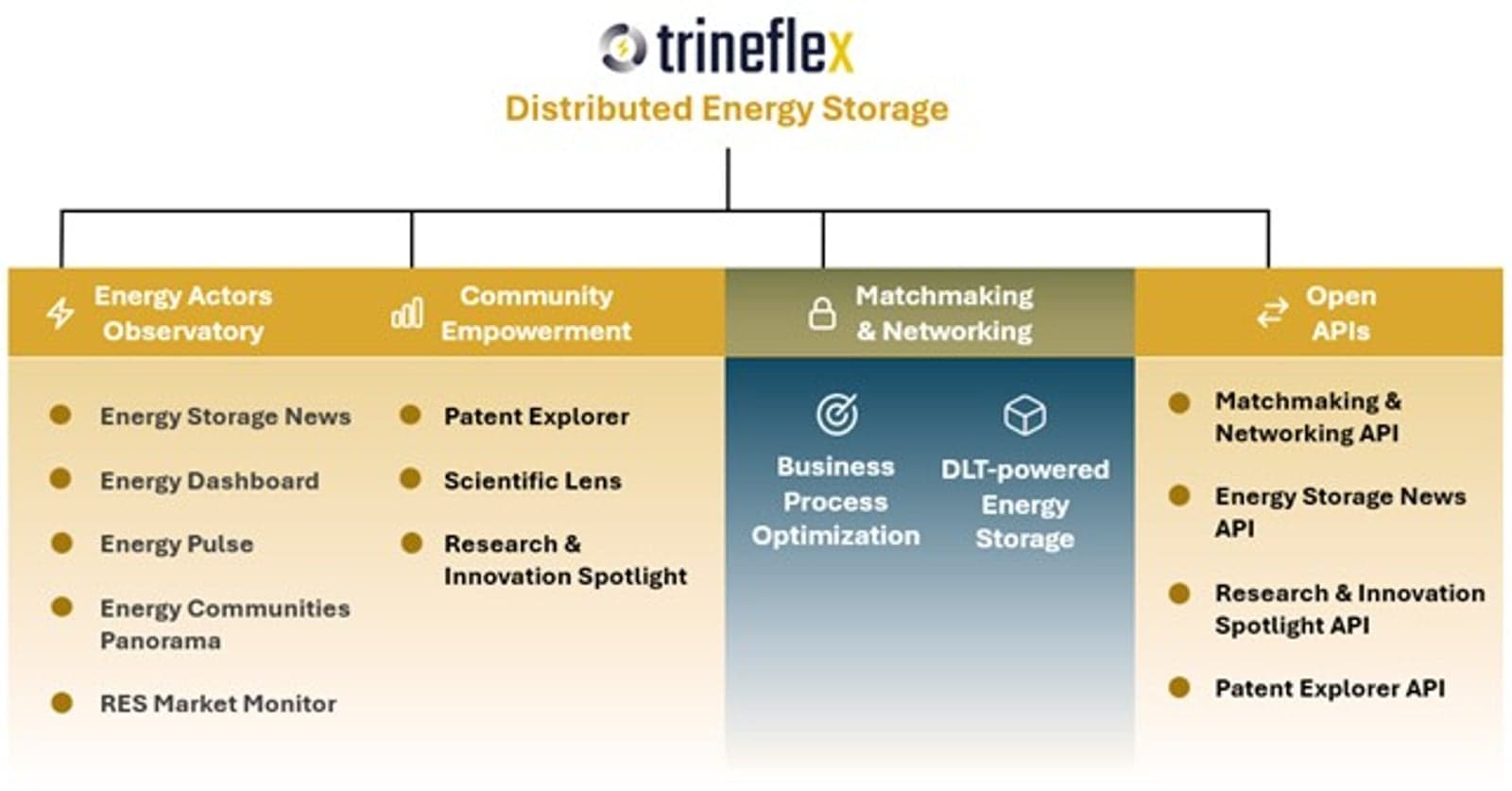
This integrated methodology makes distributed energy storage partnerships technically viable and scalable across European markets, spanning industrial sites, energy communities and municipal microgrids, while remaining storage technology agnostic and adaptable to regulatory frameworks and deployment scales. It positions TRINEFLEX to accelerate distributed energy storage uptake across diverse contexts and to support evidence-based planning, procurement and operations.
Market overview
Global and European distributed energy storage markets are expanding rapidly, driven by the penetration of renewable energy sources, the deployment of electric vehicles and heightened resilience need in industry and local grids brought into the spotlight by recent energy-price shocks. These forces are pushing storage closer to loads and generation, especially in regional energy ecosystems and energy-intensive industries targeted by TRINEFLEX.
Still, adoption is constrained by high upfront investment, integration with existing infrastructure and the need for interoperable, multi-actor arrangements. These barriers call for new collaboration models and better market intelligence.
Business models
A promising trend is the emergence of service-based and multi-actor storage models that reduce capex and coordination risk. Beyond classic behind-the-meter ownership, TRINEFLEX DES supports:
- Energy storage-as-a-service: Long-term service contracts deliver peak shaving, resiliency and market participation without asset ownership. Providers finance, operate and optimise the system while clients pay as-a-service, directly addressing upfront-cost and integration barriers for industrial sites.
- Cooperative or group investment schemes: The matchmaking platform assembles consumers, producers and storage providers into targeted partnerships (e.g. shared storage pools for industrial parks or energy communities), enabling scale benefits and diversified value streams.
- Industrial symbiosis and local flex markets: Cross-sector collaborations unlock revenues from flexibility, congestion management and self-consumption optimisation, with process orchestration improving distributed energy resource allocation and participation in local markets.
Intelligent matchmaking and networking in TRINEFLEX operationalises these models by profiling actors (buyers/sellers of energy and storage), generating partnership suggestions and supporting negotiation. Its feedback loop adapts recommendations as users interact, building durable collaboration networks. Open REST APIs then expose results to third party energy managements systems and market platforms, easing interoperability and uptake.
Digital innovations
- Energy actors observatory: Aggregates news, policy, market and technology signals so stakeholders can spot distributed energy storage opportunities and risks early.
- Energy communities panorama: Maps active local energy initiatives to identify partners and locations where shared or community distributed energy storage can scale.
- Energy pulse (social analytics): Tracks emerging conversations and sentiment to anticipate distributed energy storage trends and inform outreach and engagement.
- Energy dashboard: Harmonises statistical indicators (storage capacity, renewables, industrial demand) to support siting, sizing and timing of distributed energy storage investments.
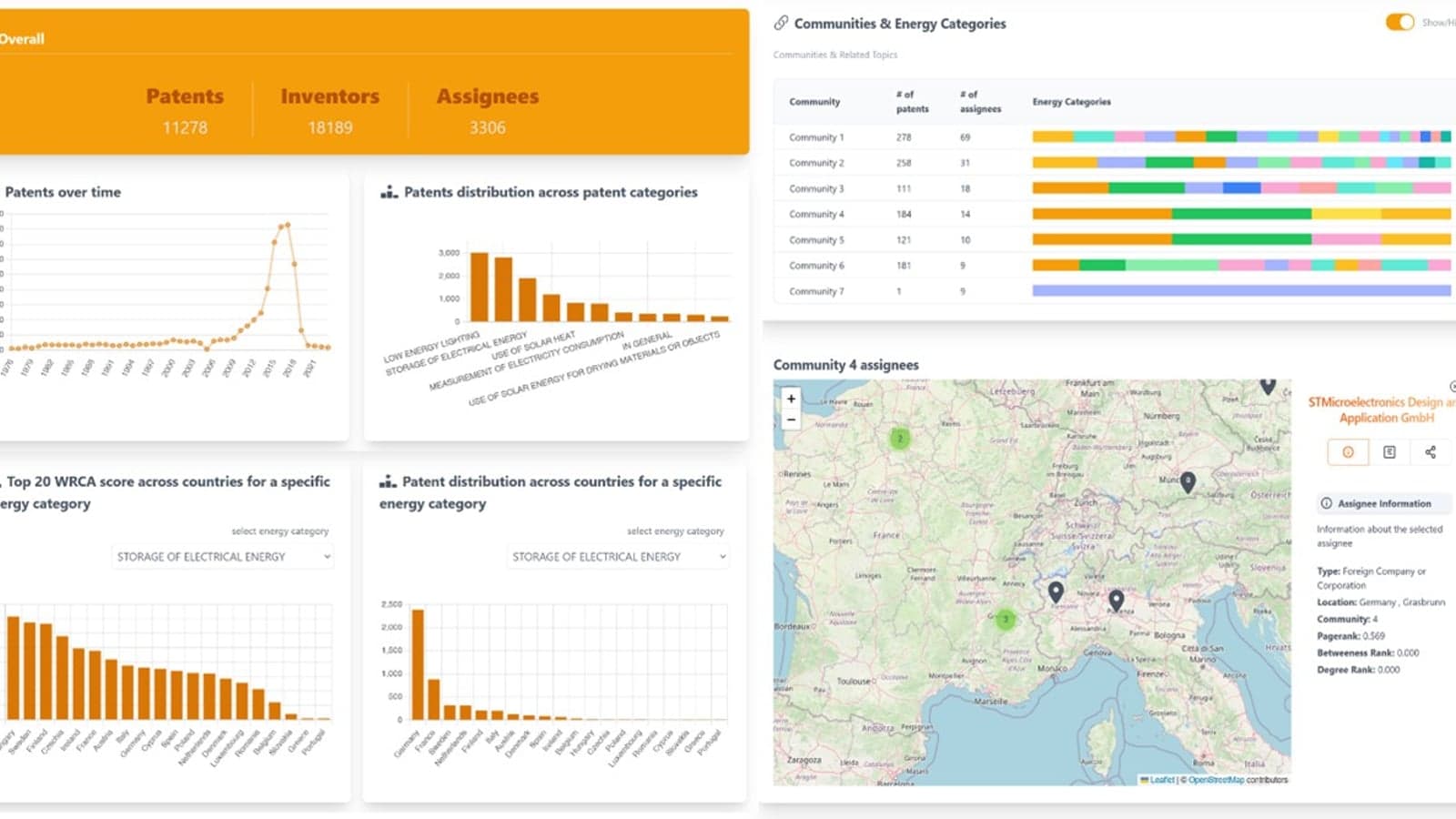
- Scientific lens: Surfaces publication trends and regional specialisation to guide distributed energy storage R&D priorities, identify emerging topics and locate relevant expertise.
- Research and innovation spotlight: Indexes EU projects and funding activity to reveal synergies and accelerate innovation scouting and consortia formation.
- Patent explorer: Curates and analyses distributed energy storage relevant patents to reveal technology trajectories, key stakeholders and potential freedom-to-operate insights that inform strategy, R&D focus and partnership selection.
- Intelligent matchmaking and networking: Recommends collaboration pairs or groups (buyers, sellers, operators, financiers) to assemble viable distributed energy storage partnerships.
- Business process management: Orchestrates offers, negotiations, counter-offers and approvals to turn distributed energy storage matches into executable agreements.
- Permissioned distributed ledger technologies (Hyperledger Fabric): Provides tamper resistant records and automated business rules to build trust in multi-actor distributed energy storage transactions.
- Open REST APIs: Exposes data and services to third party market platforms, enabling interoperability and effortless integration of distributed energy storage workflows.
- Data lake and operational stores: Consolidate high volume events, profiles and logs for analytics and monitoring that improve distributed energy storage performance and reliability.

Implications
These innovations highlight the dual role of distributed energy storage: as a technological enabler for flexible energy systems and as a social and economic driver empowering communities.
TRINEFLEX DES operationalises this role by linking data, actors and transactions, helping:
- Industries and stakeholders shorten time-to-deal and integrate with their systems;
- System operators reliably onboard distributed assets into flexibility markets;
- Investors de-risk projects with transparent audit trails and intelligence;
- Policymakers design targeted incentives with stronger evidence.
Collectively, these assets support energy actors, advance DES adoption, facilitate collaboration and accelerate Europe’s path to resilient, low carbon energy.
Conclusion
Distributed energy storage is both a technological opportunity and a societal shift in how energy is produced, managed and consumed. The TRINEFLEX DES toolset demonstrates how emerging digital tools, innovative business models and collaborative frameworks can pave the way for broader adoption and turn fragmented intent into investable partnerships.
To unlock the distributed energy storage potential, Europe must address regulatory complexity, scale financing instruments and raise awareness with clear, evidence-based business cases.
Future developments will likely focus on integrating distributed energy storage into smart energy systems, standardising technologies and expanding business models that benefit both industries and communities. Combined with robust governance and data driven decision support, these enablers can accelerate distributed energy storage deployment and strengthen resilience for a just energy transition.
For further information and updates, visit the TRINEFLEX project website.
About the authors
Vasileios Psomiadis is a postdoctoral researcher in the Data and Web Science Lab at Aristotle University of Thessaloniki and holds an MSc in Information Systems and PhD in Civil Engineering.
Theodoros Toliopoulos is a postdoctoral researcher in the Data and Web Science Lab at Aristotle University of Thessaloniki and holds an MSc in Data Analysis and PhD in Computer Science.
Ilias Dimitriadis is a postdoctoral researcher in the Data and Web Science Lab at Aristotle University of Thessaloniki and holds an MSc in Information Communication Technologies and PhD in Computer Science.
Georgios Vlahavas is a postdoctoral researcher in the Data and Web Science Lab at Aristotle University of Thessaloniki and holds an MSc in Quality Assurance and PhD in Computer Science.
Most popular
Join the community for freeAnd get access to all content
Related projects
TRINEFLEX
1 September 2022 - 31 August 2026
View projectLatest content
+7
What will it take to truly digitalise the European power grid?
In this episode of the Energy Transitions podcast, Christiane Mann, Chair of the T&D Europe working group on grid digitalisation and Vice President, Head of Industry Affairs at Siemens Smart Infrastructure, helps unpack what true grid digitalisation really means.
- Yusuf Latief
- 19/02/2026