SINNOGENES: Storage innovations with a data space and digital applications
Guest/partner contributor
Posted on: 31 October 2025
The SINNOGENES project offers new possibilities in the use of energy storage with a digital middleware platform.
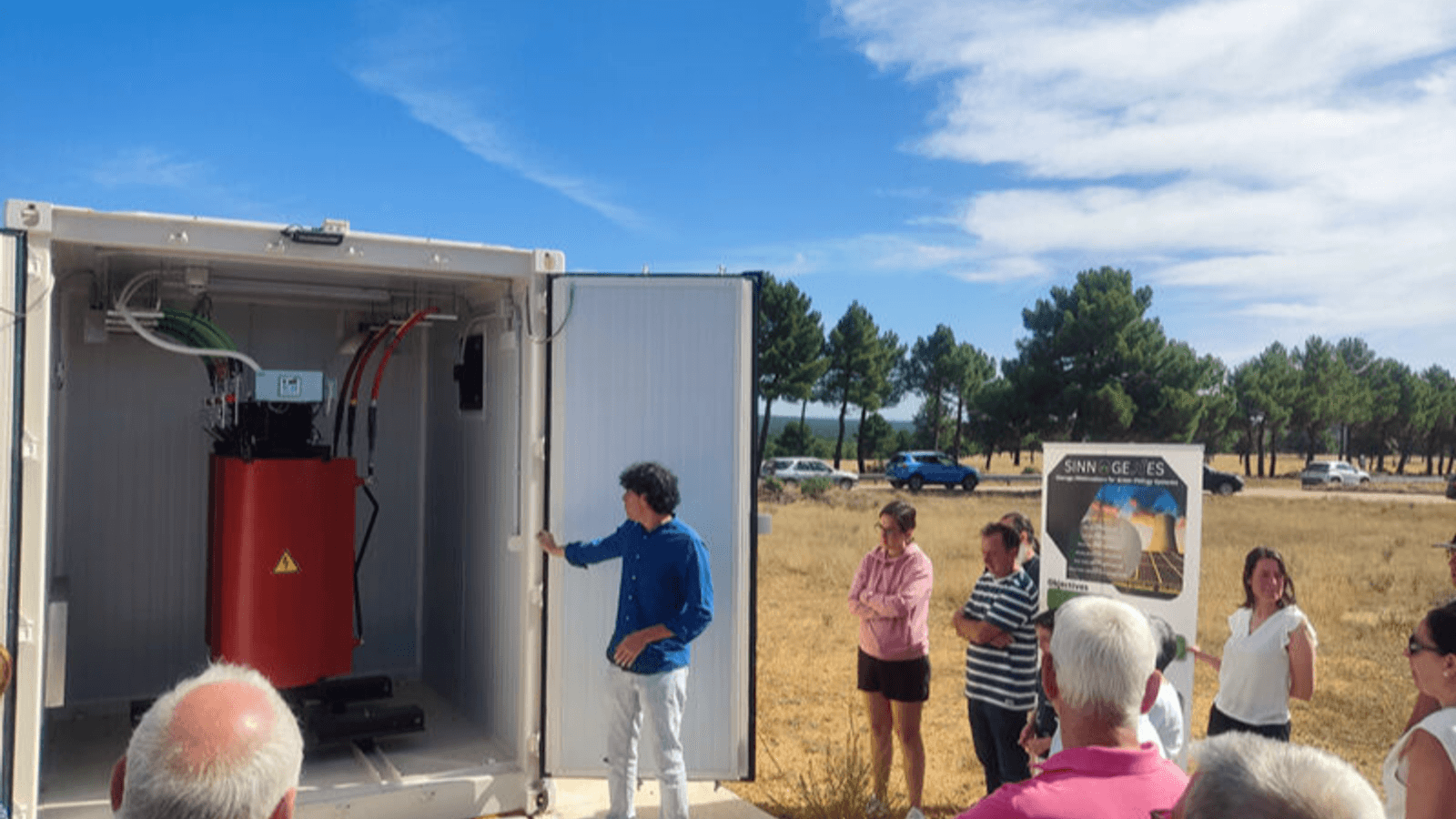
SINNOGENES was designed with a simple thought: An energy storage only delivers value when it is visible, dispatchable and trusted by the stakeholders who use it.
To do that at scale, SINNOGENES identified two key aspects. First, a middleware that lets energy actors and digital tool developers exchange data on their own terms, i.e. no central data lake, nor loss of control. Second, a set of reliable and tested digital tools that use those data flows to optimise real assets ranging from batteries, thermal systems and electrolysers to flywheels and mechanical hydro storage.
At this point, SINNOGENES has now closed the loop from design to integration. The middleware is implemented and validated, the UI exposes services consistently, while the final version of tools is being deployed at the pilots, with KPIs agreed and baselines captured.
SINNOGENES methodology
SINNOGENES implemented a connector-driven data space based on the Eclipse dataspace connector with a Sovity distribution, aligned with DERA 3.0, IDS and GAIA-X principles. Within this structure, all components are containerised and documented for reproducible deployments. Data never leaves a participant unless a usage policy allows it. [1]
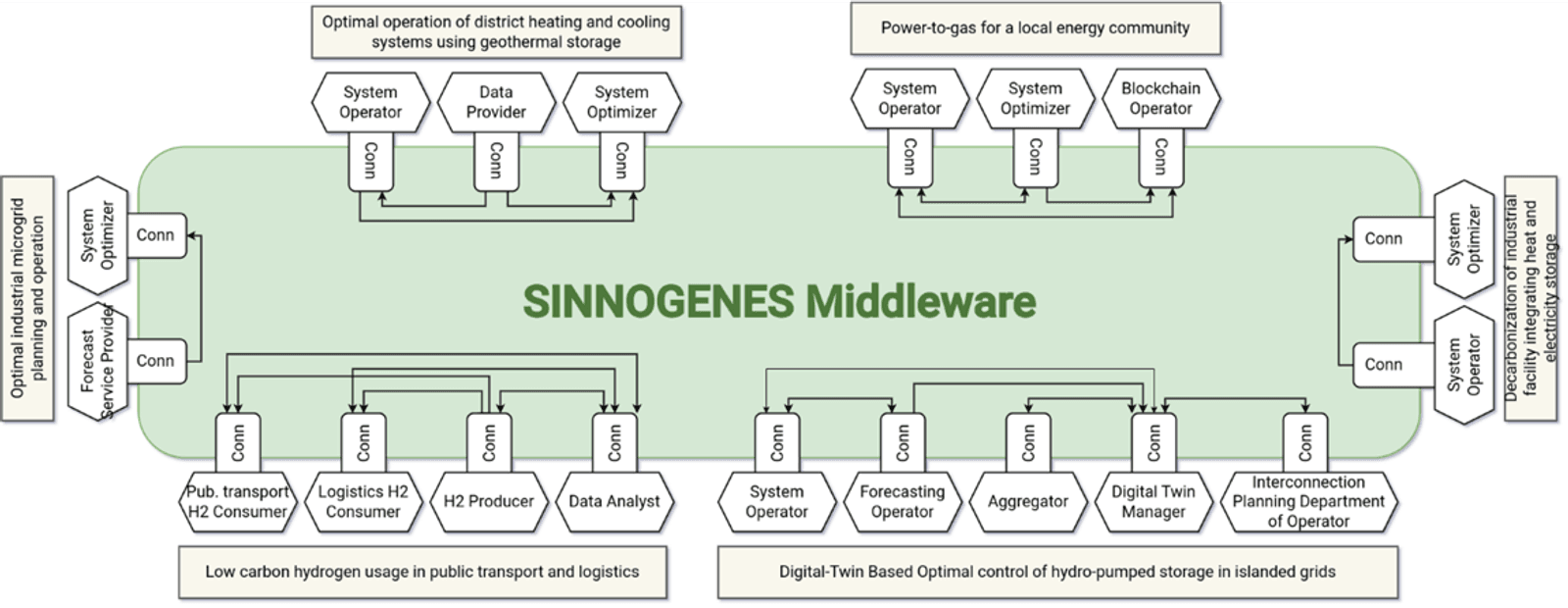
Access is enforced with OAuth2/OIDC, dynamic attribute-based tokens (DAPS), and machine-readable usage policies (time-bounded, connector-scoped). An anonymisation layer protects sensitive fields. All service APIs are documented through OpenAPI, and schemas and common vocabularies keep message formats predictable. [2]
The middleware exposes a service layer (tool discovery and request), a data exchange layer (policy governed transfers), and a data integration layer (adapters, mappings). The UI provides an interactive catalogue so end users can find tools, review input/output contracts, and request access with clear audit trails.
Tool developers provided the final designs and first integrated versions of the digital tools:
- Electricity-heat coupling and fast-response storage in Soria, Spain;
- Combined electricity-gas-hydrogen operation in Huesca, Spain;
- Industrial microgrid EMS and thermal storage integration in Maia, Portugal and Herzberg, Germany;
- Island grid planning and day-ahead dispatch (digital twin, forecasting, optimizer) in Ikaria, Greece; and
- AI-based refuelling and driving optimisation for hydrogen mobility in Geneva, Switzerland.
Storage technologies are integrated into these systems rather than developed in isolation.
Implementation and validation
SINNOGENES completed the full implementation and validation of the SINNOGENES IT architecture. A connector stack is up, usage policies are enforced end-to-end, and the UI allows tool discovery, access requests and integration guidance. The project also validated latency, availability, onboarding time, and data-sharing KPIs against the requirements defined. So far, the obtained results are within targets for pilot operations. [1]
In the industrial microgrid optimisation demonstration in Maia, an EMS is being integrated with the site’s existing Li-ion battery and a vanadium redox flow storage, with day-ahead scheduling informed by market prices and local PV/load forecasts. A thermal storage prototype is scheduled to join the stack to add power-to-heat flexibility. The objective in this case is to cut energy costs, boost self-consumption,and be ready for reserve participation where feasible. [3]
In the electricity/heat and fast response demonstration in Soria, SINNOGENES has the supervisory layer that binds the electrical microgrid to the district heating network. This enables shifting electrical surplus into geothermal storage and back, supported by sensors and a hardened data path. In parallel, the flywheel and supercapacitor prototypes are ready for rapid frequency support tests. The aim is to demonstrate sub-minute response without compromising thermal comfort or network stability. [4]
In the power to hydrogen demonstration in Huesca, the integration tool for joint operation of electricity and gas networks with on-site electrolysis is in place, with guarantees-of-origin and dispatch logic layered on top of existing planning capabilities. Towards the next months, this demo will use forecasts and market signals to decide whether renewable production should go to direct consumption, hydrogen production for mobility or storage. [4]
For the island grid planning and operations demonstration in Ikaria, SINNOGENES combined the use of a digital twin of the MV network, forecasting of demand and variable renewables, and a day-ahead optimiser that co-dispatches wind and pumped hydro under operational constraints. In this case, SINNOGENES tries to raise RES utilisation and reduce curtailment while respecting system security. Outputs will be used for both daily operation and longer-term interconnection planning. [5]
In the hydrogen mobility services demonstration in Geneva, automated refuelling, driving behaviour optimisation and hydrogen production modelling were developed. These are now being integrated with the middleware and prepared for deployment alongside hydrogen vehicles and a green-hydrogen supply. [5]
Measurement and impact
SINNOGENES locked KPI definitions per site and high-level use case, captured pre-deployment baselines and aligned on data sources. The environmental and cost assessments will use the VERIFY tool (LCA/LCC), while pan-European system impacts will be explored with Artelys Crystal Super Grid once demo-level datasets are complete. The expected outcome will be that what is learned locally is translated into credible system-level insights.
What mattered in practice. Decisions that paid off were the following: (i) investing early in policy-enforced data exchange avoided late security rework, (ii) writing OpenAPI contracts for every tool kept integrations honest, and (iii) keeping the UI close to the connector made onboarding faster for non-IT users.
Efficient energy solution
SINNOGENES is proving that combining storage technologies and digital applications with a digital platform can deliver purpose-efficient, interoperable and secure energy solutions.
As SINNOGENES enters its final phase, focus shifts to validating scenarios under real conditions, KPI-based evaluation and scalability analysis. This last phase brings this project one step closer to facilitating Europe’s efforts to make renewable energy storage technologies more usable, valuable and overall safer for Europe’s energy transition.
References
1. SINNOGENES, D2.4 SINNOGENES IT Architecture - Final Version.
2. SINNOGENES, D2.2 Data interoperability, security, and privacy for innovative storage technologies uptake.
3. SINNOGENES, D4.4 - Design and implementation of tools for storage technologies in industrial environments – Final Version.
4. SINNOGENES, D3.4 - Design and implementation of tools or storage technologies in multi-energy carriers - Final Version.
5. SINNOGENES, D5.4 - Design and implementation of tools for storage technologies in transport and insular systems – Final Version.
About the author
John Avramidis is an experienced project delivery manager with over eight years of comprehensive experience running EU-funded projects from inception to fruition. Working across diverse sectors, including AI in healthcare, cybersecurity, border security, IoT and energy, he possesses a broad understanding of cutting-edge developments in these domains
Related tags
Latest content
+4
Dispatchable power: how data centre microgrids can accelerate Europe’s energy transition
In this episode of the Energy Transitions podcast, Ben Pritchard of AVK and Malin Östman of Wärtsilä Energy explain why data centres can become pillars of stability in Europe’s energy grid.
- Pamela Largue
- 11/11/2025