Enhancing energy management and planning through interoperability
Guest/partner contributor
Posted on: 19 September 2025
The ELEXIA project is demonstrating digitised energy system integration across sectors enhancing flexibility and resilience towards an efficient, sustainable, cost-optimised, affordable, secure and stable energy supply.

The ELEXIA project is demonstrating digitised energy system integration across sectors enhancing flexibility and resilience towards an efficient, sustainable, cost-optimised, affordable, secure and stable energy supply.
ELEXIA is a 48-month Horizon Europe project which consists of 22 partners from eight countries and coordinated by NORCE Research AS. The project’s primary goal is unlocking the full potential of existing tools for planning and operating local energy systems and to combine them into a robust digital services platform (DSP) for local site managers and planners.
The project is anchored under the EU Green Deal and the EU strategy for energy system integration. It is in line with the Paris Agreement and the UN’s 2030 Agenda for Sustainable Development.
Interoperability between various components and tools across multiple providers is the paradigm to successful implementation for versatile and agile energy management systems (EMS). To develop further ad hoc solutions, the ELEXIA project has been working on implementing an ontology that will enhance any providers to connect to push and pull data from a single point contained in the DSP.
The ontology is formed from a combination of two existing ontologies, the SAREF (Smart Applications REFerence ontology) and CIM (Common Information Model). Documentation for this ontology exists in the public domain. Communicating with the DSP can be done either through an API end point, sFTP or by subscribing to an MQTT broker.
The ontology and its supporting infrastructure enable multiple stakeholders to exchange data with the DSP, thereby enhancing system flexibility, transparency and availability. The DSP provides a digital hierarchical representation of the physical infrastructure, where static system data, device-level data and forecast data can be attached to each segment of the representation.
Through this structure, the DSP can continuously supply information to the EMS framework in a common format. In return, the EMS tools, whether data driven analytics or optimisation models, can submit control commands to operate local assets or provide recommendations for their optimal use.
The interoperability model developed in the ELEXIA project is designed to be both scalable and replicable across different contexts, thanks to its open source foundation.
Port pilot application
The DSP concept was applied in three pilots. One of them is a maritime port in Portugal where the aim is to optimise the distributed energy resources (DERs) according to the energy prices and the renewable generation available.
The software tool used for the optimisation is an EMS, which provides optimal schedules for all the existing DERs. The electric vehicles fleet, the photovoltaic installation, the LNG plant and the HVAC of some buildings belonging to the port authority will be used as elements of inertia in order to provide flexibility and displace consumption to more convenient moments of the day.
This will require a number of participants working together and communicating between each other. The weather forecast will allow the estimation of the HVAC demand and the PV production for the day. Price forecasts are provided for day-ahead markets or intra-day/balancing market to better manage the assets in the different markets.
A generalised (non use case specific) representation of the data flow, interaction with the DSP and the asset owner is shown below.
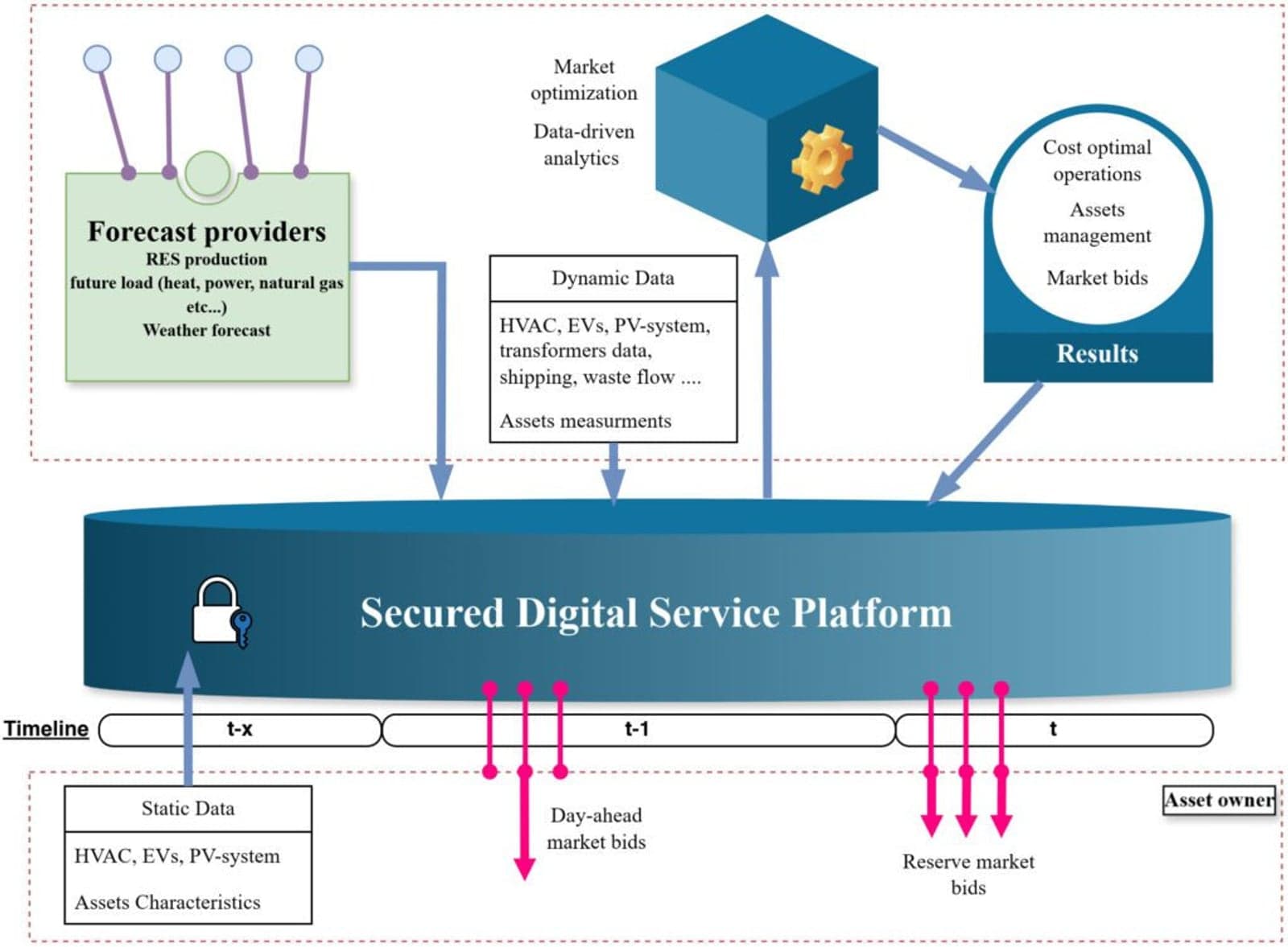
In parallel, on-site data are constantly feeding the DSP at different time intervals that are further ingested into a data-driven analytics tool developed by Tecnalia to assess the optimal market operations of the assets. The optimal points are then routed to the DSP to be further communicated to the asset owner in the maritime port. At first, these optimal point of operations and market strategy will run in parallel to existing system before being potentially adopted by the local authorities.
The solution developed in the ELEXIA project provides a platform that is not vendor specific and where multiple solutions can be plugged in, independently of the source. While some work is required from tools and data providers, the work is to be done once as all tools and data can then be pushed and fetched from a central point where detailed analysis can be performed further.
This project combined two existing data models to have a light and yet comprehensive description of the energy system present in the three pilots involved in the project. Thus, the project sheds light on the needs to develop lighter data model standard for energy management that does not require hand-picking from multiple standards.
We will implement the solution in the coming months and will be able to validate the approach with our pilots sites partners that will need to have multiple solutions to run their business activities, across multiple sectors and energy.
About the authors

Louis Jean-Nicolas leads VTT’s Design and Operation of Energy System team, driving innovation in carbon neutral energy technologies. With expertise in energy systems and climate resilience, he spearheads research on energy optimisation and market interactions. His work bridges academia and industry, advancing energy efficient solutions to support the energy transition.

Mikkel Copeland is experienced in driving implementation of digital energy solutions with a strong focus on an integrated energy sector, smart energy systems and data infrastructure. Dedicated to turning research concepts into practical outcomes, he ensures reliable, scalable and sustainable solutions through digitalisation and hands-on implementation and collaboration.

David Gonzalez-Sanchez holds a master’s degree in industrial engineering, specialising in electricity and renewable energies. He has been a researcher in Tecnalia since February 2024. Currently he is working with optimisation algorithms and models for calculating the available flexibility in energy consumption systems, storage systems and non-manageable generation plants.
Most popular
Join the community for freeAnd get access to all content
Related projects
ELEXIA
1 October 2022 - 30 September 2026
View projectLatest content
+2
Building block of an advanced metering infrastructure - Part 2: The meter data management system
Power utilities are rapidly becoming data-driven organisations. A decentralised energy model, powered by intermittent renewables depends on two-way communication between utilities and all other participants in the energy landscape.
- Guest/partner contributor
- 01/06/2023
Partner content
+2
The four key integrations powering the energy industry: An exploration
Technology is changing our energy system and the power utilities that operate within it. Utilities are digitally transforming and adopting software solutions to manage core operational processes.
- Guest/partner contributor
- 08/05/2023