ENPOWER and the shift towards data driven energy secure communities
Guest/partner contributor
Posted on: 24 March 2026
ENPOWER combines social innovation, digital tools and new business approaches to support energy activated citizens and data driven energy secure communities
As Europe moves towards a cleaner, more decentralised and more participatory energy system, citizens are increasingly expected to play a more active role.
Yet active participation in energy systems is not the expected and requires the right mix of enabling technologies, clear incentives, supportive governance models and practical ways for citizens to engage individually or collectively.
This is precisely the challenge addressed by ENPOWER, a Horizon Europe project designed, developed and now implementing its methodologies, tools and services for energy activated citizens and data driven energy secure communities [1].
Its overall vision is to help consumers move from passive energy use to active participation, either as individuals or through collective initiatives such as citizen energy communities and renewable energy communities. In doing so, the project supports a more consumer-centric energy system that links local action with broader system-level benefits such as energy efficiency, flexibility, resilience and security of supply.
Rather than focusing only on technology, the project combines advanced digital solutions with social science methodologies and organisational innovation. It brings together behavioural insights, AI-based tools, data sharing mechanisms, planning services and new business models in order to make citizen participation more feasible, more attractive and more scalable across Europe.
ENPOWER is designed not as a single local experiment, but as a framework that can be tested, refined and replicated in different socio-economic and geographical contexts. By working across multiple pilot countries and energy settings, it seeks to generate lessons that are useful well beyond the initial demonstration sites and identify gaps and opportunities, facilitating the scaling of energy communities.
ENPOWER methodology
ENPOWER’s methodology is built around the interaction of three core layers: the social layer, the technological layer and the business layer. This structure reflects the project’s central idea that meaningful energy participation depends on more than infrastructure alone. Citizens need to be engaged and supported through mechanisms that are technically robust and organisationally viable.
The social layer focuses on understanding people: their preferences, expectations, motivations and barriers to participation. Using social sciences and humanities methodologies, deliberative citizen engagement and co-creation processes (such as a discrete choice experiment), ENPOWER examined how different groups of consumers can be encouraged to participate in the energy transition [ENPOWER Deliverable D2.2, 2].
The technological layer provides the tools needed to translate these social insights into action. ENPOWER includes planning and operation services, AI-based clustering [3,4] and segmentation approaches, optimisation services [1,5,6], and an energy data space compliant digital backbone for secure and sovereign data sharing across energy and non-energy sectors. The technological ambition is to help consumers and communities make better-informed decisions and interact more effectively with the energy system.
The business layer complements these efforts by addressing the market and governance dimension. ENPOWER recognises that active participation must be supported by appropriate business models, new market roles and viable value propositions. For this reason, business model development and validation were embedded in the project from an early stage, alongside the broader objective of supporting local energy communities and hybrid forms of collective participation.
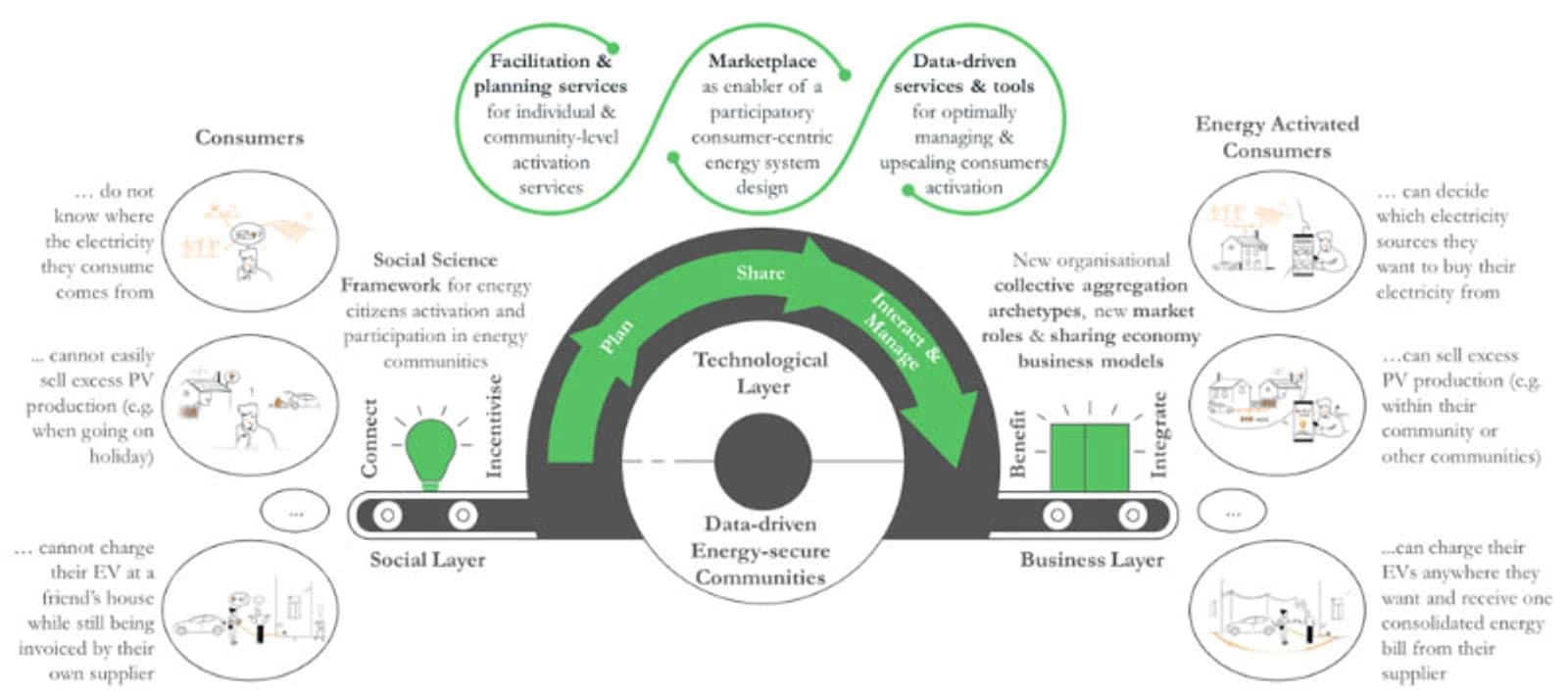
The framework is applied in six real life pilot communities across six countries, including four front runners, Austria, Portugal, Greece and Ireland, and two early adopters, Hungary and Spain, with the explicit aim of testing replicability under different conditions.
Results and discussion
ENPOWER current results show promising progress across the three dimensions of the project. On the social side, the identification of six consumer clusters and four multidimensional incentives confirmed that citizen participation cannot be supported through a one size fits all approach. Instead, different groups require different motivations, engagement pathways and support mechanisms [ENPOWER Deliverable D2.2].
This approach is reflected in the project’s outreach performance. More than 1,980 citizens were engaged through project’s activities, while the average activation rate reached 48%, showing that nearly half of the engaged participants moved beyond awareness to more active involvement.
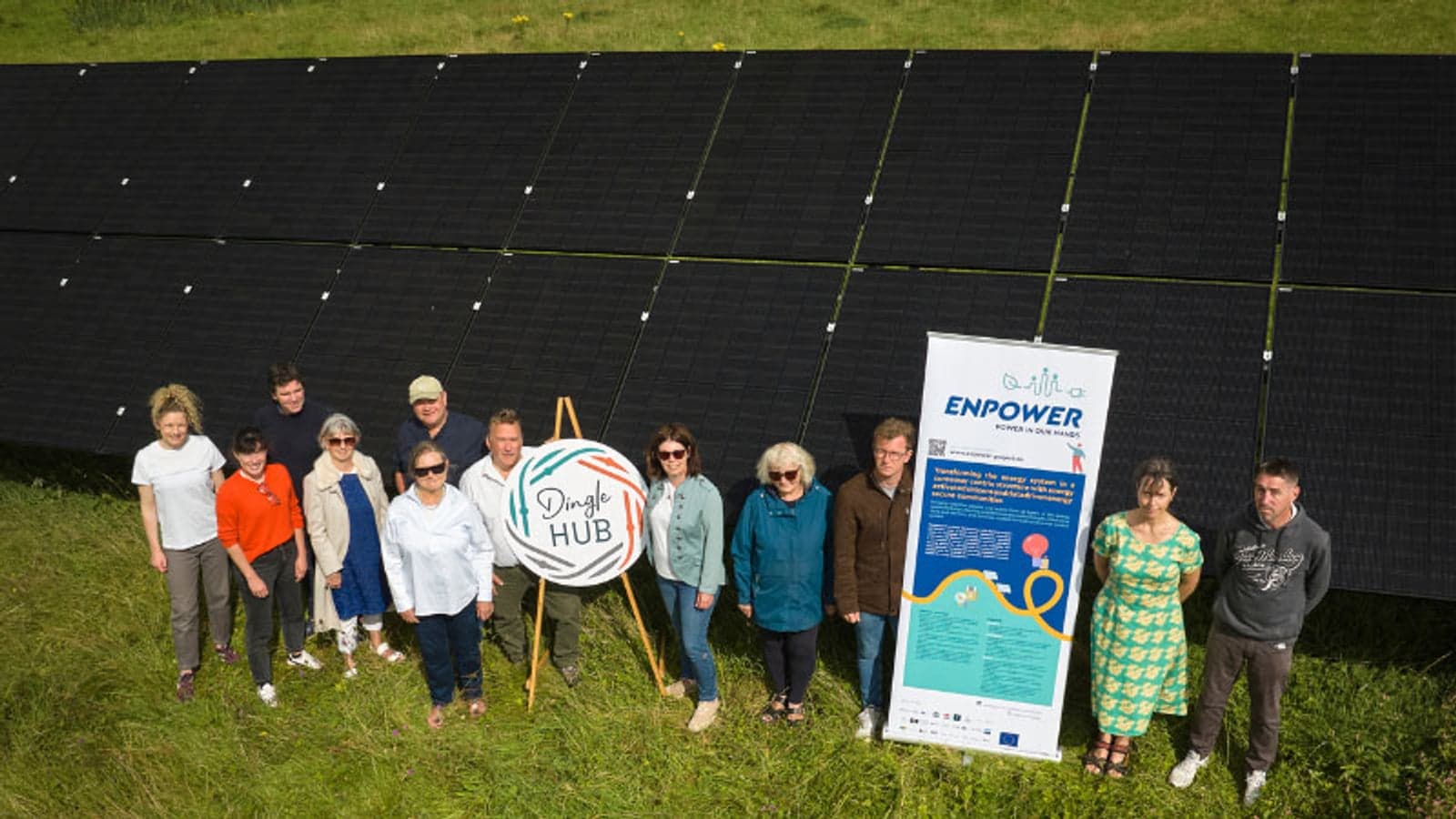
In the Dingle Peninsula, Ireland, increased awareness of the benefits of collective energy action contributed to the creation of five new sustainable energy communities and in Austria the solutions started to be used by energy communities outside of the project. This suggests that targeted and practical engagement strategies can play a key role in turning citizens into active energy participants.
From a technological perspective, ENPOWER also achieved the successful implementation of the energy data space through the ENPOWER middleware, enabling the secure transfer of energy data from one pilot to another. This is an important result, as trusted and interoperable data exchange is essential for the development of consumer centric and data driven energy services.
At the same time, the project reported an average energy bill reduction of 13%, indicating that ENPOWER can deliver not only stronger engagement but also tangible economic benefits for citizens.
Overall, these findings show that combining tailored social approaches with secure digital infrastructure can support more effective and scalable energy community models.
Conclusion
As implementation progresses, ENPOWER is expected to provide further evidence on how communities can be supported to engage more effectively in local energy systems and markets.
More information and future updates can be shared through the project’s official communication channels and public project outputs. More about ENPOWER can be found at the project website.
References
- Matsagkos, N., Kanellou, E., Fragkiadaki, A., Michalakopoulos, V., Marinakis, V., & Doukas, H., 2024. Democratise energy through energy activated citizens and data-driven communities: The ENPOWER approach. In 2024 15th International Conference on Information, Intelligence, Systems & Applications (IISA) (pp. 1-8). IEEE.
- Couto, M., Jimenez, M., Richardson, P., Coccia, A., Revez, A., Blanke, J., ... & Walsh, J., 2025. Data access and effective social engagement: a pathway to resilient and consumer-activated communities. In 28th International Conference and Exhibition on Electricity Distribution (CIRED 2025) (Vol. 2025, pp. 2790-2794). IET.
- Sarmas, E., Fragkiadaki, A., & Marinakis, V., 2024. Explainable AI-based ensemble clustering for load profiling and demand response. Energies, 17(22), 5559.
- Michalakopoulos, V., Papias, I., Sarantinopoulos, E., Sarmas, E., Marinakis, V., & Askounis, D., 2025. A hyperparameter-space clustering methodology of residential electricity loads. Applied Soft Computing, 181, 113497.
- Sarantinopoulos, E., Michalakopoulos, V., Matsagkos, N., Kanellou, E., Sarmas, E., & Marinakis, V. A forecast-driven, comfort-aware load shifting optimization tool for optimizing solar self-consumption in island energy communities.
- Mello, J., Rodrigues, L., Villar, J., & Saraiva, J., 2024. Energy allocation and settlement in collective self-consumption. In 2024 20th International Conference on the European Energy Market (EEM) (pp. 1-6). IEEE.
About the author
Nektarios Matsagkos is a researcher in the Decision Support Systems Laboratory at the National Technical University of Athens, Greece.
Related tags
Most popular
Join the community for freeAnd get access to all content
Related projects
ENPOWER
1 September 2023 - 31 August 2026
View project