Europe Energy Briefs: Quantum set for mainstream in Europe
Jonathan Spencer Jones
Posted on: 8 July 2025
Quantum technology is increasingly being talked about with its potential for new levels of computation and the innovation that this can offer.
Quantum technology is increasingly being discussed for its potential to enable new levels of computation and the innovation it can offer.
In the energy sector, quantum computing is attracting increasing interest due to its potential to address new challenges, such as grid optimisation in a decentralised power system with the multiplicity of power flows that can result, and the search for new materials, for example, for batteries.
Quantum cryptography is also emerging as the next generation cybersecurity to address the security challenges that will result as quantum computing becomes more widely available.
Also of interest
How quantum computing is disrupting power utilities
Indeed, under a new roadmap to transition to post-quantum cryptography issued by the European Commission, member states are required to have implemented at least the first steps for the transition by the end of 2026 and to have completed the transition for high-risk use cases by the end of 2030.
Other quantum technologies with potential in the energy sector are quantum sensing to improve the calibration of existing sensors, and further into the future, quantum communications or quantum teleportation that could make distributed quantum computers more easily available.
Europe's quantum strategy
Closely following, the new ‘Quantum strategy’ is aimed at positioning Europe as a global leader in quantum by 2030, the Commission has stated.
According to the Commission, despite its progress in quantum technology, the EU is currently lagging behind in translating its innovation capabilities and future potential into real market opportunities, while also struggling with fragmentation of strategies and roadmaps across member states.
The strategy, focused on “fostering a resilient, sovereign quantum ecosystem”, covers five areas, all with opportunities for the energy sector.
Research and innovation is to be advanced through consolidating activities across Europe. Activities will range from supporting foundational research to technological development and innovation in quantum computing, communication and sensing and supporting the development of applications in key public and industrial sectors.
Quantum infrastructure development is envisaged through coordinated infrastructure hubs to support production, design and application development. The EU intends to expand its investments in public infrastructures across computing and simulation, communications and sensing and a pilot facility for a European quantum internet is proposed for 2026.
Europe’s quantum ecosystem is to be strengthened through investments in startups and scaleups, securing supply chains and the industrialisation of quantum technologies. Specifics include six new quantum pilot production lines, a quantum chips industrialisation roadmap and a European quantum standards roadmap
Space and dual-use quantum technologies for security and defence are to be advanced by integrating sovereign quantum capabilities into the respective space and armaments activities.
Quantum skills to build a diverse workforce will be developed through coordinated education, training and talent mobility across the EU. Among the commitments is the launch of a European quantum skills academy in 2026.
The Commission says it intends to work closely with the member states and the European quantum community to turn the strategy's objectives into reality.
In addition, a high-level advisory board is planned to bring together leading European quantum scientists and technology experts to provide independent strategic guidance on the implementation of the strategy.
A Quantum Act is also proposed for 2026 to strengthen the quantum ecosystem and to incentivise member states and stakeholders to invest in (pilot) production facilities.
Commenting on the strategy, Henna Virkkunen, Executive Vice-President for Tech Sovereignty, Security and Democracy, said that with quantum science advancing rapidly, we are on the verge of some of the most transformative scientific and technological breakthroughs.
“We have everything we need to become a leading quantum continent, from a highly skilled workforce to a robust research infrastructure. As the global quantum race intensifies and moves from lab to real-world application, Europe must maintain its leadership. That's why we are launching the Quantum Europe Strategy – to bring together member states, industry, academia and society to unlock the full potential of quantum technologies.”
First EU quantum computer
Days before the release of the quantum strategy, the European Commission announced the inauguration of the region’s first quantum computer, such devices currently being only commercially available in organisations such as IBM.
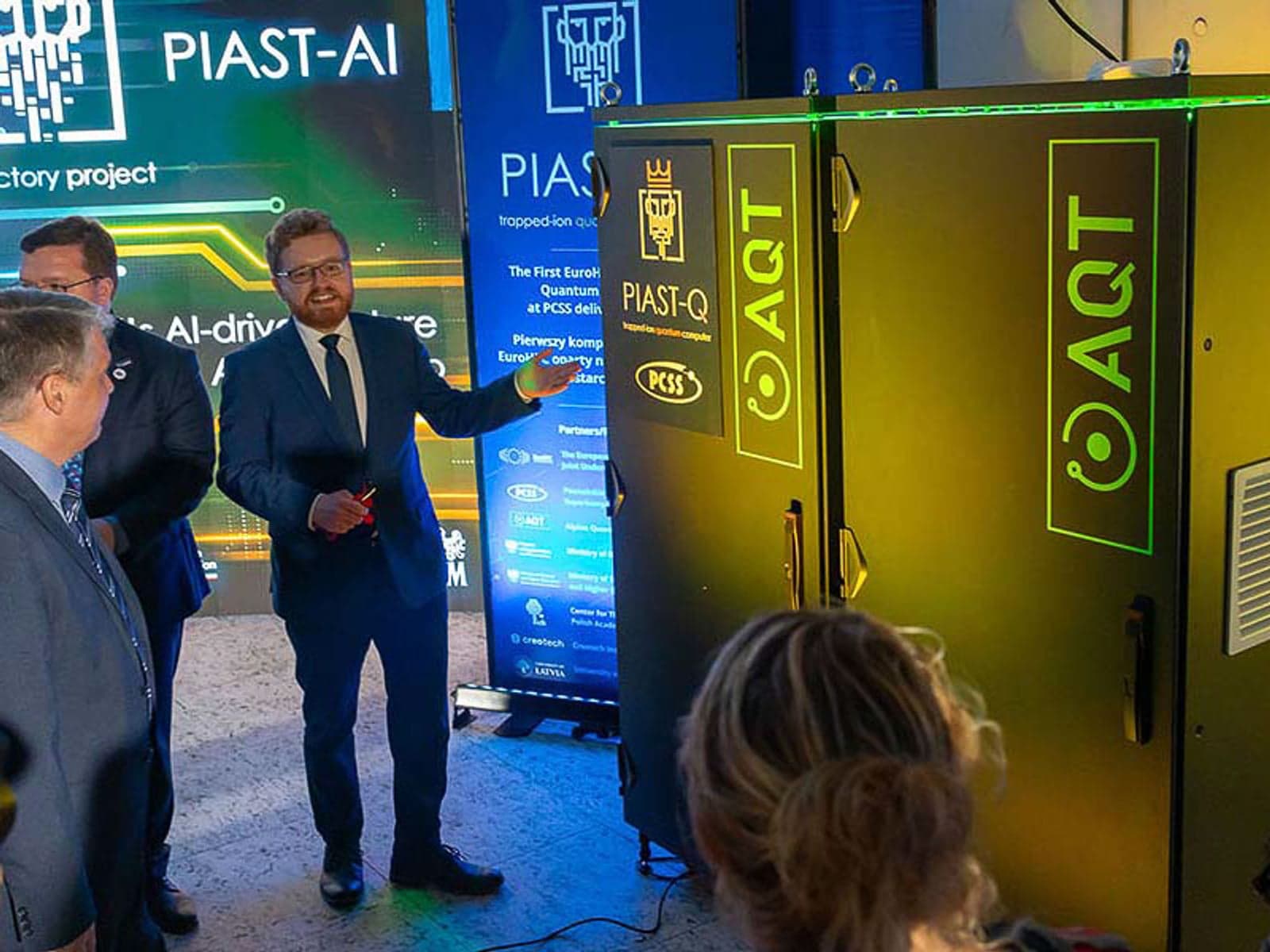
This first machine is the PIAST-Q at the Poznan Supercomputing and Networking Centre (PSNC) in Poznan, Poland. It is a laser-based trapped ion digital quantum computer – one of the six quantum computing architectures that are planned for the eight quantum computers for the Commission’s EuroHPC deployment.
PIAST-Q was supplied in under a year by Innsbruck, Austria-based Alpine Quantum Technologies at a cost of €12.3 million ($14.5 million) and will be coupled first to the ALTAIR supercomputer and later with the PIAST-AI supercomputer.
With the performance of twenty physical qubits, PIAST-Q should enable hybrid quantum-classical computing in areas including quantum optimisation, materials science and machine learning.
PIAST-Q is expected to become available for compute services to users by the end of the year following calibration in the coming months.