H2GLASS designing hydrogen supply for industry decarbonisation
Guest/partner contributor
Posted on: 12 December 2025
H2GLASS aims to decarbonise the glass industry by enabling 100% hydrogen combustion, focusing on safety, optimal maintenance and high product quality.
Decarbonising energy intensive industries is crucial for Europe to achieve its climate goals of becoming the first climate neutral continent by 2050. Renewable hydrogen particularly stands out due to its ability to provide high temperature process heat while generating no direct carbon emissions.
H2GLASS is actively demonstrating the feasibility of hydrogen integration in energy intensive industries by creating the technology stack, e.g. innovative burner and furnace designs, needed for glass manufacturers to realise 100% hydrogen combustion in their production facilities. The technology will be tested and validated by five industrial demonstrators from the glass industry and one replicability demonstrator from the aluminum industry.
However, this transition comes with various challenges that are being addressed by the consortium. One core challenge is optimising the hydrogen combustion process (e.g. mitigating NOx emissions and managing high flame propagation speed) while maintaining safety and high product quality at the same time. Another key challenge lies in developing infrastructure capable of ensuring a safe and reliable supply of green hydrogen. In this context, H2GLASS has investigated the key factors influencing hydrogen supply system performance, providing insights to guide strategic decision-making in system design.
H2GLASS methodology
The methodological approach comprises several steps and systematically integrates multiple established frameworks and methods.
Step 0. System definition: Schematically defines the system under investigation, including the main modules, their functions and the flows between them (Figure 1). The system is based on a conceptual design developed for experimental hydrogen testing campaigns within the H2GLASS project and considers two supply alternatives: on-site production via PEM electrolysis and high-pressure delivery by truck.
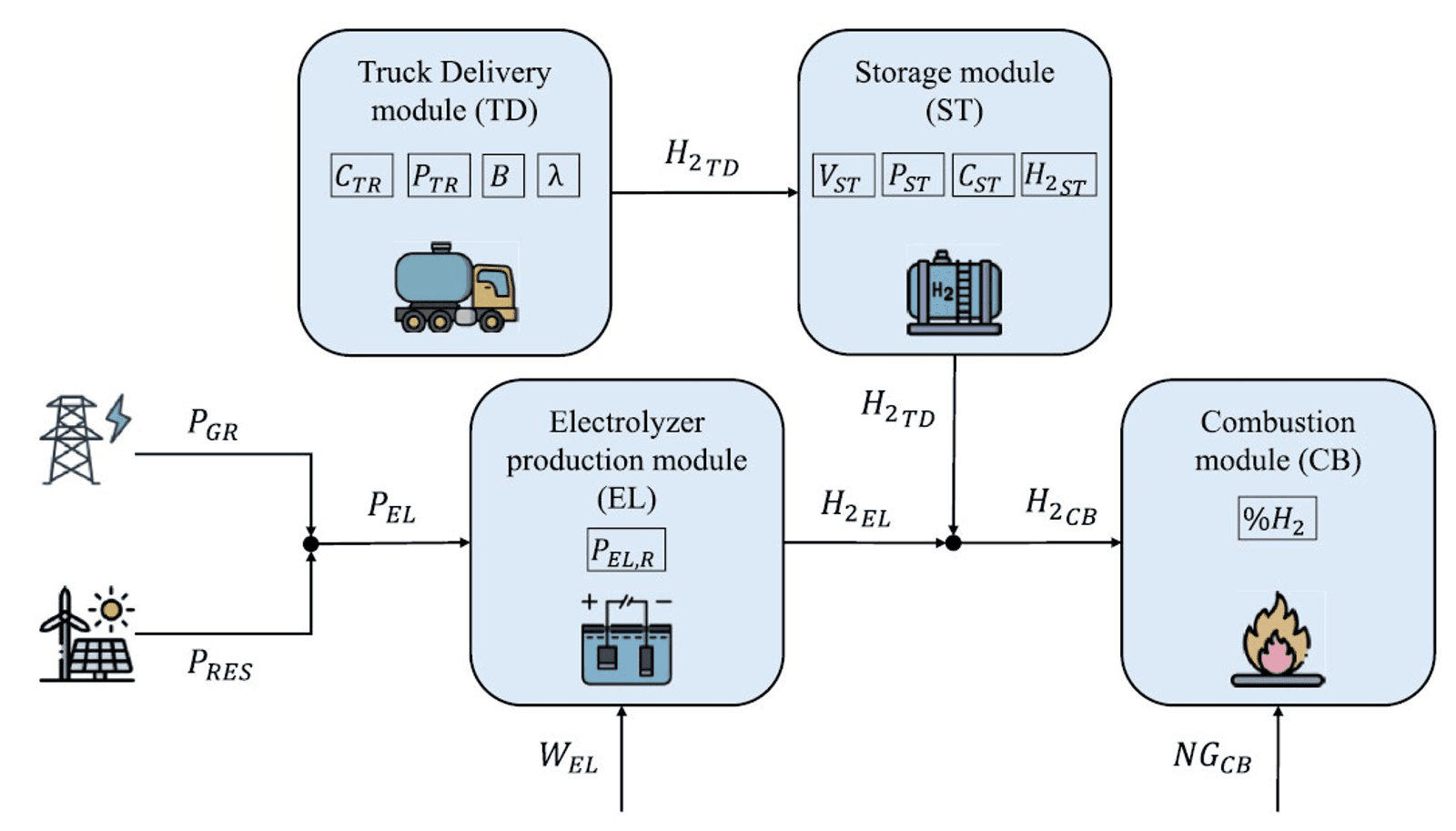
Step 1. Mathematical formulation: Defines the system’s behaviour and quantifies its performance in terms of cost, inherent safety and environmental impact. A physical model represents the main modules, including electrolyser production, truck delivery, storage and combustion, while dedicated models for cost, safety, and equivalent CO2 emissions derive corresponding performance indicators. Mathematical formulation is adapted to the baseline scenario to enable comparison between current operations and hydrogen-based scenarios.
Step 2. Scenario analysis and case study: Evaluates multiple hydrogen-based system configurations by considering different commercially available module solutions to ensure practical relevance. A real case study in the glass manufacturing sector illustrates the application of the multi-objective framework.
Step 3. Results analysis: Examines the results to identify key trends and trade-offs. An unconstrained analysis evaluates the performance of all hydrogen-based configurations, including the baseline scenario, while the constrained analysis introduces constraints reflecting potential company requirements. A sensitivity analysis is performed on key factors influencing strategic decisions, such as electricity price and the type of externally supplied hydrogen. Ultimately, this step aims to provide insights and support the strategic design of hydrogen-based systems.
H2GLASS results
For the analysis it is assumed that hydropower supplies the electrolyser, while grey hydrogen, produced from fossil fuels through steam methane reforming, is the alternative external supply, reflecting its status as the most commercially available hydrogen type.
The unconstrained analysis evaluates system performance across all hydrogen-based configurations and shows that increasing electrolyser capacity enhances safety and reduces emissions, but at the expense of higher costs and water consumption. None of the evaluated configurations offers simultaneous improvements across all performance dimensions. Therefore, the most suitable design configuration depends on the specific context and application requirements.
The constrained analysis introduces various internal and external factors that companies may face and evaluates their impact on hydrogen-based system design. The examined cases include limitations related to:
- Hydrogen percentage in the fuel mix, e.g. due to customer sustainability expectations or melting process requirements;
- Equivalent CO2 percentage reduction, e.g. driven by regulatory standards or corporate sustainability goals;
- Renewable energy availability, e.g. constrained by limited local renewable infrastructure;
- On-site hydrogen production, e.g. reflecting the company’s need for direct control over part of the supply or its preference for operational flexibility;
- Safety performance, e.g. prioritising configurations with superior inherent safety characteristics.
The impact of each of these potential constraints on hydrogen-based system design is discussed in more detail in the original publication by Fede et al [1].
Recommendations
Based on the findings and the trade-offs emerging from the analysis, the following recommendations are provided to practitioners:
- Full on-site hydrogen production delivers the highest level of safety, while incorporating any external supply, such as truck deliveries, significantly reduces safety performance. However, using larger capacity trucks can minimise hose connection risks but may increase delivery pressure hazards, which can be managed by carefully choosing the location of the delivery area to address potential damage distances.
- The economic and environmental appeal of on-site hydrogen production versus external supply depends heavily on electricity prices; high electricity costs favour external supply, while low electricity rates make on-site production more competitive. Although external supply offers price stability, on-site generation can achieve lower hydrogen costs when electricity is affordable.
- On-site production of hydrogen becomes more cost-effective when market prices are high, reducing the levelised cost of hydrogen by 22% compared to external supply. However, if external hydrogen prices are low, expanding internal production can increase costs, though it offers the benefit of stabilising expenses during market fluctuations.
- Electrolyser sizing decisions must consider the carbon footprint of electricity, since using electricity with high emissions can make hydrogen production more polluting than natural gas. To mitigate this, companies may need to increase investments in renewable energy or source cleaner hydrogen, both of which would raise overall costs.
- Outsourcing hydrogen supply should factor in market trends and the environmental and economic differences among hydrogen types. While external grey hydrogen is cost-effective but increases carbon emissions, green hydrogen significantly cuts emissions at a higher cost and blue hydrogen provides a middle ground between sustainability and affordability.
- When renewable energy is scarce, it may be more effective to prioritise the use of available green electricity rather than maximising hydrogen integration by relying on secondary energy sources. Opting for a lower hydrogen share with a smaller electrolyser can achieve similar environmental benefits, while also reducing costs and improving safety.
Reference
1. Fede, G., Collina, G., Tugnoli, A., Bucelli, M., Silva, D.F. & Sgarbossa, F. (2025) Hydrogen supply design for the decarbonization of energy-intensive industries addressing cost, inherent safety and environmental performance. International Journal of Hydrogen Energy, Volume 175, 6 October 2025, 151373.
About the author
Giulia Fede is a PhD candidate at the Department of Mechanical and Industrial Engineering at NTNU, Norway. Her research interests include the development of optimisation and decision support tools for hydrogen-based energy intensive industry operations, with a particular focus on production and maintenance planning.
Most popular
Join the community for freeAnd get access to all content
Related projects
H2GLASS
1 January 2023 - 31 December 2026
View project