How Crete is seeking the perfect synergy between geography and renewables
Guest/partner contributor
Posted on: 13 May 2025
Crete Valley, a renewable energy valley project on the island of Crete, aims to enhance energy autonomy by integrating diverse renewable energy sources tailored to specific geographic regions.

Crete Valley, a renewable energy valley project on the island of Crete, aims to enhance energy autonomy by integrating diverse renewable energy sources tailored to specific geographic regions.
Amidst escalating climate challenges and geopolitical instability, the urgency for a shift to renewable energy systems has become critical.
The transition towards decentralised energy systems, exemplified by renewable energy valleys (REVs), offers a sustainable solution to these challenges.
REV systems are pivotal in the shift from centralised to decentralised energy landscapes, enabling local energy production, storage and sharing through renewable energy communities.
This democratises energy access and fosters long-term sustainability. However, integrating such systems into the broader energy market requires overcoming significant technical, social, and regulatory barriers.
The operational requirements of DSOs and TSOs necessitate adaptable frameworks that can accommodate the scalable and efficient deployment of decentralised energy resources.
Evaluating REV projects is essential for monitoring progress and outcomes, as well as determining the overall value and impact of implemented solutions. This evaluation is particularly crucial in REVs, where diverse solutions must be applied across different spatial scales to meet the energy needs of large, varied populations.
Given the complexity and scope of REVs, which interconnect distant energy communities, key performance indicators (KPIs) provide a structured approach to assessing the effectiveness of these initiatives.
Research conducted in the Crete Valley project introduced a detailed KPI inventory and a REV readiness assessment framework specifically designed for REVs. These instruments are developed to assess the direct impacts, co-benefits and potential barriers to the effective deployment of REVs.
Through a rigorous review and stakeholder consultations, a comprehensive set of KPIs was established, addressing technical, social, environmental and economic dimensions.
The REV readiness assessment framework, informed by this KPI inventory, facilitates a systematic evaluation of the feasibility and sustainability of REVs. This framework not only aids in monitoring REVs but also integrates a persona-based approach to identify potential barriers, thereby enhancing the involved stakeholders' understanding and awareness.
Indicative examples of the output of the proposed framework are presented, providing a structured multidimensional approach to navigate the complexities of REVs. The research contributes significantly to strategic planning and operational execution in the renewable energy sectors, promoting a sustainable energy transition at various scales.
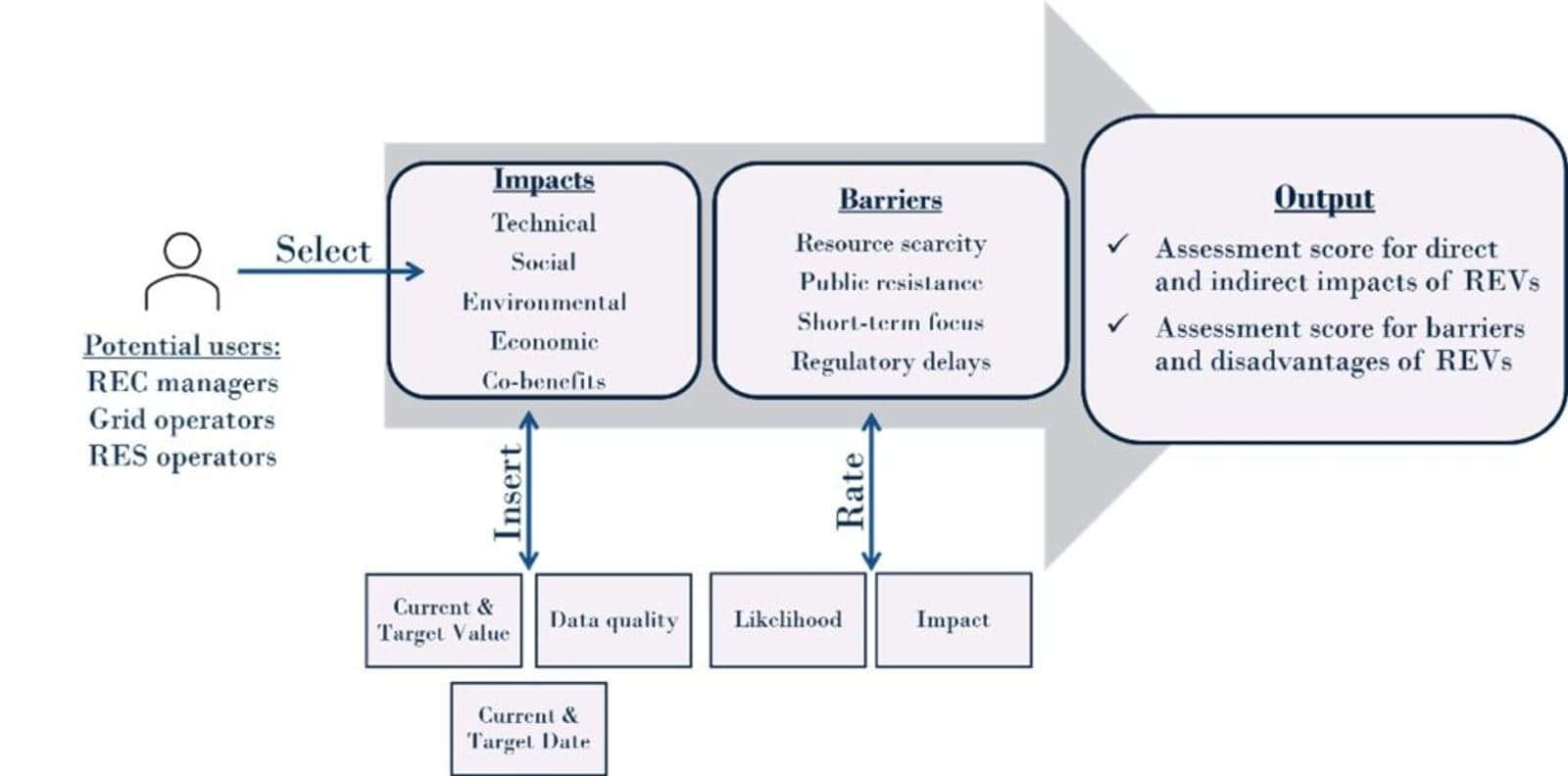
As a next step, the REV readiness assessment framework could be demonstrated and validated within small scale real life REV projects, as for example through its application in the four community energy laboratories established across Crete within the Crete Valley project.
These community energy laboratories represent diverse environmental, economic and social conditions, offering a unique opportunity to test the effectiveness of the framework in real-world settings.
This approach will allow for validation of the REV readiness assessment framework's adaptability to different energy needs and community characteristics, ensuring that it can be scaled and adapted for broader use.
Learn more about Crete Valley at the website and subscribe to the Crete Valley newsletter for updates.
Related tags
Latest content
+6
RECreation: A digital platform to manage energy communities with support for flexibility markets
In the context of the BeFlexible project, the RECreation renewable energy communities management digital platform has been enhanced to participate in local flexibility markets.
- Guest/partner contributor
- 18/09/2025