How digital twins enable smarter buildings in BuildON
Guest/partner contributor
Posted on: 20 February 2026
Two complementary digital twin approaches are being developed in the BuildON project, open loop and closed loop.
Digital twins are increasingly recognised as key enablers for improving the energy performance and operational efficiency of buildings.
By linking physical assets to virtual models fed by real data, they offer the potential to better understand building behaviour, anticipate future conditions and support better informed decisions [1]. As a result, digital twins are now widely mentioned in strategies for smart and sustainable buildings across Europe [2].
However, their practical use often falls short of expectations. In many cases, they remain limited to visualisation tools or offline simulations, disconnected from the day-to-day operation of the building. In others, they rely on complex infrastructures that are difficult to replicate beyond large buildings [3].
In the specific case of small residential and tertiary buildings, there is a clear need for digital twin solutions that are scalable and closely aligned with actual operational needs.
A key challenge lies in translating analytical insights into actionable improvements. Understanding how a building behaves is essential, but it does not automatically lead to better performance. To deliver real impact, digital twins must be able to evolve from supporting analysis and exploration to enabling optimisation and, where appropriate, automated control.
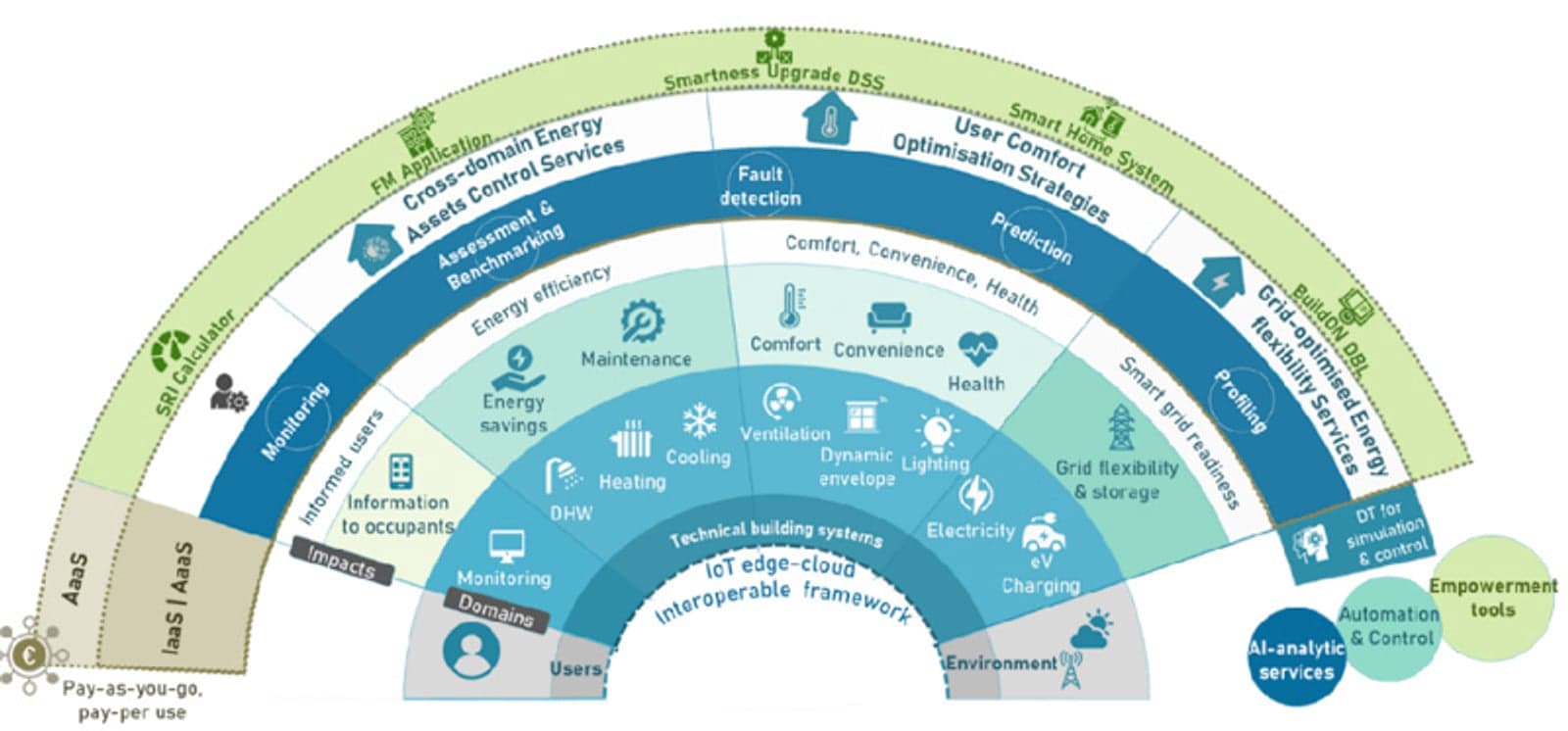
In this context, the Horizon Europe BuildON project proposes a structured and pragmatic approach to digital twins based on two complementary configurations: open loop digital twins, focused on performance simulation and decision support, and closed loop digital twins, designed to interact with building systems and support smart operation [4].
Together, these approaches provide a progressive path from simulation to action, adaptable to different types of buildings and levels of digital maturity.
Digital twin concept and maturity levels
In BuildON, digital twins are conceived as virtual representations of buildings that can reproduce their dynamic behaviour to support monitoring, assessment, prediction and optimisation (MAPO) activities across different operational domains [1,2].
Rather than treating digital twins as standalone models, BuildON positions them as core enablers within a broader analytical and optimisation framework designed to evolve alongside the building and its available data.
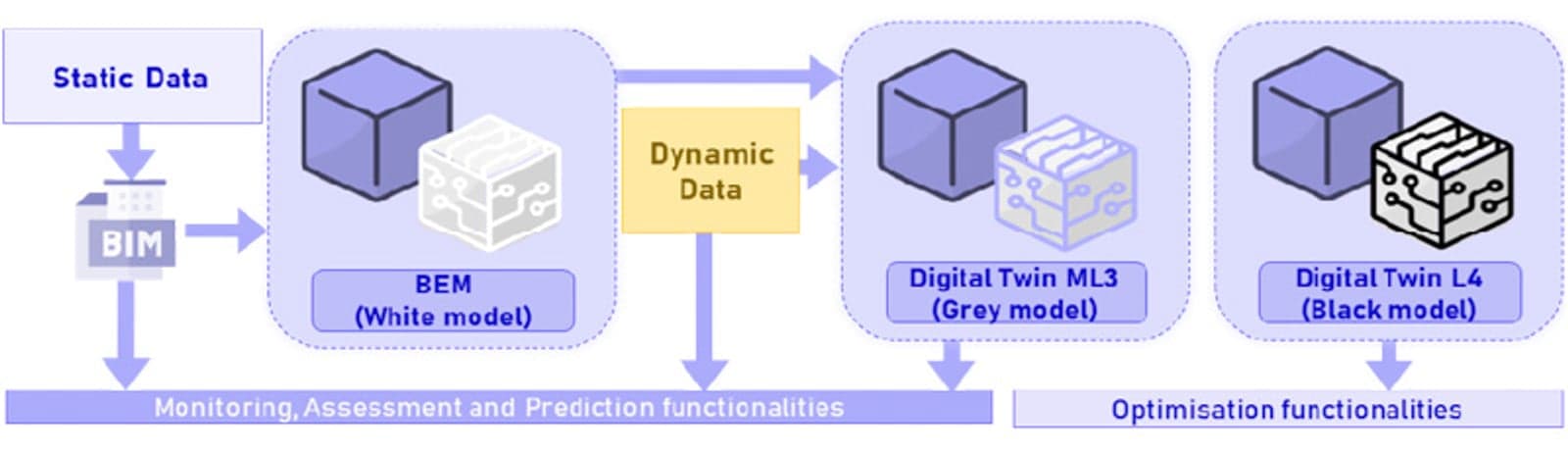
Digital twin development follows a structured three-step process. First, a physical representation of the building is created to capture its geometry, systems and thermal characteristics; secondly, a sensitivity analysis identifies the parameters with the greatest influence on performance; finally, the model is calibrated using monitored data from the building to reduce discrepancies between simulated and real behaviour an ensure operational reliability.
Based on this, BuildON adopts a maturity-based approach, distinguishing between two complementary digital configurations that support a progressive transition from performance understanding to smart operation.
Open loop digital twins for building performance simulation
At maturity level 3, BuildON develops open loop digital twins to support and validate monitoring, assessment and prediction (MAP) capabilities [3]. In this configuration, the digital twins act as analytical representations of real buildings, enabling data driven services to be evaluated without directly interfering with building operation.
The process begins with the creation of building information models, which describe spaces, thermal zones, materials and energy-related components. From these, calibrated physical energy models (white models) are generated to reproduce the thermal behaviour of the buildings.
Real monitored data from the pilot sites is then used for calibration, ensuring consistency between simulation and observed performance.
Open loop digital twins are orchestrated alongside analytical services to support forecasting, anomaly detection and performance assessment. They also enable the creation of virtual sensors, providing information at locations where physical measurements are unavailable. By enriching the analytical layer with reliable, interpretable outputs, open loop digital twins strengthen decision making while remaining decoupled from real-time control.
Closed loop digital twins for smart building operation
Building on the analytical foundation established by MAP services and open loop digital twins, BuildON takes the digital twin concept to maturity level 4. This enables closed loop digital twins, which support smart, proactive and automated building operation [3].
Under this configuration, insights and predictions generated by MAP services are combined with optimisation services to determine the most appropriate control strategies in line with the desired performance indicators. These strategies may address multiple domains, including indoor environmental quality, heating and cooling efficiency, renewable energy operation or electrical flexibility.
Closed loop digital twins establish bi-directional interaction with the physical building. Real-time data updates the digital model, while optimised control commands are dispatched back to building systems, effectively closing the loop between analysis, optimisation and execution.
To support this functionality, data-driven artificial intelligence and machine learning models are introduced to specialise the digital twin according to the KPIs being optimised.
BuildON results
The dual digital twin approach implemented in BuildON showcases the benefits of adopting a progressive, service-oriented strategy for building digitisation. This approach moves beyond the use of isolated simulation tools, providing solutions that support real operational needs [1]. Rather than relying on a single model, different digital twin configurations coexist and evolve in line with a building’s level of digital maturity.
Open loop digital twins strengthen analytical services by providing calibrated and reliable representations of building behaviour, supporting monitoring, assessment and prediction activities while mitigating operational risk. Building on this analytical foundation, closed loop digital twins enable the transition from insight to action. By combining predictions from MAP services with optimisation algorithms, control strategies can be applied dynamically across diverse building domains without requiring disruptive changes to existing infrastructure.
This integrated approach allows digital twins to be introduced incrementally, in line with recognised frameworks such as the Smart Readiness Indicator (SRI) [2].
Conclusions
This article presents the digital twin strategy developed within the BuildON project, emphasising how open loop and closed loop digital twins can be integrated to facilitate a gradual shift from performance analysis to smart building operation. By embedding digital twins within the broader framework of the MAPO functionalities, BuildON ensures that modelling, analytics and optimisation work together rather than in isolation.
By acknowledging the diversity of Europe’s building stock, the BuildON approach promotes a realistic and scalable pathway to digitalisation. As buildings progressively increase their level of data availability and automation, digital twins can evolve accordingly to support improved energy performance, occupant comfort and operational efficiency.
References
1. X. Liu, D. Jiang, B. Tao, F. Xiang, G. Jiang, Y. Sun, J. Kong, and G. Li. A systematic review of digital twin about physical entities, virtual models, twin data, and applications, Advanced Engineering Informatics, Vol. 55, Art. no. 101876, 2023. DOI: 10.1016/j.aei.2023.101876.
2. European Commission, Smart Readiness Indicator.
3. P. Spudys, N. Afxentiou, P.-Z. Georgali, E. Klumbyte, A. Jurelionis, and P. Fokaides. Classifying the operational energy performance of buildings with the use of digital twins, Energy and Buildings, Vol. 290, Art. no. 113106, 2023. DOI: 10.1016/j.enbuild.2023.113106.
4. S. Mulero-Palencia et al. A Smart Toolbox for the Digital Transformation of Buildings, in Proc. 2024 15th Int. Conf. Information, Intelligence, Systems & Applications (IISA), Chania, Crete, 2024, pp. 1–6, DOI: 10.1109/IISA62523.2024.10786633.
About the author
Sofía Mulero-Palencia is a researcher at the CARTIF Technology Centre in Spain, specialising in smart building management, digital twins and energy optimisation. She contributes to different EU-funded projects focusing on the digital transformation and decarbonisation of the built environment.
Most popular
Join the community for freeAnd get access to all content
Related projects
BuildON
+1
1 May 2023 - 1 October 2026
View project