How underground hydrogen storage turns summer sun into winter energy in Austria
Yusuf Latief
Posted on: 7 January 2026
RAG Austria and INNIO Group show how a subsurface reservoir stores summer renewable energy as hydrogen and later converts it to heat and power for winter.
When it comes to securing renewable energy year-round, most discussions focus on improvements to batteries and short-term storage. But in Austria, using what’s already beneath our feet has shown promise as one of the most effective ways to make solar energy available in winter.
Europe’s energy transition success depends not only on producing renewable electricity, but on storing it for when it is actually needed.
Batteries cover hours, pumped hydro covers days, but neither can bridge the gap between surplus summer generation and high winter demand. That requires large-scale, long-duration storage. In Rubensdorf, near the municipality of Gampern in Austria, that has meant going underground.
At the site, Austria’s largest energy storage company RAG Austria have turned a natural gas reservoir - formed millions of years ago - into a seasonal storehouse for hydrogen.
Their Underground Sun Storage project taps into a 1,000-metre-deep porous sandstone formation, where natural gas once accumulated naturally. These types of reservoirs are relatively common: across the continent, including the UK and Ukraine, the capacity of working gas volume stored in such reservoirs comes to approximately 81%.
Banking summer sun
But it is in its current use that RAG Austria and energy solutions provider INNIO innovate, banking summer solar energy as a gaseous form, holding it for months as hydrogen before returning it as heat and power during winter peaks.
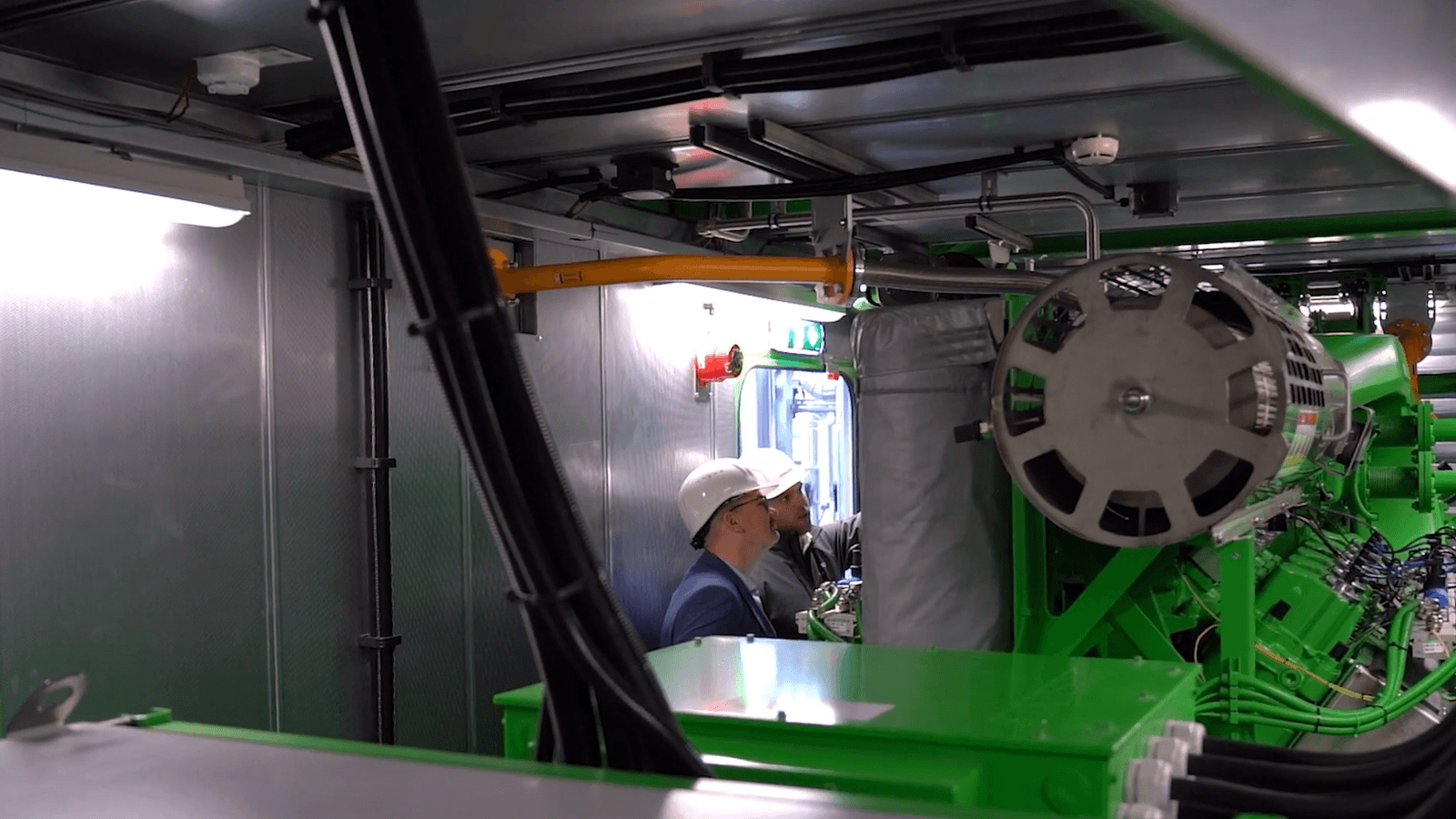
The site in Gampern sees INNIO Group’s 1MW hydrogen combined heat and power support RAG Austria at the start of the heating season. The solution was commissioned by the group in June 2024, supplying the industrial plant with green electricity and green heat.
When Enlit on the Road visited the facility, Stefan Steinegger of INNIO Group told me: “Here [RAG Austria] can store a really large amount of hydrogen over the seasons, months and even years, and then use the hydrogen, which is produced from solar energy in summer, when we need it, in winter times.”
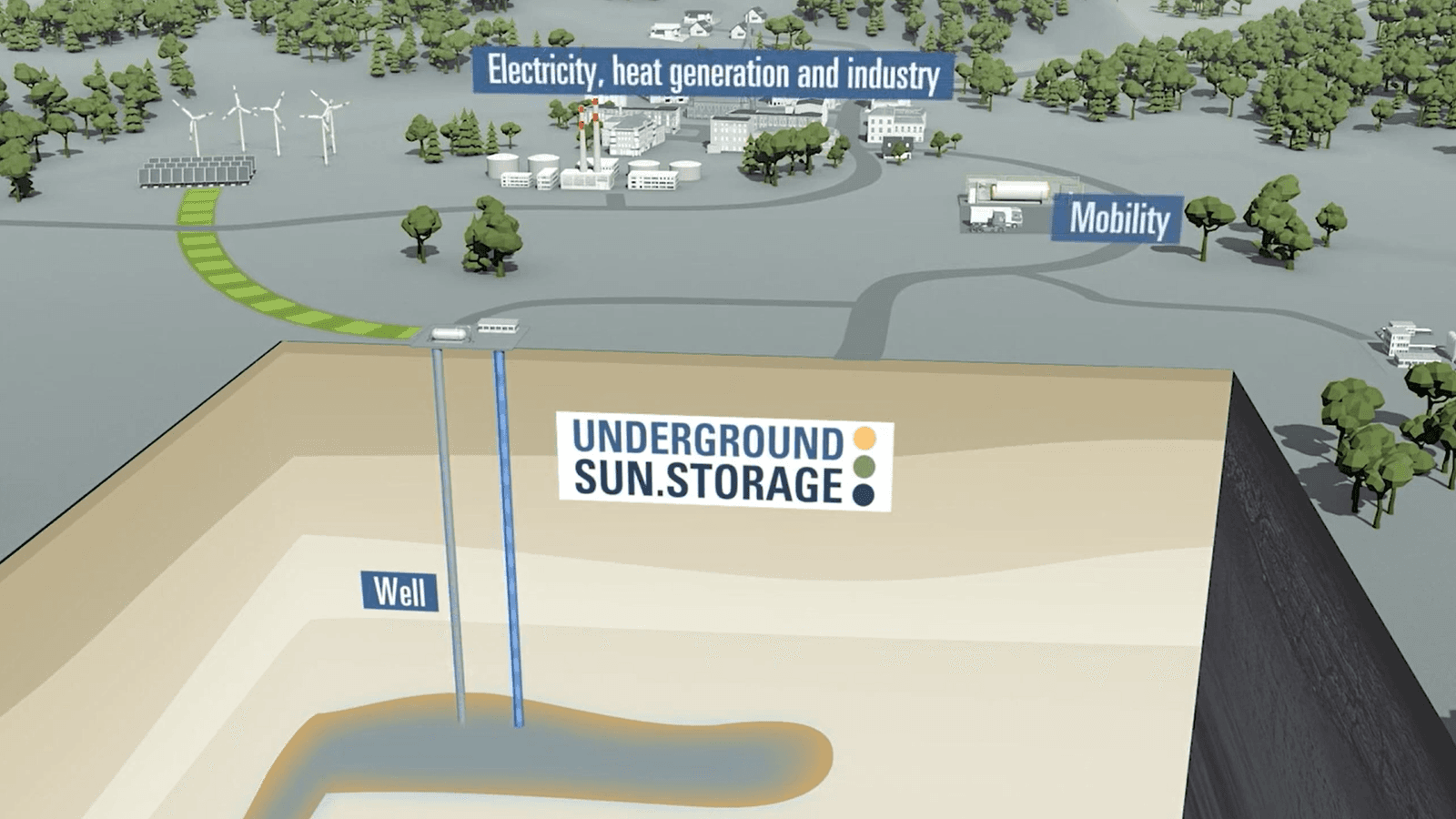
According to Steinegger, the Product Manager of Containerised Solutions, “the hydrogen gets produced via an electrolyser, and through that process the hydrogen’s produced already with a certain pressure, and this gets stored in the reservoir more than 1,000 meters below us".
“When the demand is there, the valves can be opened and the energy can flow. In that case, the energy will flow to the CHP power plant, and then it gets transformed from H2 to electricity and to heat.”
More from Enlit on the Road Austria:
Why repowering wind farms is a win-win for companies and communities
How intelligent flexibility can make renewables more profitable
How viable is e-mobility in Austria as a source of power grid flexibility?
Here, one of the specialties is that the engine can run also on not-clean or not-pure H2, which is a big advantage...
Key to the system’s benefits, says Steinegger, are its flexibility and resilient nature.
Dual-gas engines, INNIO’s Jenbacher technology, at the CHP plant can operate on different gases, ensuring uninterrupted heat and power even if the hydrogen supply is limited.
Steinegger said: “If there is no hydrogen available, the system can be supplied with natural gas from the pipeline, so it can always produce heat and power.
“If there is only a mixture available, it can also produce energy safely. Here, one of the specialties is that the engine can run also on not-clean or not-pure H2, which is a big advantage, especially for these kinds of installations where hydrogen is stored in a porous sandstone reservoir.”
Additionally, he adds, the engine’s quick response times provide a high level of resilience. "Gas engines have very rapid starting times. In this project, we have starting times under 300 seconds. [Depending] on the customer requirements and the application they need it, the system can [be] completely customised for that."
Rubensdorf [gave] us the first information, the first experience to operate storage with hydrogen. We need this information to scale it up.
A major benefit from the system for operators, according to RAG Austria’s Head of Gas Storage Operations, Stefan Lehner, is hydrogen storage’s predictability “to calculate the costs for energy".
"When we have hydrogen for energy, we can calculate it for a long time, not day-by-day. The big advantages for hydrogen is you can store it for a long time and in big volumes."
Additionally, says Lehner, Rubensdorf marks both a demonstration site and a blueprint for future expansion.
“Rubensdorf [gave] us the first information, the first experience to operate storage with hydrogen. We need this information to scale it up. Success from this year would, down the line, translate into additional facilities.
Also of interest: OMV secures €123m for largest green hydrogen project in Austria
“In 15 years I hope we’d have two, three big facilities for hydrogen storage here. For example, here for 14 years we have built up the first natural gas storage facility. Ten, 15 years later, you build a bigger one and this goes, we think, the same with hydrogen.”
Steinegger added: “We've proven that the system is working. That means the technology is here, so we can use it. We need strong partners that are also ready to move… and want to change the energy future green.”
Watch the full video for more insights on the project’s replicability, the key advantages behind hydrogen for storage, what to consider when scaling up this technology, and how the Underground Sun Storage project moves the needle for Europe’s energy transition.
Most popular
Join the community for freeAnd get access to all content
Related companies
INNIO Jenbacher GmbH & Co OG
Latest content
Partner content
+5
The future of district heating: A relay race to clean energy
Decarbonising district heating is not a leap into the unknown but a measured relay race, with today’s gas-fired plants evolving into energy hubs that underpin a future powered by renewables and zero carbon fuels.
- Guest/partner contributor
- 26/11/2025