Hydrogen delivers power and heat at commercial airport in UK first
Pamela Largue
Posted on: 30 October 2025
A CHP system powered the airport terminal, runway lighting and met heating demand.
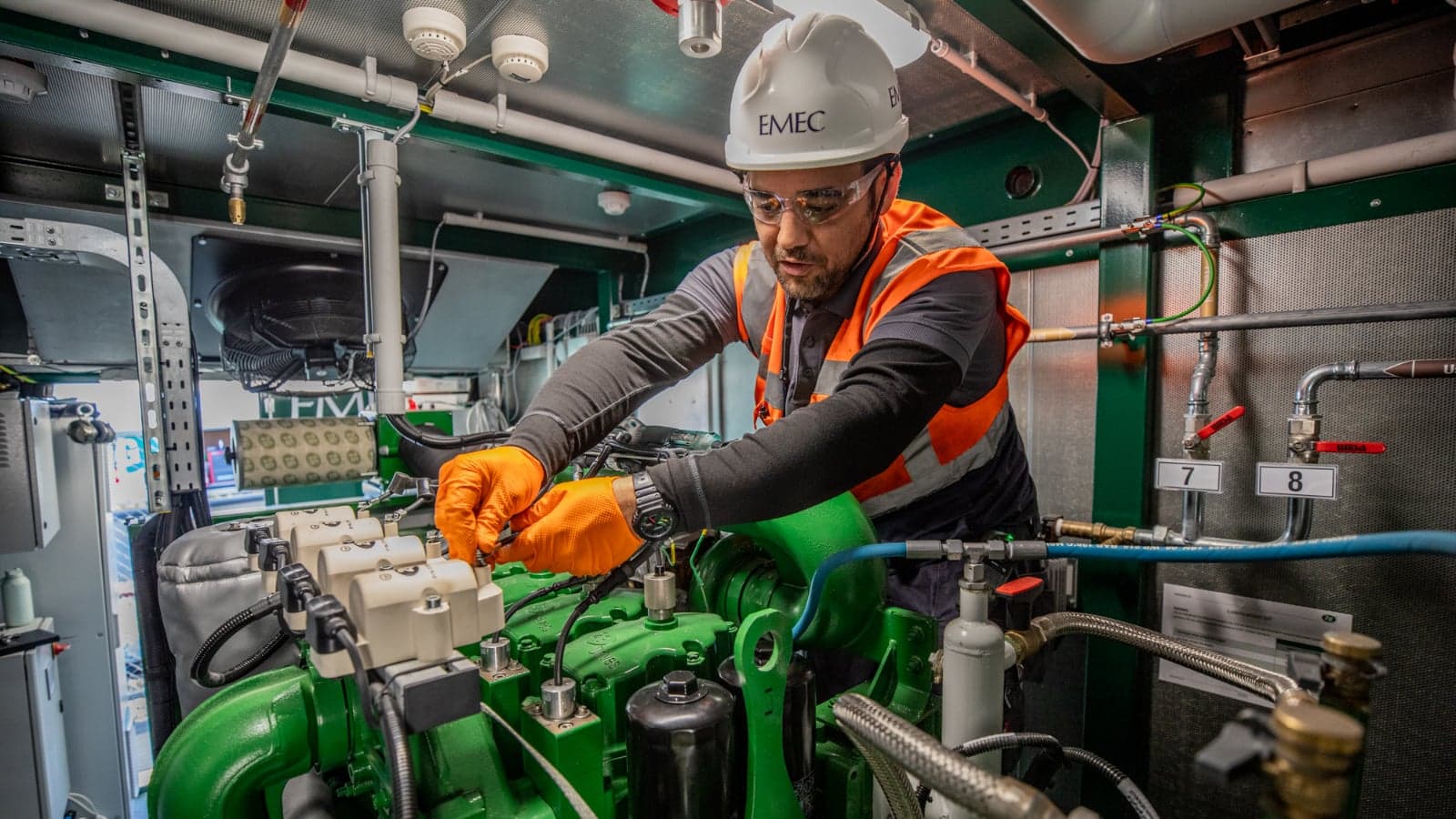
The European Marine Energy Centre has completed a novel hydrogen combustion engine technology trial at Kirkwall Airport in Orkney, UK.
A combined heat and power system manufactured by 2G used green hydrogen supplied by EMEC to generate electricity and recover heat.
It was positioned airside at Kirkwall Airport and coupled with the airport’s existing heating system to supply heat to the main terminal building and power across the entire site.
EMEC explained that as part of the trial, additional electrical loads were activated to test the system, allowing the CHP to supply a steady output.
Have you read?
EMEC and FLOWRA partner to develop floating wind test site
Orkney: small islands with global ambitions for marine energy
During the trial, CHP powered the airport terminal and runway lighting, and the system was able to meet the heating demand while running at 60% capacity without the need for the airport’s boilers to run.
EMEC claims that it is the first time hydrogen has been used to meet both the power and heat demands of a commercial airport in the UK, and will advance the integration of hydrogen technologies with airport infrastructure in the future.
Leonore Van Velzen, operations and maintenance manager at EMEC, said: “This trial is a great example of collaboration in action, combining EMEC’s hydrogen expertise, the technical capabilities of 2G, and the operational insight of the airport team, specifically the airport fire service.
"Seeing hydrogen deployed in a live airport environment is a significant step forward in exploring practical decarbonisation solutions and we’re proud to have supported the safe delivery of this first-of-its-kind demonstration.”
Mark Holtmann, managing director at 2G, said: “Demonstrating how hydrogen can reliably deliver both power and heat in such a critical infrastructure setting is an important step towards decarbonising energy-intensive operations."
Energy Transitions Podcast: Marine energy - From bathtub to the big blue
The initiative formed part of a broader programme led by EMEC and Highland and Islands Airports Limited to identify decarbonisation opportunities at airports. Specifically, a study was conducted by EMEC under the ReFLEX Orkney project, which revealed that space and water heating in the airport terminal accounted for the largest source of greenhouse gas emissions after aircraft operations.
The project was funded by the Scottish Government via Highlands and Islands Enterprise and supported by the Sustainable Aviation Test Environment and Rural Energy Hubs projects.
Hydrogen on Orkney
Orkney has an abundance of renewable energy: so much so that parts of the electricity grid routinely hit full capacity and wind energy generators have to limit production or stop completely, states EMEC.
To prevent wastage of valuable renewables, EMEC has been working on several projects relating to hydrogen production.
One project that started in 2015 was Surf ‘n’ Turf, the first community project in Orkney to harness wind and tidal power for hydrogen production.
A 500kW electrolyser was set up at EMEC’s tidal test site on Eday. The hydrogen generated at the site was stored then transported in specially designed hydrogen storage trailers. The hydrogen was then shipped to Kirkwall where a 75kW fuel cell housed at Kirkwall Pier could convert hydrogen back to electricity to be used as auxiliary power for the ferries when docked in the harbour.
The project proved pioneering when in August 2017 the world’s first tidal-powered hydrogen was generated at EMEC’s tidal test site.