INESC ID Cluster: From pilots to practical energy solutions
Areti Ntaradimou
Posted on: 6 May 2026
In this episode of the EU Energy Projects Podcast, we look at one of the most important questions in Europe’s energy transition: how do we move from promising pilots to solutions that work in real life?
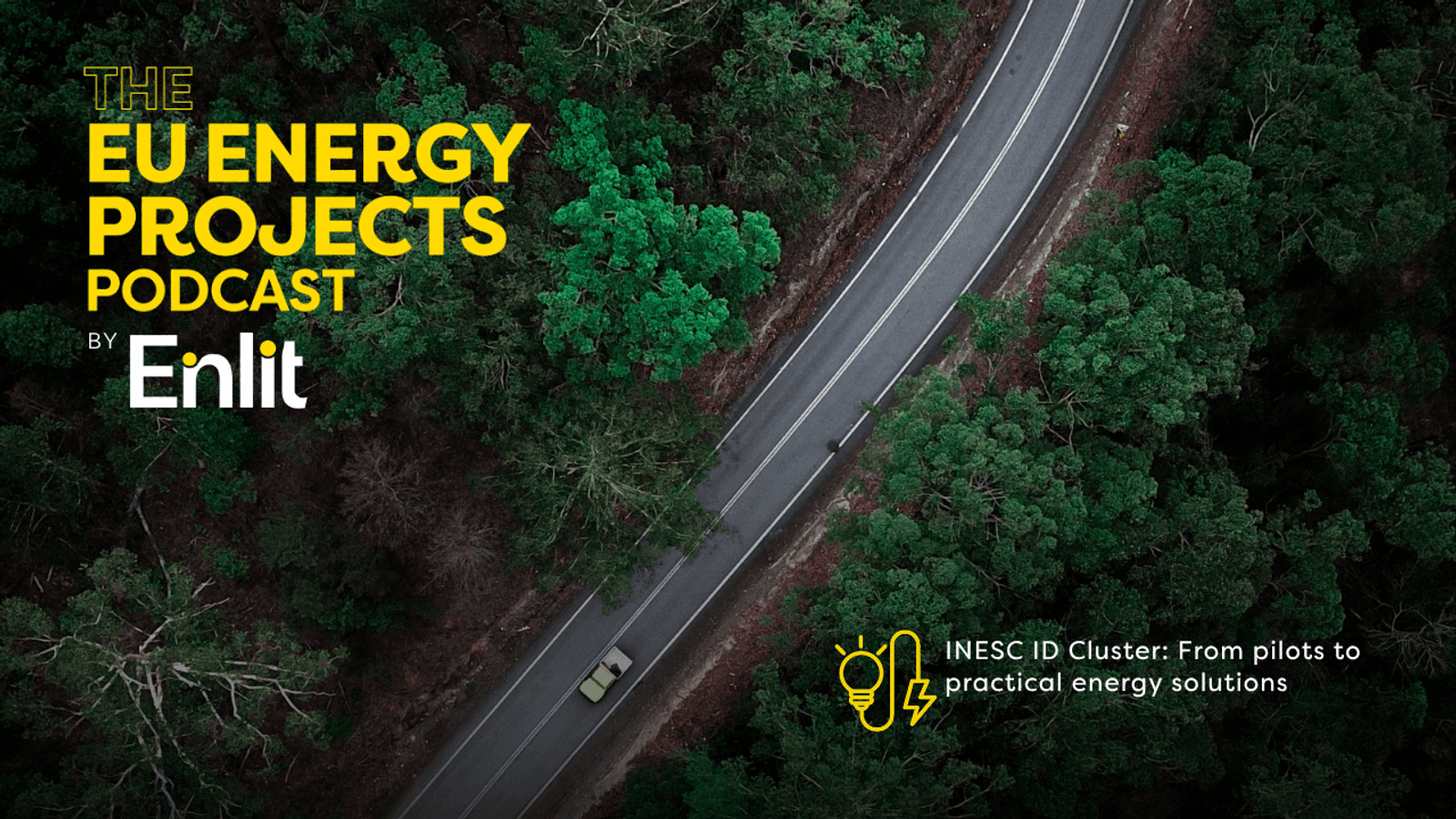
In this episode of the EU Energy Projects Podcast, I am joined by Hugo Morais from the INESC ID cluster, representing three EU-funded projects: SHIFT2DC, U2Demo and EV4EU.
While the projects focus on different parts of the energy system, they share a common ambition: to support electrification, increase flexibility and make energy assets more visible, controllable and useful for the grid.
SHIFT2DC explores the potential of direct current solutions in buildings, data centres, industry and ports. The logic is simple but powerful: many of the technologies we use today, from PV panels and batteries to EV chargers and servers, already operate in DC. Reducing unnecessary conversions could therefore improve efficiency and support decarbonisation.
U2Demo focuses on energy communities and real-life demonstrations. Here, the challenge is not only technical. As Hugo explains, integrating heterogeneous systems is difficult, but regulation can be just as complex. Different countries have different rules on governance, for example or in sharing flexibility services, which means tools often need to be adapted country by country.
EV4EU, which is approaching its conclusion, brings the electric mobility angle. Among its key results is a prototype bidirectional charging station using CCS technology, as well as open source tools for charging point operators. Yet the conversation also makes clear that electric vehicles will only become real flexibility assets if users are engaged, infrastructure is ready, and business models properly reward participation.
What stands out in this discussion is that digitalisation is not just a nice addition. Without data, there is no control; without control, there is no intelligence; and without intelligence, the benefits remain limited.
Still, I remain slightly skeptical about how fast markets and regulation can adapt. Hugo is more optimistic, pointing to lower thresholds for flexibility participation in some countries and to future EU calls focusing more on large-scale pilots.
Perhaps the answer is not pilots or deployment, but both: robust testing where technologies are still maturing, and larger scale replication where they are ready. Europe needs both the evidence and the ambition.