New EU energy director general calls for electric revolution
Jonathan Spencer Jones
Posted on: 10 June 2026
In her first public address at EUSEW 2026, new energy director general Céline Gauer focussed on electrification as key for the energy transition.
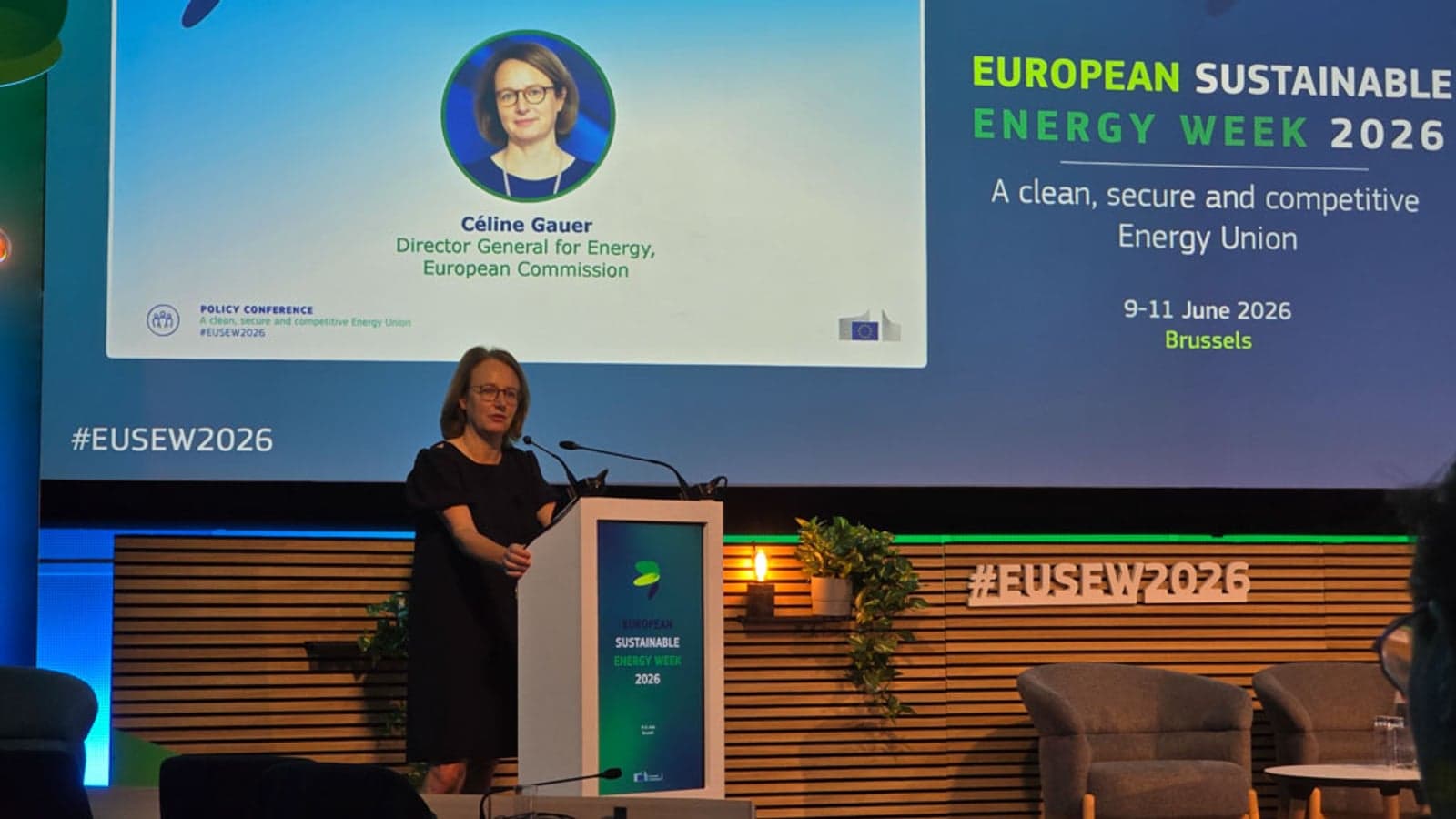
Electrification is key for strengthening resilience and reducing the dependency on fossil fuels, said Céline Gauer, opening her keynote with comments on how energy policy has shifted over the past decade from liberalisation and market integration to resilience and competitiveness.
Highlighting the current top challenge of high energy prices in the current energy crisis from the extra costs of imports, she said the case for electrification is easy to make: it can be home grown, low carbon and therefore affordable.
However, despite progress – such as the more-than 500,000 EVs registered in the EU and more than 400,000 heat pumps sold in Q1 of 2026 – electrification is stagnating and neither sufficient nor fast enough and what is needed is a real electricity revolution.
“We did it in the last century and we need to do it again so Europe can become the first electric continent.”
Also of interest
EUSEW 20: out of Brussels and into an empowered Europe
How the energy-economics nexus is driving the energy transition
Barriers and costs
And that will be what the upcoming electrification action plan is planned to achieve.
Gauer commented that there are several barriers to electrification to address. These include the upfront investment, costs of electricity, insufficient infrastructure, lack of skills and in some sectors the need for innovation.
“The plan will offer a pathway to addressing these barriers in all the relevant sectors, transport, buildings and industry, and more broadly electrification will be at the core of the post-2030 framework we are designing,” she said.
“We need predictability and a trajectory that doesn’t change for investors,” she continued, noting that while 20 years is a long time in terms of a human lifetime, it is short for changing energy mixes and energy systems.
Gauer also noted the latest investment estimates for the sector at €660 billion annually from 2026 to 2030 and close to €700 billion annually post 2030, commenting that this will be possible only by combining public and private investment options.
“The open investment strategy gives us the springboard to strengthen the financing capacity, foster innovation in new technologies and improve coordination between investors, policy makers and public banks,” she said.
Support also will come from the newly announced €75 billion three-year package to support the energy transition from the European Investment Bank.
It also requires taking account of efficiency gains that can be made with investment in the digitalisation of the grids and the use of demand side response as well as investments in those end use sectors.
Market reforms
The other key element Gauer mentioned is market reforms, saying that investments are most effective when combined with such reforms because those new market frameworks are implemented at the national level.
Citing the EU’s recovery and resilience plan and combined reform and investment strategies from the UK and Netherlands – the latter comprising a reform package with €1.4 billion in subsidies to support 600,000 residential energy efficiency improvements – she said the post 2030 national energy and climate plans should provide a good framework.
“We want to create a framework with this smart combination of investment and reforms to unlock the necessary support.”
In conclusion, Gauer said she intends to work with all stakeholders in delivering these objectives as they cannot be delivered by the Commission alone and in particular she encouraged responses to open consultations.
“I am new here and know a few faces and really look forward to working all of you on this important package and on increasing the sustainability, security and affordability of our energy systems.”