OMEGA-X – towards an energy data space for Europe
Guest/partner contributor
Posted on: 16 January 2025
The EU-funded OMEGA-X project is aimed to establish an energy data space based on common European standards.

The EU-funded OMEGA-X project is aimed to establish an energy data space based on common European standards.
Energy systems are rich in valuable data, but it is often under-utilised. For example, there is no single data platform connecting data from generation, transmission, distribution and consumption in the European power sector or between the different energy vectors, electricity, gas, heat, etc.
Barriers also involve the lack of appropriate mechanisms and policies to ensure secure, sovereign and fair data exchange.
Components of OMEGA-X (Orchestrating an interoperable sovereign federated Multi-vector Energy data space built on open standards and ready for GAia-X) include a federated infrastructure, data marketplace and service marketplace to enable data sharing between different stakeholders.
Its value is to be demonstrated in real and concrete energy use cases and needs, while guaranteeing scalability and interoperability with other data space initiatives, not only for energy but also cross-sector.
To achieve this, a series of objectives are envisioned, namely:
● Aligning to a data space standard architecture
● Shaping, building and operating a data and services marketplace
● Proposing effective data governance models
● Demonstrating how a data space can be relevant for all energy actors in concrete case studies
● Achieving data space interoperability both within and outside the project
● Following a multi-vector approach
● Focusing on iteration and cooperation, and
● Integrating a user centric and collaborative approach.
OMEGA-X data space architecture
How will OMEGA-X achieve these ambitious objectives?
Among the technical building blocks is the compliance services, and specifically the Gaia-X Digital Clearing House for verification against the Gaia-X rules, and thus obtaining compliance in an automated way and assuring distributed and decentralised operation.
In order to ensure interoperability with both the Gaia-X and IDSA approaches to identity management and trust, the solution obtains a digital identity at IDSA using a Dynamic Attribute Provision Service (DAPS), and as an alternative has the option to use SSI credentials instead, as suggested by Gaia-X.
The OMEGA-X platform also includes a Gaia-X-based catalogue, which allows producers to share their offerings. Two main roles are considered: the participant provider and the federated catalogue.
With this, the solution aims to make possible interoperability and federation, as well as to provide advanced search capabilities.
As the next step, OMEGA-X employs a data space connector to establish a contract. This is a managed connector to establish a link between data sources and consumers, where the control plane of the connector triggers contract negotiations with other connectors. Hence, a data offering can be provided, checked and eventually consumed.
There also is a set of APIs to perform internal and external connections and strengthen interoperability, built using OpenAPI as the standard for OMEGA-X APIs. Current endpoints associated to components from the initial version of the platform include those associated to identity, data connectors, vocabulary and the marketplace
Finally, the OMEGA-X data and app marketplace acts as the main ‘entry point’ for users in the data space, offering an intuitive graphical user interface with core management operations, such as registration, management of data/service offering, searching and contracting of offerings, as well as management of participants.
The marketplace enables the discovery and contracting of OMEGA-X services which support the realisation of the different use case families across the project’s pilots.
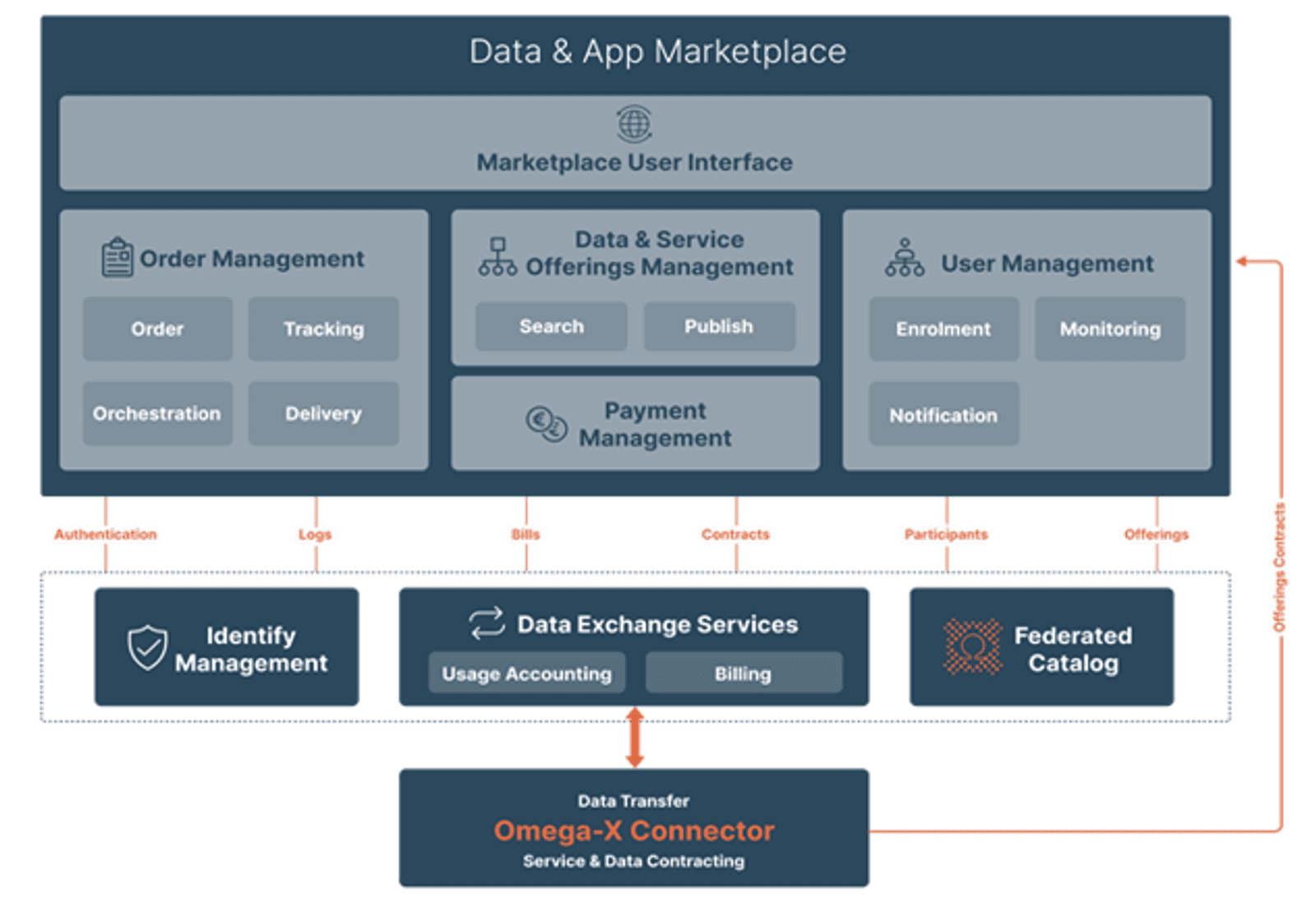
OMEGA-X architecture
Up to four use cases families will be showcased to demonstrate the value of a common data space for a particular problem identified by energy stakeholders.
OMEGA-X has identified and engaged nine pilot sites across the identified use case families, where innovative analytics services will be implemented and tested:
● Local energy communities (LEC): 4 pilot sites in Belgrade (Serbia), Granollers (Spain), Osimo (Italy), Evora (Portugal).
● Renewables (REN): 3 pilot sites in Narbonne (France), Caravaca (Spain), Córdoba (Spain).
● Electromobility (EM): 1 pilot site in France/Belgium.
● Flexibility (FLEX): 1 pilot site in Maia (Portugal).
The proposed business model for OMEGA-X will consider the interests of all involved stakeholders and identified target groups, and it will be based on a business model logic that promotes a sustainable approach to value creation, delivery and capture.
For instance, OMEGA-X will enable the deployment of spatially distributed assets to provide flexibility services to the DSO. From an economic point of view this will allow creating a new business model for flexibility providers by creating new revenue sources.
Related tags
Latest content
+6
OMEGA-X – designing an energy data space
OMEGA-X, a European Union-funded project, concludes in April 2025 after a three-year lifespan aimed to revolutionise the energy sector by establishing a federated, multi-vector energy data space underpinned by open standards.
- Guest/partner contributor
- 24/04/2025
+6
RECreation: A digital platform to manage energy communities with support for flexibility markets
In the context of the BeFlexible project, the RECreation renewable energy communities management digital platform has been enhanced to participate in local flexibility markets.
- Guest/partner contributor
- 18/09/2025
Latest in Digitalisation
All articlesPartner content
+1
Digital water management: Empowering utilities with scientific decision-making
As urban water distribution networks continue to expand and water resource management becomes increasingly complex, water utilities are facing growing operational challenges.
- Guest/partner contributor
- 03/07/2026