Powering utilities via smart metering and energy intelligence
Yunus Kemp
Posted on: 19 May 2026
Smart metering improves operational efficiency by reducing manual meter-reading errors, enables remote operations, says William Liu, INHE GROUP Vice President
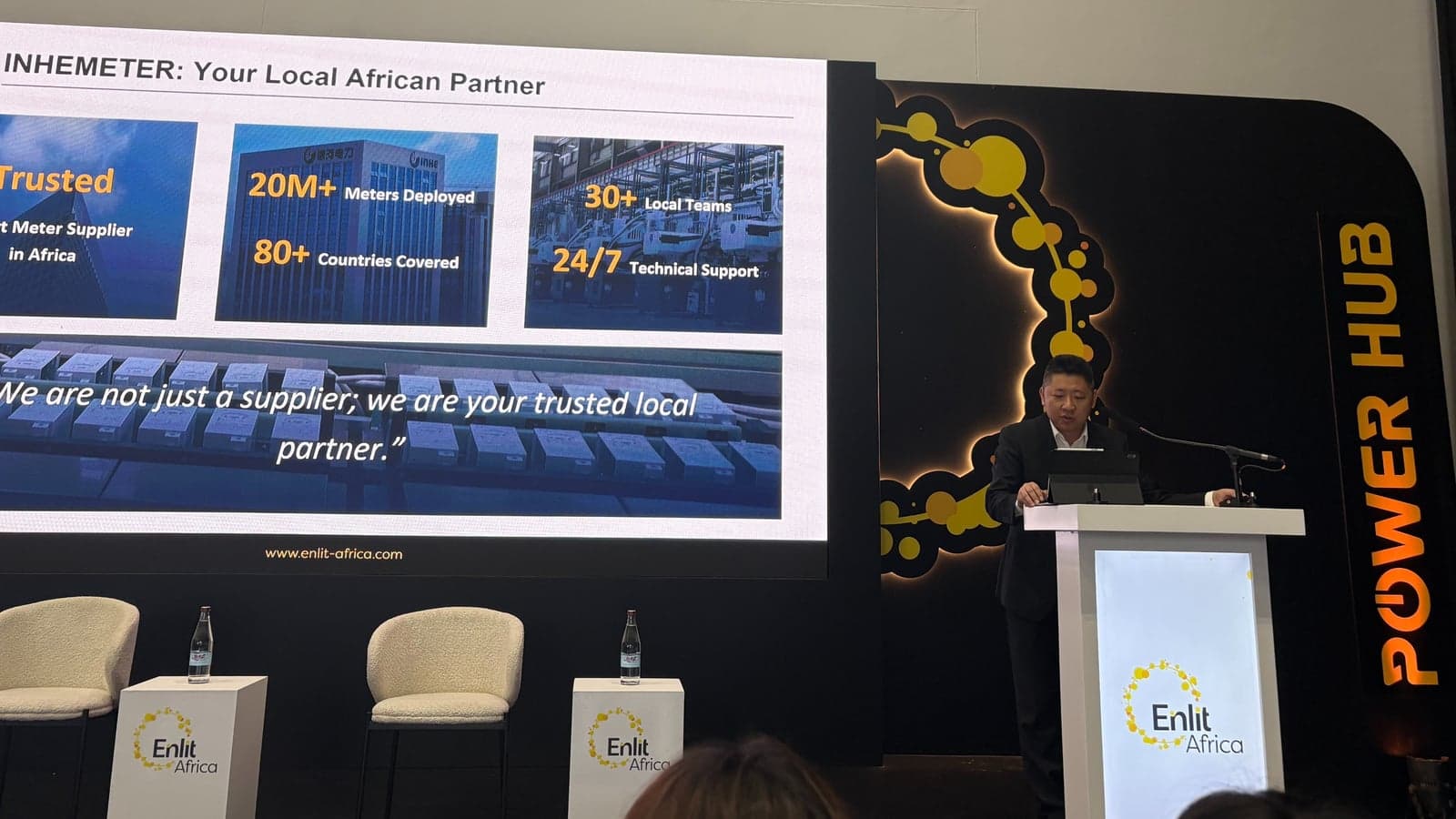
The electricity meter has evolved from primarily being used as a tool for measuring usage to becoming the first intelligent interface between the utility, the grid, and the customer.
This was the central message on the opening day of Enlit Africa in Cape Town from William Liu, Vice President of Technology for INHE Group and the Dean of the INHE Electrical Power Institute, where he focuses on the future of energy digitisation and the global energy transition.
Liu is a leading expert with more than 20 years of experience in the smart metering and smart energy industry.
In his presentation – Powering Digital Utilities: An End-to-End Smart Metering & Energy Management Ecosystem – Liu pointed out that across emerging markets, utilities are accelerating smart meter deployment, modernising electricity services, and increasing investment in digital automation.
Worldwide deployment of smart meters
“South Africa is a strong example of this trend, with growing demand for smart metering solutions. Municipal utilities are improving operations and adopting more advanced systems, but they also face significant challenges: unstable infrastructure, limited resources, and ongoing cash flow pressure.
“For this reason, any solution deployed today must be reliable, flexible, secure, and adapted to local operating conditions,” said Liu.
The company, said Liu, has so far deployed more than 20 million meters across over 80 countries, with local service capabilities in many emerging markets.
“Utilities need more than products… they also require training, logistics support, and operational efficiency. We are not simply a smart meter supplier; we are a long-term partner to utilities.
“Our mission is straightforward: to build trust with local partners and support sustainable utility transformation.”
So, what does an end-to-end smart metering and energy management ecosystem provide?
Lui said it begins with real-time data collected from smart meters. That data is integrated into a central smart system, which generates actionable insights.
“These insights then help utilities improve operational performance. It becomes a continuous cycle of optimisation and improvement.”
“To support this cycle, a robust digital architecture is essential. The smart meter provides accurate, real-time data collection. The communications network ensures secure connectivity and remote-control capabilities.”
Have you read?
Europe’s energy reality check: We cannot solve every crisis with fiscal escape clauses
Powering progress: Putting people at the heart of the energy transition
Smart meter functionality
Together, these components, among others form a connected digital ecosystem.
“Data flows from the meter to the platform, enabling operational decision-making and ultimately feeding back into the system to create a closed-loop process.
“As a result, utilities can improve performance, reduce operational costs, and deliver better services to customers. At the heart of this ecosystem is the smart meter itself,” said Lui.
He highlighted that today’s smart meter is far more than a basic measuring device.
It supports key functions including:
- Local tariff configuration;
- GPS positioning;
- Remote connection and disconnection;
- Accurate billing;
- Temperature detection;
- Abnormal consumption alerts;
- Voltage monitoring; and
- LV measurement for consumers.
“Even when communications are temporarily unavailable, the meter must still store data securely and support local control functions. In other words, it must operate as a secure, intelligent edge device… not merely a simple counter.
“For utilities, the benefits are highly practical,” said Liu.
He said smart metering improves operational efficiency by reducing manual meter-reading errors and enables remote operations.
“It strengthens revenue protection through tamper detection, abnormal consumption monitoring, line-loss analysis, prepayment systems, and real-time tariff control. These capabilities improve cash flow and help reduce arrears.”
A customer centric approach
But digital transformation is also about the customer experience.
Liu said today’s customers expect convenient, digital-first services. They want to pay via mobile phone, monitor their electricity usage, receive low credit alerts, and report issues quickly and easily.
Customer mobile applications improve the user experience while reducing pressure on customer service teams.
Ahead of Enlit Africa, INHE announced that its subsidiary, INHENERGY, had officially secured the Bureau Veritas Spain grid-connection certification for its HI-7~10K-SL2 single-phase LV storage inverter series, “fully complying with UNE 217001, UNE 217002, and NTS 631 standards.”
“This milestone underscores our commitment to technical compliance and asset safety in Europe. INHE GROUP remains dedicated to empowering grid-tied assets worldwide with efficient smart power solutions,” the company reported.
The group also exhibited at last year’s Enlit Europe in Bilbao, Spain
“As the EU continues to push energy transition and grid digitalisation, Europe is entering a new phase of large-scale smart meter replacement. The demand for reliable and compliant smart metering solutions is growing rapidly. As a key player in the global smart metering industry, INHE is actively expanding in the European market,” the company said at the time.
Enlit Africa is at the Cape Town International Convention Centre running 19-21 May.
Related tags
Latest in Digitalisation
All articlesPartner content
+1
Digital water management: Empowering utilities with scientific decision-making
As urban water distribution networks continue to expand and water resource management becomes increasingly complex, water utilities are facing growing operational challenges.
- Guest/partner contributor
- 03/07/2026