Skeleton unveils tech to keep the AI data centre lights on
Enlit Editorial Team
Posted on: 4 June 2026
As grid operators tighten connection codes, data centre deployments face increasing challenges in meeting grid stability requirements.
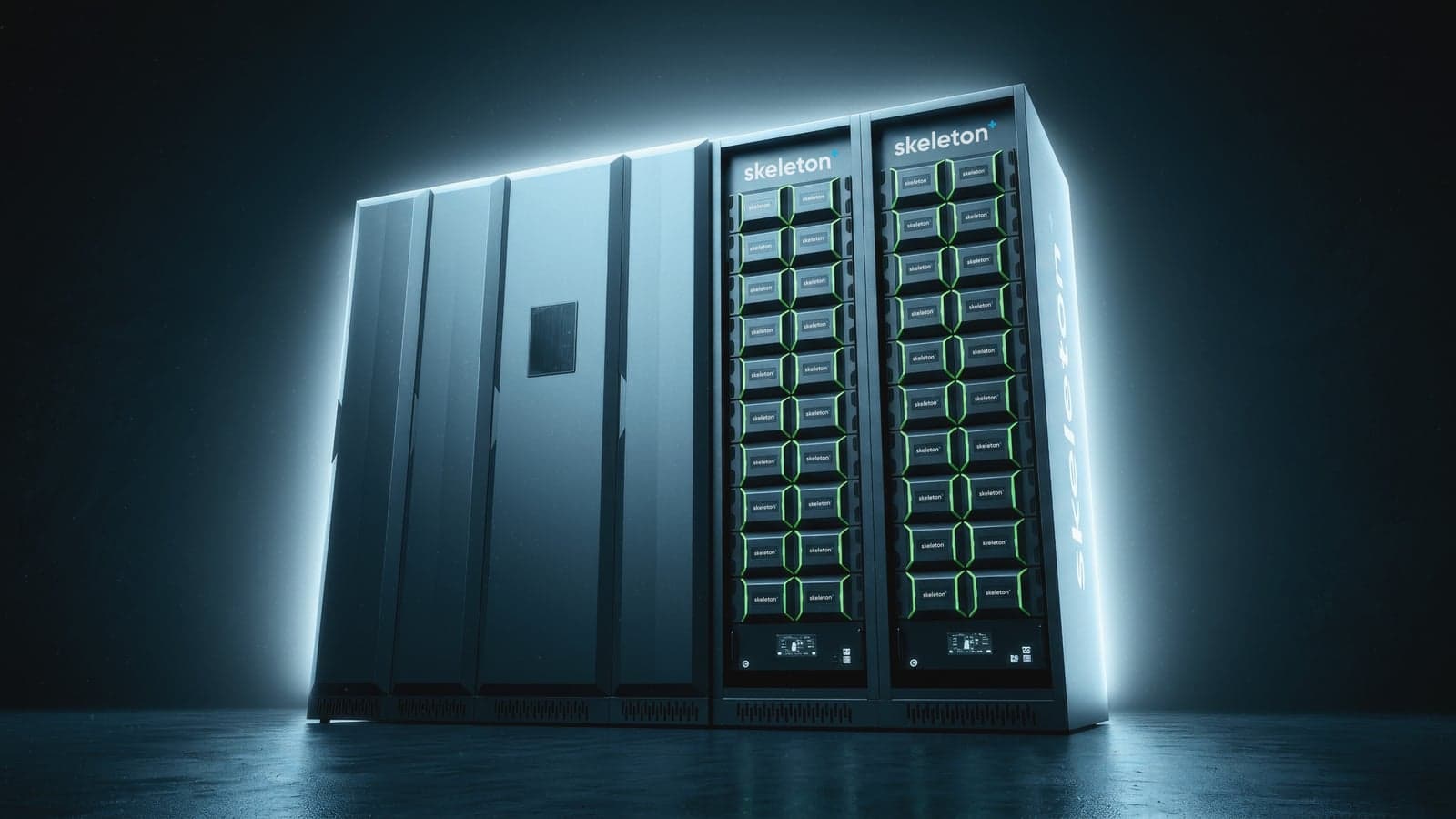
A global AI infrastructure and grid power systems provider has launched technology that provides an uninterruptable power supply for AI infrastructure.
Cost-of-downtime industry benchmarks show that a power outage at an AI data centre can cost up to $1 million per hour, destroy training data, and cause cascading problems across the grid.
And as grid operators tighten connection codes, data centre deployments face increasing challenges in meeting grid stability requirements.
The risks are rising, said Skeleton Technologies, as it unveiled its GrapheneUPS system - a high-density UPS made in Europe with cutting edge technology to provide an uninterruptable power supply for AI infrastructure.
Skeleton builds AI infrastructure globally, delivering to US hyperscalers while pushing for European AI sovereignty.
Keeping the AI lights on
The GrapheneUPS system delivers continuous power protection while enabling compliance with increasingly stringent data centre grid connection requirements, the company said.
“As grid operators tighten connection codes, data centre deployments face increasing challenges in meeting grid stability requirements. GrapheneUPS addresses these challenges by enabling reliable compliance with grid connection standards.”
Skeleton noted that unlike conventional UPS architectures, double conversion systems continuously convert incoming AC power to DC and back to AC, isolating critical AI equipment from utility disturbances.
“GrapheneUPS builds on this by actively stabilising grid power, mitigating fluctuations during events such as voltage dips, interruptions, and grid restoration. This enables compliance with grid code requirements without additional stabilisation equipment.
“The system enables a 40% increase in computing power and up to a 44% smaller grid connection, confirming the company’s role as the only full provider of AI infrastructure power systems from data centres to the grid.”
Have you read?
AI-powered grid assistant goes open source
AI infrastructure surge reshapes private capital strategies
Reducing downtime risk
Skeleton said that by stabilising short duration disturbances and managing rapid load fluctuations, GrapheneUPS helps reduce downtime risk, protect sensitive equipment, and optimise power delivery for increasingly dynamic AI workloads.
"As grids become increasingly volatile and prone to disturbances, Skeleton’s approach is to support grid infrastructure and to ensure that data centre operations remain stable and protected through interruptions.
“GrapheneUPS acts as a resilience layer that secures continuous operation during grid incidents, shielding critical AI workloads from instability,” said Tero Järveläinen, Chief Product Officer at Skeleton Technologies.
The GrapheneUPS system can be deployed in data centre white space, grey space, or outside the facility as a containerised solution, delivering 50% lower volume for the same performance compared to competitors.
The system is designed to operate as a load proximate no-break layer near critical equipment, complementing site-level battery energy storage systems optimised for longer-duration campus energy reserve and energy shifting.
The system is aligned with evolving HV data centre roadmaps and supports integration across multiple DC voltage levels, with readiness for future higher-voltage standards.
In an AC-connected sidecar configuration, GrapheneUPS integrates with standard three-phase LV distribution to deliver stabilised DC power to IT racks, providing power smoothing and short-term backup capability, the company said.
System safety
“Safety and resilience are core design priorities. Skeleton highlights an inherently safe energy storage approach intended to mitigate key safety concerns associated with lithium-ion systems, including thermal runaway.”
Recently, Skeleton announced that it had secured initial investment which it says will enable it to meet the demand for its high power energy storage solutions that address power constraints within AI data centres.
The firm confirmed the first close of a larger funding round at €33 million, raising its total venture capital funding to €392 million in preparation for its planned initial public offering in the US in 2027.