SMARTeeSTORY preparing Europe’s historic buildings for a climate neutral future
Guest/partner contributor
Posted on: 20 March 2026
The SMARTeeSTORY project is targetting the digitalisation of historic non-residential buildings, where deep energy renovation is often not an option.
Europe is home to countless historic buildings that are not only architectural marvels but also symbols of cultural heritage. However, many of these buildings face challenges in improving energy efficiency while preserving their unique character, i.e. façade, structure, materials, etc.
The refurbishment of historic buildings is crucial for achieving energy savings and contributing to the European Union’s long-term objective of full decarbonisation. By implementing sustainable and digital strategies, these buildings can significantly reduce their carbon footprint while preserving their cultural significance and character.
Moreover, the green and digital transition in the refurbishment process can enhance the quality of life for citizens working in historic non-residential buildings by creating more comfortable, efficient and technologically advanced workspaces.
From protected heritage to smart buildings
SMARTeeSTORY develops an integrated, interoperable and cybersecure-by-design digital platform that brings together monitoring, analysis, prediction, optimisation and control services.
The approach combines physics-based and data-driven models to create accurate digital twins of historic buildings, enabling advanced forecasting and multi-domain control across heating, cooling, ventilation, lighting, electricity and user interaction.
A key innovation is the strong user-centred dimension: SMARTeeSTORY identifies occupant archetypes and preferences and aims to integrate them into real-time control strategies, ensuring comfort and acceptance alongside energy savings.
SMARTeeSTORY solutions are being validated in three real-life demonstration sites located in distinct climatic and regulatory contexts: the Riga City Hall (Latvia), the Faculty of Architecture at TU Delft (Netherlands), and the Royal Chancellery of Granada (Spain). The digital solutions prepare the three heritage buildings for future smart automations (smart readiness) while respecting preservation.
Measuring smart readiness of buildings
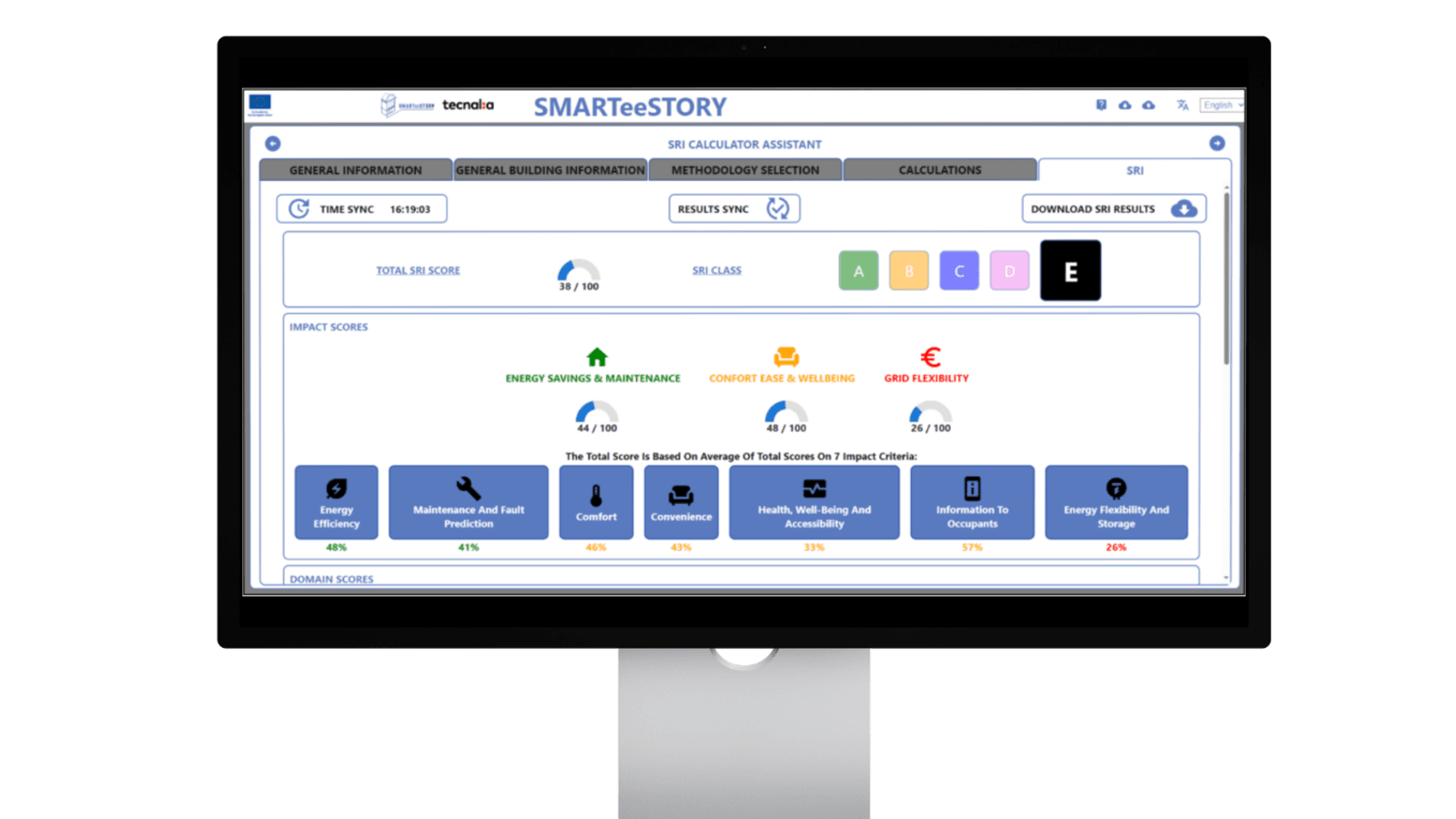
SMARTeeSTORY has created a smart readiness indicator (SRI) calculation web tool designed to support the digital and energy transition of non-residential historic buildings across Europe.
The smart readiness indicator is a European Commission framework that measures a building’s readiness to use smart technologies such as automation, digital control systems and energy management solutions. It evaluates how effectively a building can optimise energy use, adapt to occupants’ needs and interact with the energy grid.
For historic buildings, where physical interventions are often limited, the smart readiness indicator offers a structured way to identify non-invasive, smart solutions that improve comfort, energy performance and operational efficiency without compromising architectural value.
The calculation webtool (illustrated above), developed by TECNALIA, implemented the full smart readiness indicator calculation process through a guided and user-friendly interface. TECNALIA and RINA-C introduced additional functionalities:
- Target setting based on economic, environmental or energy priorities;
- Suggestions of smart solutions to increase smart readiness indicator scores based on user preferences;
- A financial module providing high level estimates of savings and return on investment through a cost-effectiveness indicator for the proposed solutions.
Together, these enhancements turn the tool into a decision-support platform that links technical assessment with practical renovation planning.
Testing on real historic buildings
The web tool was applied to assess both baseline and post-intervention scenarios for the three SMARTeeSTORY demonstrator buildings, all of which are heritage-protected.
The analysis showed substantial improvements in smart readiness. After the project intervention, Riga is expected to reach a smart readiness indicator score of 83% and Delft 77%, while Granada is projected to reach 71%, corresponding to readiness class B. The results confirm that, although achieving a perfect smart readiness indicator score is rarely feasible in real buildings, historic buildings can still reach high levels of smart readiness through carefully selected digital upgrades.
SMARTeeSTORY demonstrates that historic buildings should not be left behind in the energy transition. Through smart, interoperable and user-centred digital solutions, the project shows how energy efficiency, comfort and heritage preservation can be reconciled. As the project progresses, its results will provide valuable guidance for building owners, public authorities and technology providers seeking scalable pathways to climate-neutral historic buildings.
SMARTeeSTORY is part of the Smart Energy Cluster, collaboratively pushing smart energy innovations forward. More information, resources and updates are available at the project website.
About the author
Matteo Porta is a mechanical engineer and team lead at RINA Consulting (Italy). He specialises in energy efficiency for buildings, districts and communities, with expertise in innovative energy systems, modelling, planning, smart grids and building/district automation. He has extensive technology‑transfer experience from EU projects, including SMARTeeSTORY and STUNNED.