The rise of medium voltage direct current in the global energy transition
Guest/partner contributor
Posted on: 7 November 2025
Medium voltage direct current (MVDC) is emerging as the next important development for transmitting large amounts of decarbonised energy, essential for global electrification.
Interest in MVDC is driven by the rise of distributed energy resources (DERs) that need grid integration and the increased electricity demand from heavy industry, transportation and data centres. For certain applications, MVDC offers greater efficiency and cost savings by reducing energy losses compared to AC, especially for industries with substantial power needs. HVDC is often too high in voltage for direct industrial use, while MVDC can step down HVDC for industry or step up solar/storage voltages to HVDC for long-distance transmission.
MVDC also enables flexible conversion between AC and DC systems. The deliverable will further investigate MVDC’s role in the energy transition, present real-world applications, and highlight industry investments in related technologies.
The war of currents
Thomas Edison was a pioneer in the development and commercialisation of electric power. In the late 19th century, Edison championed the use of DC for electric lighting and power distribution, establishing the first electric utility in New York City back in in 1882.
George Westinghouse, an inventor and industrialist, later promoted AC as a superior method for distributing electricity over long distances. Westinghouse worked with Nikola Tesla, who developed key AC technologies, including the induction motor and transformers.
The rivalry between Edison and Westinghouse – known as the 'War of Currents' – centered on whether DC or AC would become the standard for electricity distribution. Ultimately, AC proved to be more practical and efficient for large-scale transmission, and Westinghouse's AC systems became the industry standard.
Edison contributed to the initial spread of electric power with DC systems, while Westinghouse (with Tesla’s innovations) enabled the widespread adoption of AC, shaping the modern electrical grid.
MVDC: A paradigm shift
While AC has dominated transmission and distribution systems for over a century, DC is experiencing renewed interest due to several advantages. DC systems offer lower power losses, require fewer cables for high capacity transmission and provide opportunity for enhanced safety through advanced protection devices and fast fault detection. Integrated DC systems also simplify design, reducing hardware, costs, and increasing efficiency and reliability.
Recent technological advancements in semiconductors and power electronic converters are enabling broader adoption of DC in modern power systems.
Several pilot projects have demonstrated the potential of MVDC distribution, notably GE Vernova’s Power Conversion & Storage business supplying Europe’s first MVDC link in the Scottish Power Energy Networks’ Angle-DC project (2016–2020). This initiative established a controllable, bidirectional DC connection between the island of Anglesey and North Wales by converting an existing 33kV AC circuit to ±27kV DC operation.
The MVDC link improved power flow management, voltage control and circuit thermal capability, helping to accommodate growing electricity demand and integrate renewable generation. The project showed that MVDC technology can reinforce distribution networks more flexibly and efficiently than traditional methods, with benefits including a 23% increase in power capacity and enhanced thermal performance.
The successful implementation has encouraged further MVDC deployment and supported the development of the MVDC supply chain in the UK. Theoretical calculations confirmed that switching from three-phase AC to two-pole DC transmission allows for higher cable capacity, using the same insulation limits but at DC voltage levels.
Key applications of MVDC
A significant and growing portion of electricity consumption in the United States – over 50% – now comes from DC-powered assets such as solar PV, energy storage, electric vehicles and various consumer devices. Several key drivers are fueling this trend: the demand for efficient and sustainable energy solutions, advances in electric transportation and EV infrastructure, and the rapid expansion of data centres and AI computing.
The increasing interest in MVDC systems is due to:
- Technological advancements: Improved power electronics make MVDC more efficient and reliable.
- Renewable energy integration: MVDC connects directly with DC sources like solar and wind, reducing conversion losses.
- Better energy storage: MVDC is well-suited for battery energy storage systems, simplifying integration and increasing efficiency.
- Long distance transmission: MVDC transmits power over long distances with lower losses compared to AC.
- Reduced infrastructure costs: Fewer components are needed, lowering both capital and operational expenses.
- Enhanced power quality and reliability: Fewer conversion stages improve power quality, especially for sensitive or high-power applications.
- Environmental and regulatory factors: MVDC aids in emission reduction and supports clean energy integration thanks to the efficiency enhancement in emerging applications.
Currently, MVDC is widely used for railways, but its advantages also benefit distribution networks, microgrids, renewables integration and industrial applications. MVDC simplifies control and reduces conversion steps in microgrids, making it attractive for data centres, industrial facilities, office buildings, electric ships and potentially broader distribution networks.
Case studies show that MVDC links can reinforce networks more efficiently and at lower cost than traditional AC upgrades, significantly improving voltage profiles and reducing losses over the assets’ lifetime.
As the MVDC market develops, large-scale grid integration of renewables and meshed DC distribution networks are expected to grow, leading to higher efficiency, flexibility, and increased grid resiliency alongside existing AC systems.
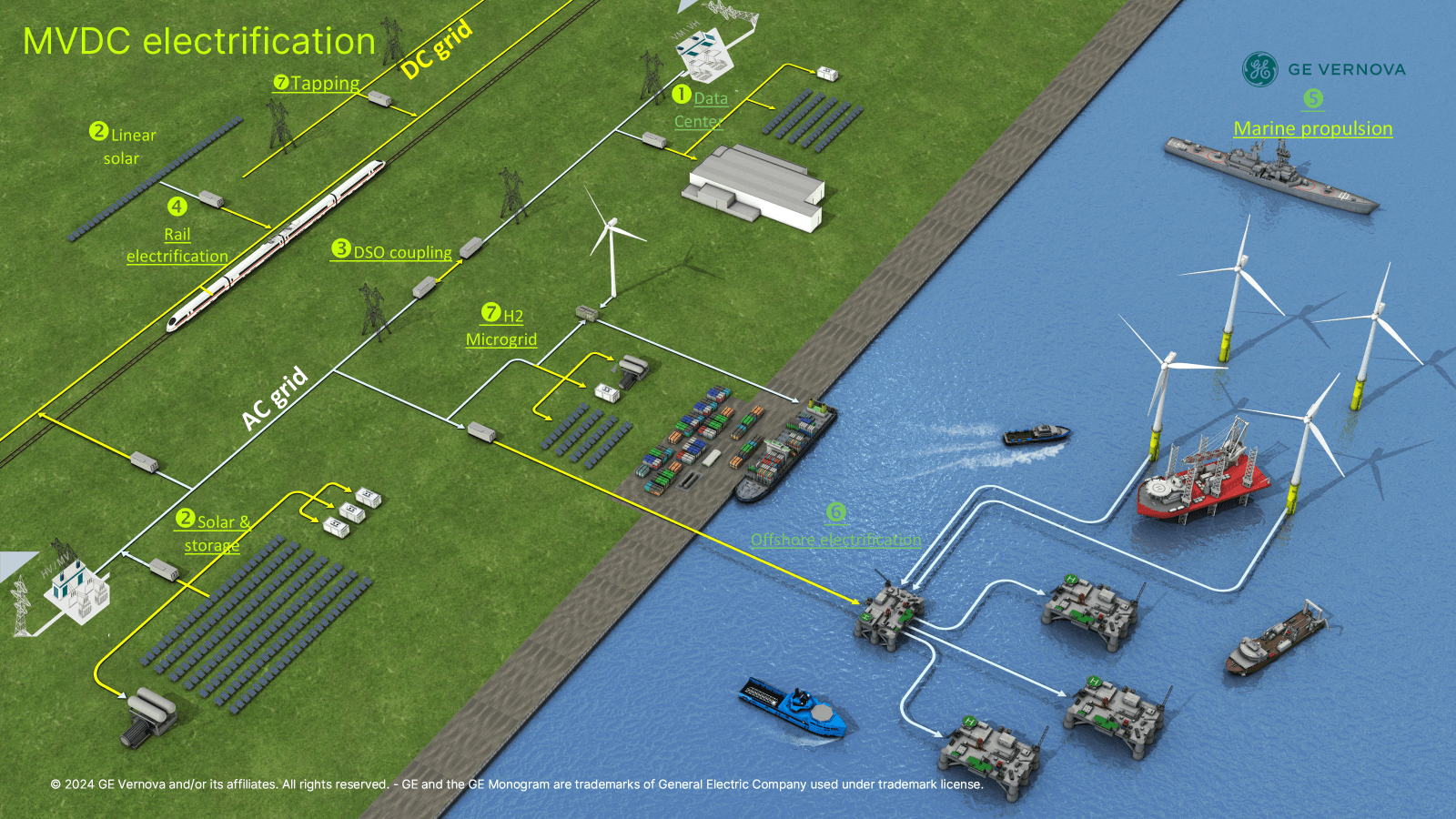
The applications being considered for MVDC include:
- MVDC utility solar and storage;
- Data centres;
- Transportation: rail and marine;
- Oil and gas offshore electrification;
- Distribution grids and transmission;
- HVDC/MVDC tapping;
- Hydrogen electrolyser power supply systems;
- Wind onshore and offshore.
Future of MVDC in the global energy transition
MVDC technology is designed to maximise energy efficiency for industries, enabling better utilisation of renewable sources like solar and wind. MVDC can provide reliable, regulated power for data centres, green hydrogen plants and energy intensive sectors such as steel, metals and petrochemicals. It also offers the potential to transform transportation by electrifying rail systems and powering ships.
By using MVDC, customers can save on energy costs and avoid expenses related to equipment needed for converting between AC and DC. To fully realise these benefits, investment in MVDC distribution infrastructure is necessary, particularly to allow industries to draw DC power at usable voltages directly from substations, bypassing the need for AC conversion.
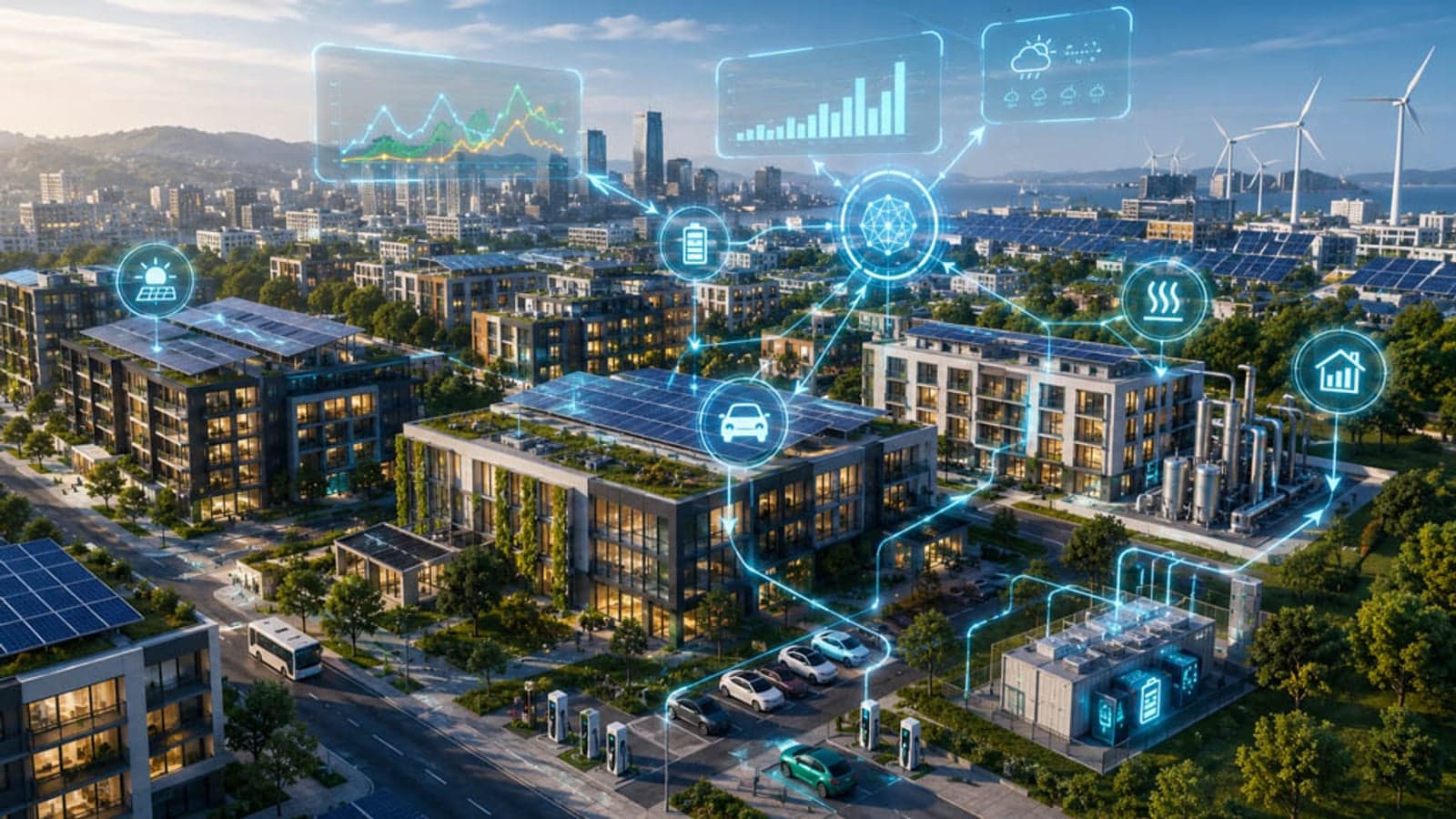
MVDC infrastructure would also facilitate direct DC connections between photovoltaics, energy storage and the grid, reducing energy losses from conversion and improving solar energy utilisation. Initiatives like the HYNET project are actively investing in MVDC research and development, collaborating with partners to explore both technical and economic advantages. Demonstration projects focused on MVDC system components
MVDC infrastructure would also facilitate direct DC connections between photovoltaics, energy storage, and the grid, reducing energy losses from conversion and improving solar energy utilization. Initiatives like the HYNET project is actively investing in MVDC research and development, collaborating with partners to explore both technical and economic advantages. Demonstration projects focused on MVDC system components – such as converters and energy storage – are essential for advancing innovation, supporting decarbonisation and helping industries’ transition to more sustainable, efficient power systems.
Follow HYNET for more interesting news.
About the authors
Samir Soua is Chief Consulting Engineer at GE Vernova.
Guillaume De-préville is Senior expert HVDC, FACTS & Power Quality at GE Vernova.
Tivon Ah Karm is New Product Introduction Programme Leader at GE Vernova.
Most popular
Join the community for freeAnd get access to all content
Related projects
HYNET
+1
1 October 2024 - 30 September 2027
View projectLatest in Digitalisation
All articlesPartner content
+1
Digital water management: Empowering utilities with scientific decision-making
As urban water distribution networks continue to expand and water resource management becomes increasingly complex, water utilities are facing growing operational challenges.
- Guest/partner contributor
- 03/07/2026