TwinEU: Empowering digital twins with data space federation
Guest/partner contributor
Posted on: 16 April 2025
The TwinEU project aims to create a federation of digital twins of the electricity grid at the pan-European level.
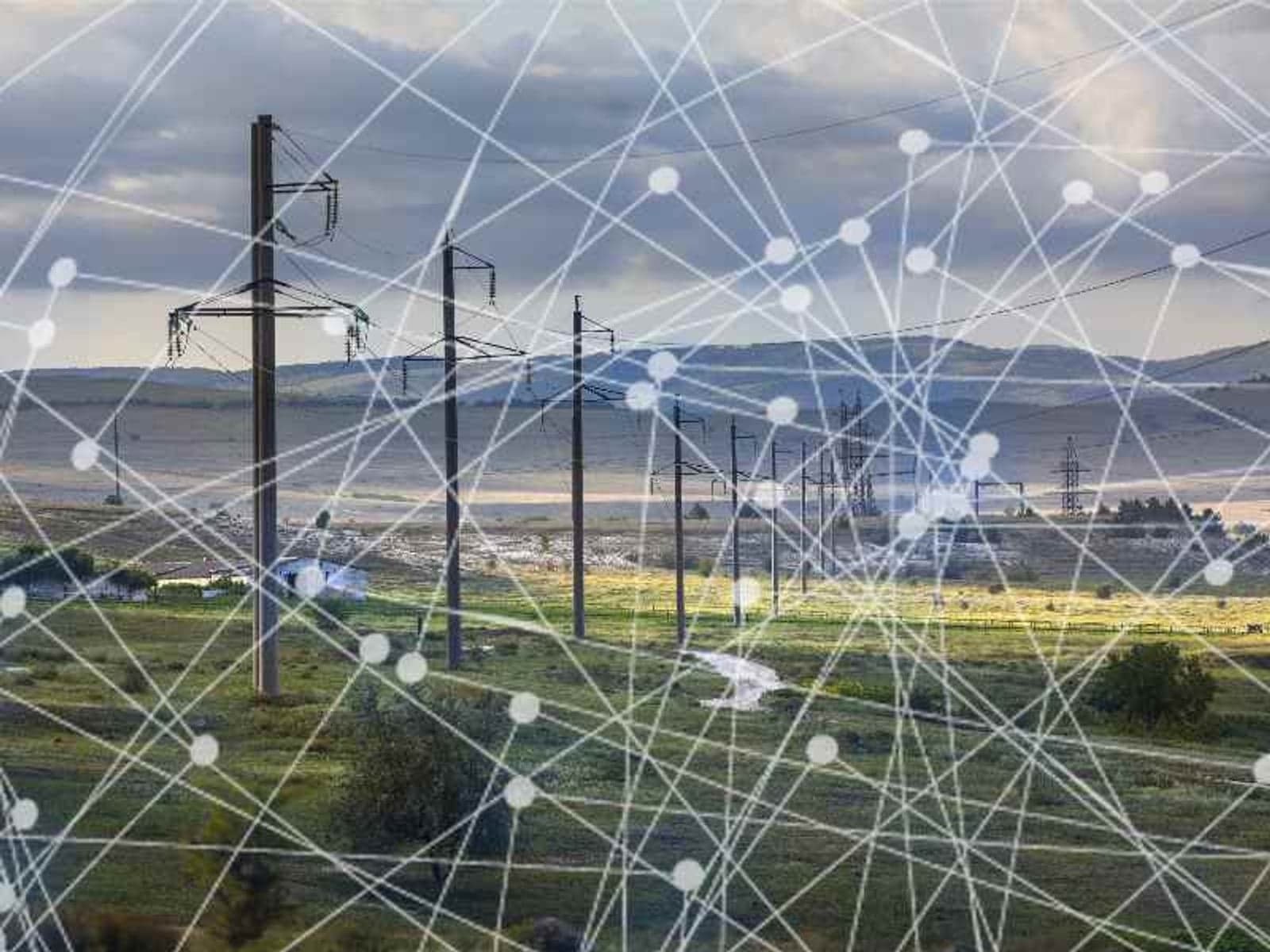
The TwinEU project aims to create a federation of digital twins of the electricity grid at the pan-European level.
In the rapidly evolving landscape of digital transformation, the concept of digital twin technology has emerged as a pivotal innovation.
Digital twins, virtual replicas of physical entities, enable real-time monitoring, simulation and optimisation of systems and processes. However, the true potential of digital twins is unlocked when they are interconnected across stakeholders and sectors, forming a federated digital twin ecosystem.
The TwinEU project will develop a sophisticated virtual model of the European electricity grid to enhance the efficiency and smartness not only the networks, but the energy system as a whole.
The creation of digital twins will be achieved through coordination in five areas: (i) observability and controllability; (ii) efficient infrastructure and network planning; (iii) operations and simulations for a more resilient grid; (iv) active system management and forecasting to support flexibility and demand response; and (v) data exchange between TSOs and DSOs.
The challenge: How to support digital twin federation in an interoperable and secure way
The implementation of federated digital twin technology presents several challenges that must be addressed to ensure its success.
Interoperability: Digital twins must communicate and share data seamlessly by using standardized protocols, data formats, and communication mechanisms. This interoperability allows for the integration of diverse systems and platforms, facilitating cross-stakeholder collaboration.
Data sovereignty: Digital twin owners must maintain control over data and models by implementing mechanisms, retaining sovereignty over their data, in a trust and cooperative ecosystem.
Scalability: It is important to provide a scalable architecture and infrastructure capable of handling large volumes of data, in order to ensure that the federated digital twin ecosystem can grow and adapt to increasing demands, supporting the integration of new business models, services, applications, and technologies such as AI, XR and IoT.
Security: It is necessary to implement robust end-to-end security measures to protect sensitive data exchanged within the federated digital twin ecosystem. These security measures maintain trust among stakeholders and ensure the integrity and confidentiality of shared data.
TwinEU digital twin federator: A data space framework for a federated digital twin
Enabling a federated ecosystem for digital twins in the energy sector is not an easy task, but the TwinEU project has a clear vision on it: implementing a digital twin federator.
The main goals of the digital twin federator are:
● Integrating heterogeneous digital twin systems,
● Orchestrating services for data and model sharing, and
● Incorporating real-world data to enhance simulation and analysis capabilities.
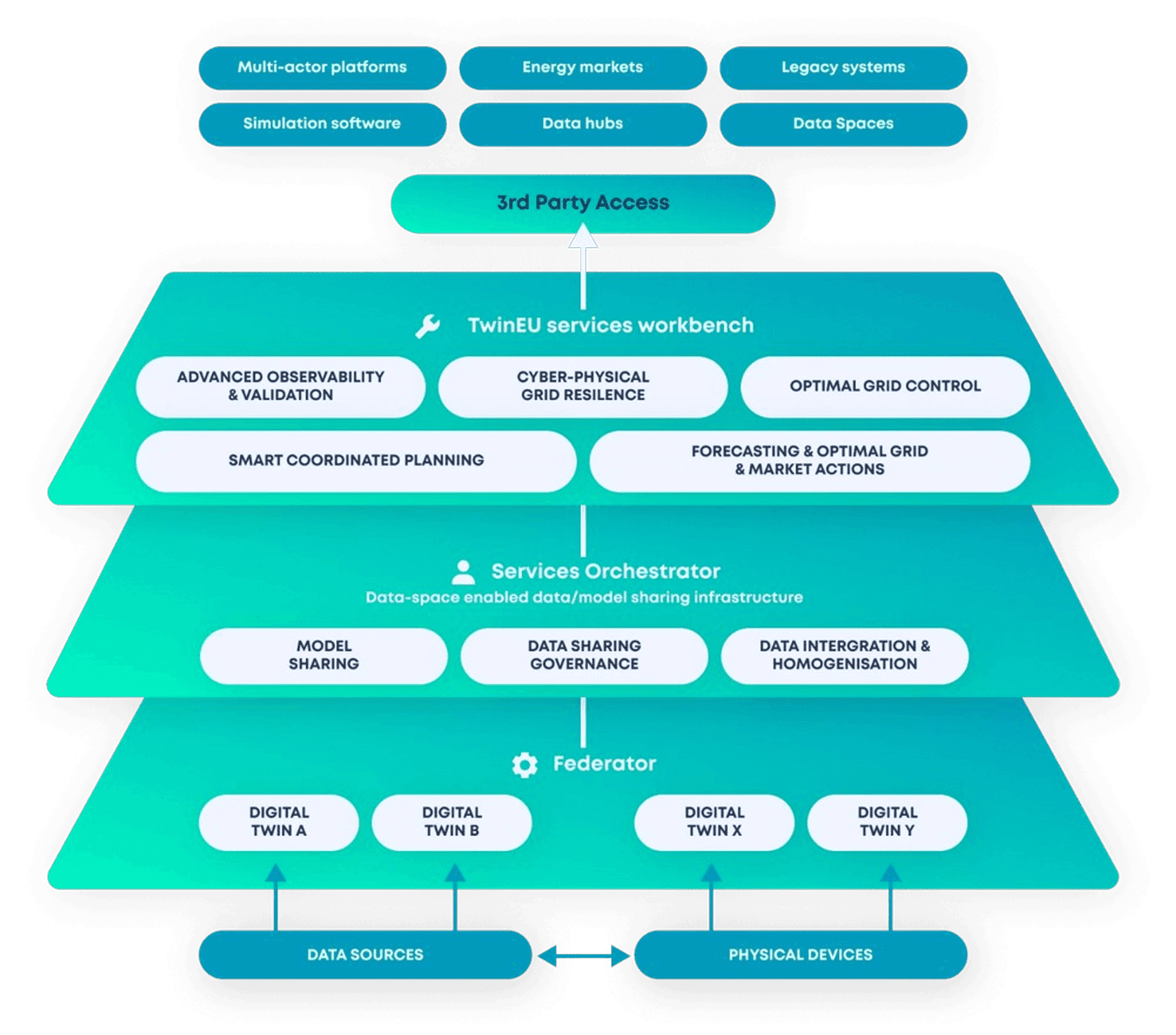
To achieve these goals, the TwinEU digital twin federator leverages on the data space concept for supporting an interoperable and secure digital twin federation with easy and effective integration of various data sources and infrastructures.
The data space-enabled structure for data and model sharing is the pivotal element of the TwinEU architecture. It involves the adaptation of the energy data space to the specific context of the TwinEU digital twin ecosystem, creating a trusted and sovereignty-preserving layer for data and model exchange.
The solution extends and improves an already existing framework, developed in the previous Horizon project, OneNet, a data space framework tailored for the energy domain, which supports standardised data exchange among energy stakeholders at any level.
At architectural level it includes two main components: the OneNet middleware and OneNet connector.
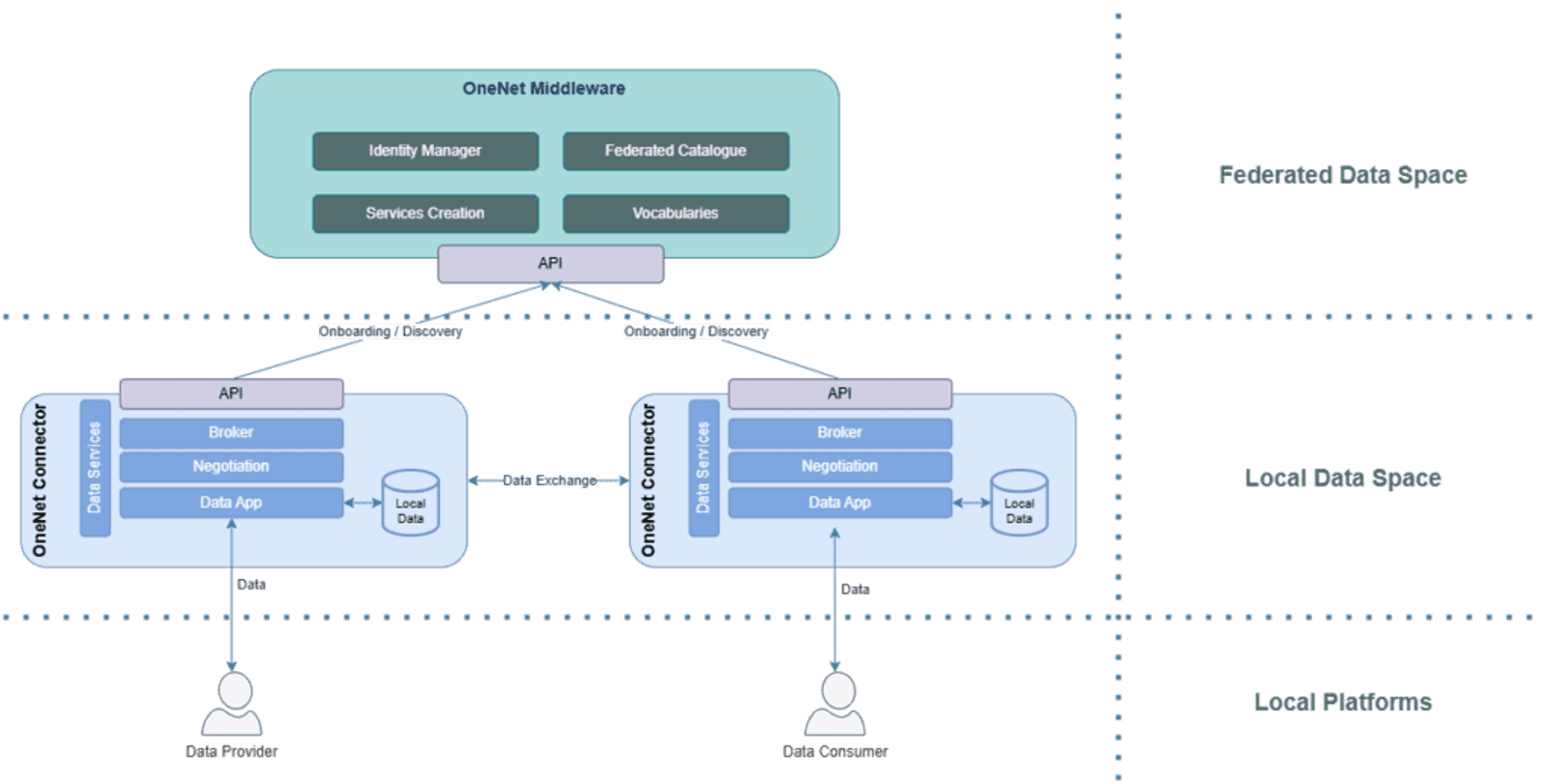
The OneNet middleware stands on top of the common infrastructure, ensuring secure and standardised communication between assets, systems, data sources, models and energy stakeholders. This middleware facilitates seamless, efficient and transparent sharing of data across the entire ecosystem, creating the concept of a federated data space.
The OneNet connector plays a crucial role in driving efficient data integration and exchange across the energy sector. It implements the core features for a complete decentralised end-to-end data exchange while maintaining full control over data access and usage. In addition, it communicates with the middleware for onboarding and data service discovery.
The OneNet middleware and connector are ready to be extended to support digital twin federation, keeping its core characteristics and supporting digital twin data and model exchange, including new communication protocols, vocabularies and standards.
Impact and applications
The implementation of a federated digital twin pan-European ecosystem, supported by the TwinEU digital federator, has the potential to revolutionise the energy sector.
By enabling cross-stakeholder and cross-sector collaboration, a federated digital twin can drive innovation, efficiency and sustainability. The seamless integration of digital twins across different stakeholders allows for comprehensive monitoring, simulation and optimisation of complex systems, leading to improved decision-making and resource management.
Moreover, the integration of new technologies such as AI, XR and IoT within the federated digital twin ecosystem can unlock unprecedented opportunities for innovation. AI can provide advanced analytics and predictive capabilities, XR can offer immersive simulations and training, and IoT can enable real-time data collection and monitoring.
Within the TwinEU project, the federated digital twin will be tested and evaluated in eight different demonstrations sites divided into four topics:
● Cyber-physical grid resilience,
● Grid management, operation and monitoring,
● Forecasting and optimal grid and market,
● Smart coordinated grid planning.
Stay in touch with us through our website, Contact – TwinEU, and don’t miss the chance to find out more about TwinEU and the digital twin federation.
About the author

Ferdinando Bosco graduated in computer engineering at the University of Palermo, Italy in 2012. Since 2012 he has been working as Senior IT Architect and Researcher in the Engineering Group - Research & Innovation department. He has participated in many European research projects in the energy domain as IT architect and technical manager. In the recent years he has specialised mainly on blockchain, XR and data space architectures. He is the technical lead of the OneNet connector and is responsible for the design and implementation of the data space based framework for TwinEU.
Related tags
Most popular
Join the community for freeAnd get access to all content
Related projects
TwinEU
2 January 2024 - 31 December 2026
View projectLatest content
+4
Smarter grids, safer supply: Digital twins in the Iberian Peninsula
The digital twin solutions developed in the context of the Iberian demonstrator of the Horizon Europe project, TwinEU, are providing system operators real-time tools to predict, prevent and stabilise the grid when it matters most, offering new ways to secure supply and strengthen system stability.
- Guest/partner contributor
- 30/09/2025