Volkswagen's Crafter factory is now powered by the sun
Pamela Largue
Posted on: 23 October 2025
Volkswagen Poznań’s Crafter factory is now fully energy self-sufficient on sunny days, thanks to the completion of an 18.3MW solar power plant.
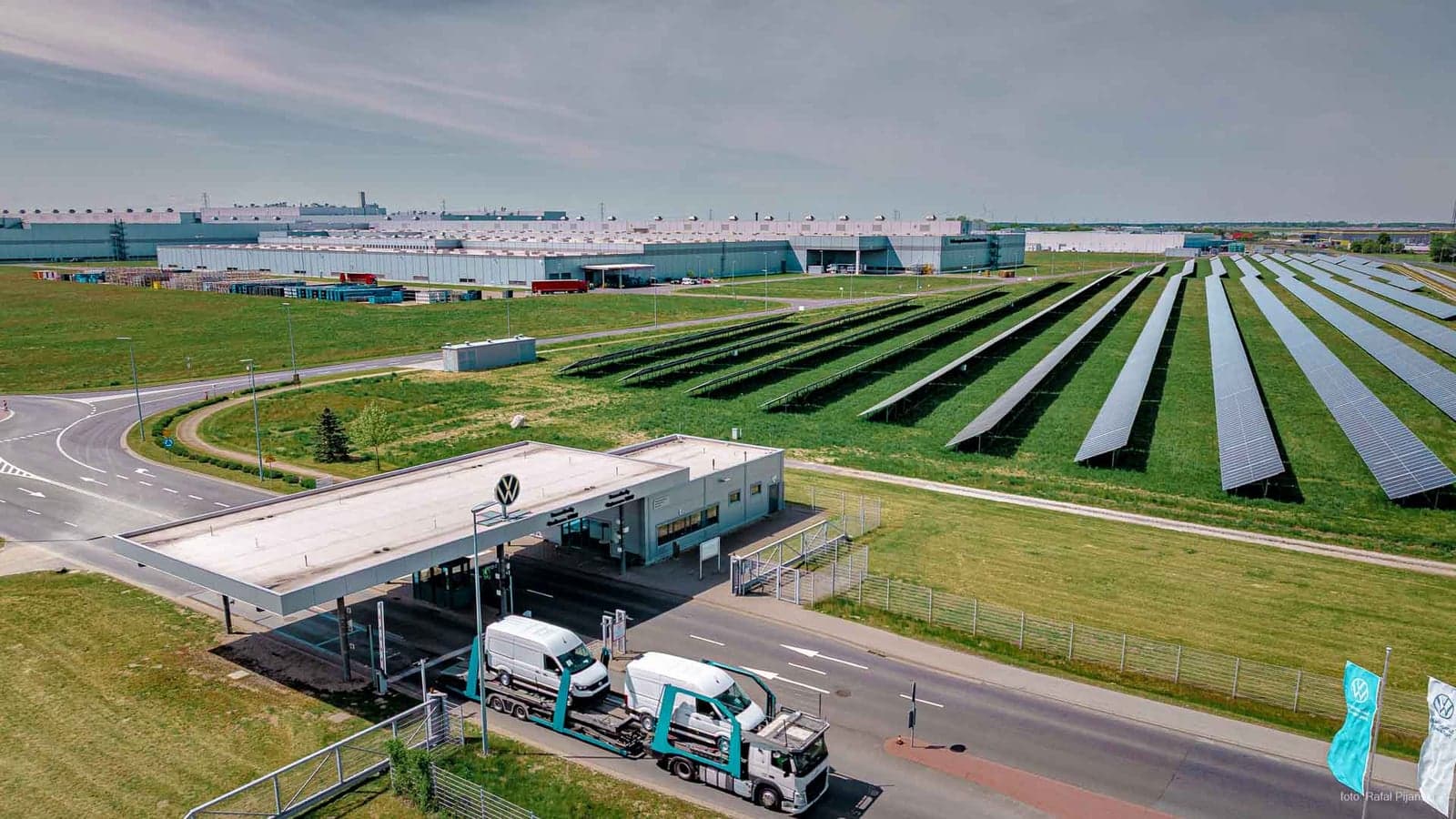
Renewables developer Quanta Energy has announced the completion of an 18.3MW solar farm for German automaker Volkswagen.
The plant, located in Września, Poland, fills an area equal to nearly 38 football pitches and includes 31,000 solar PV panels.
According to Quanta Energy, the mounting structure weighs over 430 tonnes, which is about the same as a Boeing 747 ready for takeoff, and integrating the system required 150 km of cabling.
Thanks to this sizable solar installation, 25% of Volkswagen’s Poznań Plant demand is covered by the photovoltaic farm. And that demand would be significant, as the plant has a production capacity of up to 100,000 vehicles per year, producing both conventionally powered Crafters and the all-electric e-Crafter as well.
Learn more about Poland's energy transition
Quanta Energy chief executive Piotr Grzybczak suggests this project, due to its sheer size and scale, will ultimately set new standards for the automotive industry’s decarbonisation path.
"The photovoltaic farm we built for Volkswagen Poznań is among the five largest ‘behind-the-meter’ on-site installations in Europe - the result of long-term thinking about sustainable energy."
He added: “Partnership based on trust and determination is crucial for projects of this scale. We’re proud to be working with Volkswagen on initiatives that change the energy landscape and set new standards for the entire industry.”
In the coming years, Volkswagen Poznań is planning to develop more renewable energy projects at the Września plant. These include rooftop and parking solar installations with a capacity of 14MW, as well as wind turbines. The administrative procedures for the construction of the wind turbines are currently underway.
In collaboration with Poznań University of Technology, Volkswagen is also looking to build energy storage facilities, an initiative that will move the automaker closer to its decarbonisation goals.
Also of interest: Can direct solar-to-hydrogen technology unlock industrial decarbonisation?
More specifically, up to 60% of the electricity used by the Września plant is expected to come directly from on-site renewable energy sources by 2030.
Stefanie Hegels, President of Volkswagen Poznań, said: “We are consistently implementing our strategy to achieve climate neutrality across all our plants. The completion of another stage of our photovoltaic farm marks an important step on this journey - it enables an ever-greater share of the energy required for vehicle production to be generated directly on our factory grounds.”
Hegels added that renewables investments such as this reinforces the company’s energy independence, enhances competitiveness and stabilises costs.
Solar as key to industrial decarbonisation
It’s not only Volkswagen making decarbonisation gains through the deployment of solar.
Another industry giant is doing the same, namely Heineken. At the Heineken brewery in Valencia, Spain, industrial processes are being decarbonised through the use of linear Fresnel solar thermal technology.
The solar thermal plant is assisting the Heineken factory with the decarbonisation of the steam production needed for the brewing process. It comprises of 6,000 square metres of mirrors and 182 modules and is capable of heating up pressurised water to 220°C to generate saturated steam.
While the brewery has been powered by 100% renewable electricity since 2020, projets like this help address the hard-to-abate production processes, which are crucial to ensure Heineken Spain meets its target of running entirely on renewable energy by the end of 2025.
Watch the video below to learn more about why this solar thermal plant is so innovative and unique.
Latest content
+4
European partnership on solar PV unites leading minds from research and industry
The European Partnership for Solar Photovoltaics (EUPI-PV) has been formalised in an MoU between the European Technology & Innovation Platform for Photovoltaics (ETIP PV) and European Commission.
- Jonathan Spencer Jones
- 21/05/2025