Why Europe’s cities must move from climate ambition to delivery
Guest/partner contributor
Posted on: 17 March 2026
Europe's cities are increasingly caught between decarbonisation goals, rising capital needs and a renewed imperative for growth, innovation and energy security.
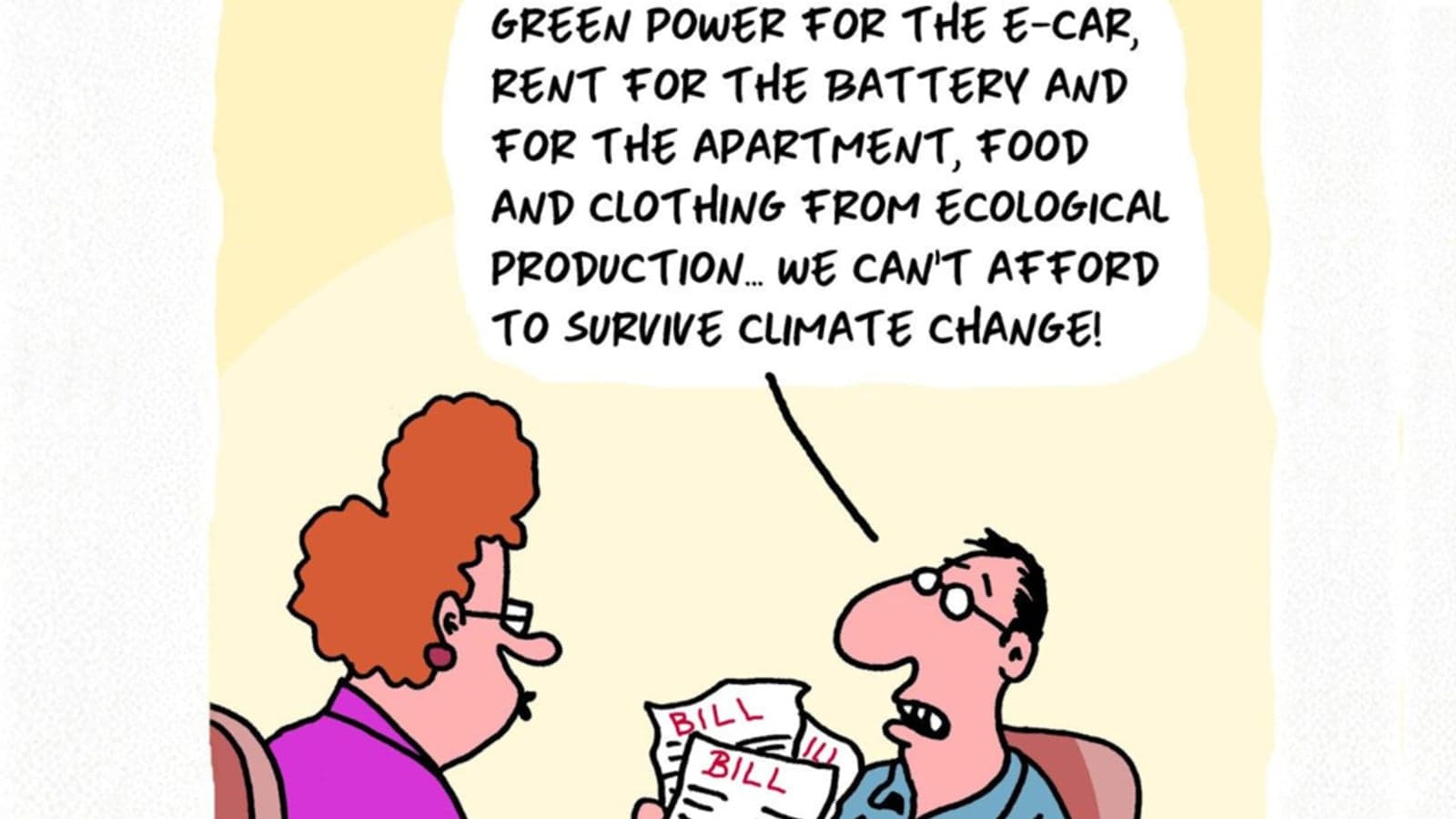
Over the past decade, a series of systemic shocks has quietly invalidated many of the assumptions on which Europe’s climate and urban policies were built.
A global pandemic, a major land war on the continent’s borders, energy supply disruptions and the sudden acceleration of AI have reshaped priorities in ways few foresaw when the Green Deal and the smart cities and communities agenda were conceived.
What was once a policy environment defined by stability, cheap energy and long term climate ambition is now characterised by urgency, constraint and geopolitical risk.
As Europe moves from vision to delivery, a harder question is emerging: have our climate and urban strategies evolved fast enough to match this new reality? Nowhere is this tension more visible than in the cities, long positioned as laboratories of the energy transition.
From Horizon 2020 to Horizon Europe
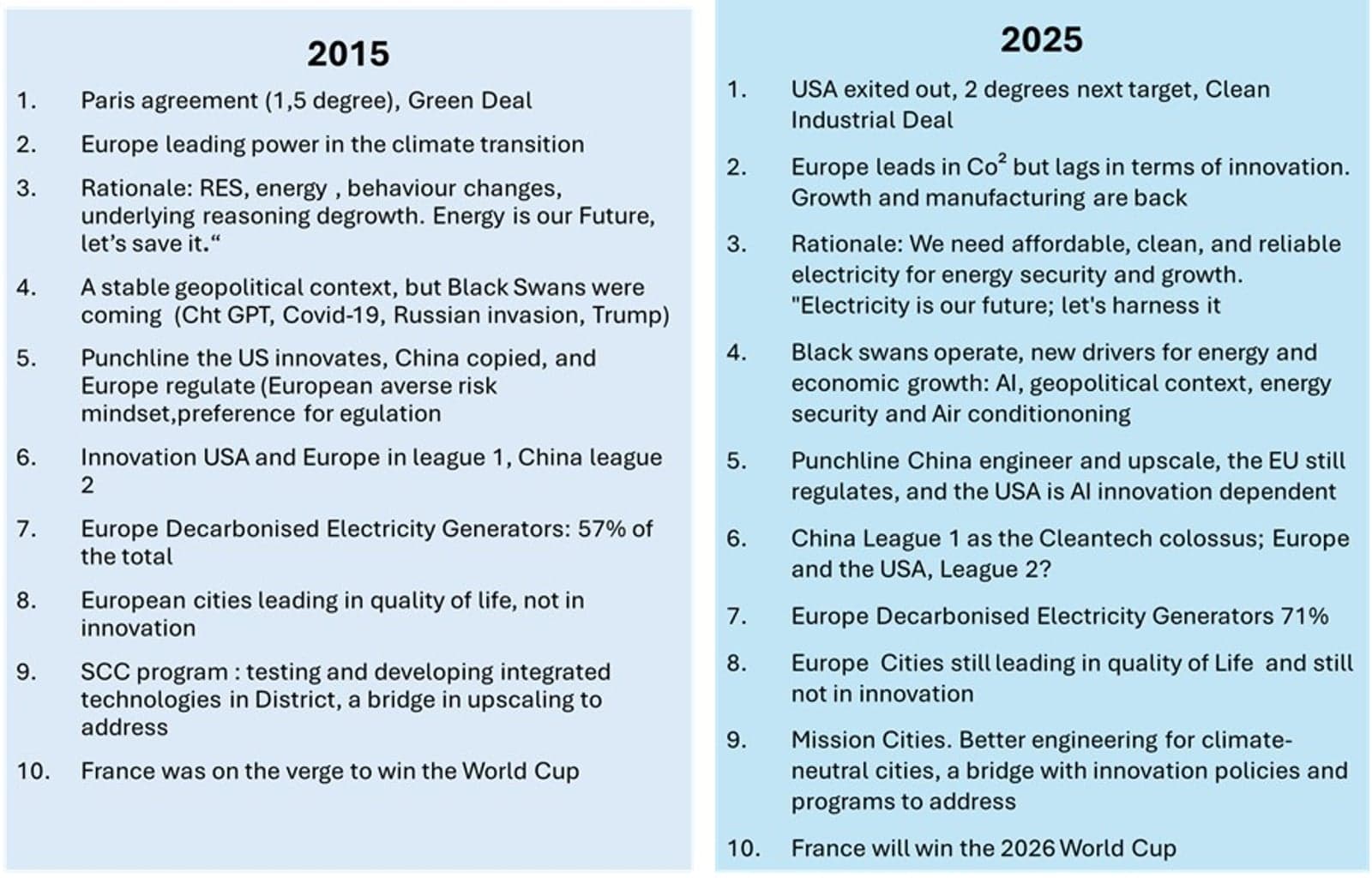
Ten years ago the climate transition focused on renewable energy sources, efficiency and regulation, aiming to create a European leadership in decarbonisation.
The smart cities and communities programme was just starting. The focus was on integrating technologies and governance approaches at the district level. The 'Mission city' programme emerged later.
The Green Deal was being prepared, a process that took over five years. Its strategy aimed to develop a decarbonised continent through a policy mix that included support for renewable energy sources, energy efficiency, tax instruments, regulations and mandates (e.g. a ban on combustion engine cars by 2035, the European taxonomy, and a plan for 100 climate-neutral cities by 2030, among others). The overarching goal was to make Europe lead the path towards decarbonisation, even though in 2015 it accounted for only 8% of global emissions.
Ten years on, the changes are striking. Europe leads in decarbonisation with a carbon emission reduction to a share of 6%, a rapid decline, but lags in growth, energy and innovation.
The vision faces significant challenges: renewable energy growth stalled in 2025 with solar the exception, demand continues to decline, indicating that electrification is not progressing at the necessary pace, and the electricity system is under strain. This is evident in the recent power outages in Iberia and the surge in negative prices driven by oversupply from wind and solar, compounded by limited demand flexibility.
It also raises a question of business models and grid robustness: when there is no wind or solar, who will finance and pay for baseload production facilities (gas/coal/nuclear) and grid adaptation in the prospect where long duration storage is not enough?
A change of paradigm
The geopolitical landscape has triggered a shift in the European political agenda from a kind of 'de-growth' approach, often associated with the Green Deal, to a new paradigm that emphasises defence, energy security, growth and manufacturing (clean industrial act), with less regulation, in stark contrast to the previous agenda.
According to reports by Letta and Draghi, Europe struggles to finance innovation, which has devastating consequences for growth and the ability to fund the climate transition and other priorities. The only area in which it excels is CO₂ emissions. This could be a result of the Green Deal, but it may also stem from a stagnant economy and weak demand.
AI and air conditioning are the most significant sources of electricity demand, catching policies a bit off guard. Contrary to expectations, air conditioning is the largest source of electricity consumption, not AI (Casey Crownhart, MIT Technology Review, January-February 2026). Both are energy intensive, but they present different challenges: sovereignty issues with AI and health concerns related to the rise in heat waves for air conditioning.
AI has also put a new spin on an old slogan (borrowing the quotes from 'Les Electrons Libres' only in French): ”Energy is our future, let’s save it". Today, it is closer to the opposite: "Electricity is our future, let us use it" (and particularly in the AI competition).
Meanwhile, the City Mission created a significant dynamic, with 112 cities engaged, peer-to-peer exchanges and pilot projects, and is trying to address the financial issues that cities can encounter. Cities are addressing climate change and leading local ecosystems.
However, I see shortcomings in the current programme. The capital needs are extremely high. Moreover, with the notable exception of the €2 billion facility from the EIB, the programme does not offer direct solutions for raising and channelling public and private funds to finance the portfolio of solutions.
The current Mission programme supports more cities in developing better engineering for their territories than in fostering disruptive or groundbreaking innovations. In the smart cities and communities programme, innovative companies have tested some energy or heating-as-a-service business models, similar to what Base Power, a Texas startup that has raised $1 billion from prominent venture capitalists, is doing.
This approach is not the Mission’s primary focus, which is more oriented toward engineering rather than innovation. The connection between cities, climate change and innovation is relatively weak. This is a limitation, as we know that innovation often begins or flourishes primarily within urban ecosystems. Additionally, innovation can also occur in smaller cities, as technological advancements have reduced the costs of entrepreneurship.
Deal room start-up cities
Europe is currently developing ambitious investment funds in collaboration with private partners. The EIC is a major investor and recently launched with the Adaptation mission, a joint call for deep tech for adaptation, which concerns cities.
Among these initiatives is the decarbonisation bank, which aims to finance significant investments in hard-to-abate industrial sectors. Another example is the Scaling Up fund, which seeks to provide substantial funding (up to €100 million) to start-ups.
While the intentions behind these initiatives are promising, the real challenge lies in the details, particularly the selection of the fund manager and its level of independence. Public authorities lack the skills to identify successful investments; it’s not their cup of tea. What we need is someone akin to Warren Buffett, with real skin in the game, but does Europe have a figure like that?
A new paradigm for cities?
In summary, the challenges Europe faces have shifted significantly. Without substantial economic growth to support innovation, achieving a successful climate transition will be impossible. While cities are vital players in this process, they have not yet fully embraced their potential as hubs for European innovation.
Today, the drivers of the market are evolving, as Climate Tech Venture Capital mentioned in its last report: "2025 closed as the second-hottest year on record, capping the three hottest years ever measured. Global temperatures again exceeded 1.5 °C above preindustrial levels, at least temporarily breaching the world’s most crucial climate target."
Yet the investment signal moved in the opposite direction. Decarbonisation powered climate tech’s take-off in 2020, backed by strong policy tailwinds and corporate net zero commitments. What replaced emissions targets as the primary driver is rapidly rising energy demand. AI, data centres, electrification and grid stress are pulling capital toward anything that can deliver power fast, reliably and at tolerable cost. Buyers are optimising for speed to electrons, not tons of CO2 avoided. Emissions reduction still matters, but it’s no longer the pitch. That shift explains why the biggest deals of 2025 clustered around firm power, energy security and system resilience.
Europe’s challenge today is no longer to prove that decarbonisation is possible. That case has largely been made. The harder task is to sustain the energy transition in a context of weak growth, intensifying global competition, rising electricity demand and mounting geopolitical risk. Without innovation, capital mobilisation and affordable, reliable power, climate ambition alone will not hold.
Cities sit at the centre of this tension. They remain Europe’s strongest asset in terms of quality of life, social cohesion and democratic legitimacy, yet they are not fully positioned as engines of innovation, investment and system-level experimentation. If cities continue to be treated primarily as policy delivery vehicles rather than as platforms for innovation and capital formation, Europe risks missing the next decade as decisively as it shaped the last.
The question is no longer whether cities can deliver climate objectives. It is whether Europe is willing to let them drive growth, innovation and energy resilience and accept the risks that real progress inevitably entails.
About the author
Philippe Fournand is the chair of Blue-Sight Conseil, a consultancy company working in innovation and smart cities at the European and national levels. His main areas of expertise include innovation, smart cities, business models and technology transfer programmes. He is deeply committed to sustainability, as evidenced by his current pivotal role in ASCEND.