Why it's time for Europe to create a level playing field for CCS
Pamela Largue
Posted on: 5 December 2025
Experts at Enlit Europe warn that fragmented regulation, incompatible ETS systems and slow permitting threaten to derail Europe’s CCS ambitions
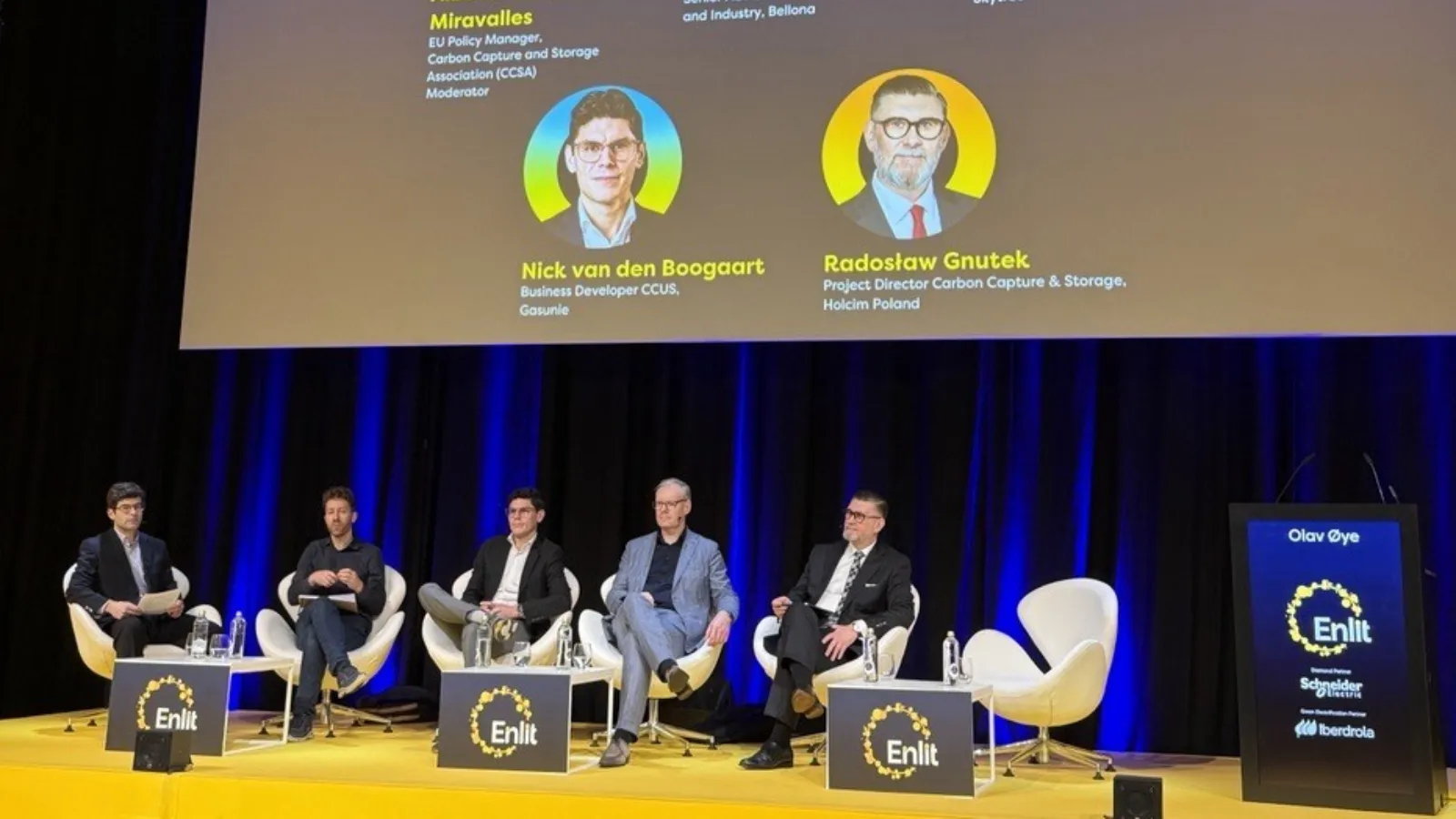
Realising the potential of carbon capture in Europe will depend on whether governments can align regulation, harmonise standards and enable cross-border collaboration. This was the clear message of industry experts at Enlit Europe, who warned that without a level playing field, CCS will struggle to fulfil its critical role in industrial decarbonisation.
Peter van Hooft, Vice President of Project Development EMEA at Dutch start-up Skytree, suggests that Europe still fails to speak with one voice. Some countries, he says, are even “pushing the brakes” on achieving Paris Agreement goals.
“This is killing us as Europe and making us lose the battle to the US and Asia,” he said. “We need regulation that stimulates the market and creates a level playing field.”
A fragmented CCS landscape
To illustrate how uneven the playing field is, Nick van den Boogaart, Business Developer for CCUS at Dutch TSO Gasunie, pointed to the Delta Rhine Corridor project.
The project aims to build underground pipelines and cables from Rotterdam through the Netherlands to the German border, transporting hydrogen and CO₂ to support industrial decarbonisation and link to North Sea storage sites.
The corridor’s international nature reveals the challenges of misaligned regulatory regimes—particularly the incompatibility between the EU Emissions Trading System (ETS) and the UK ETS.
“The UK has a lot of potential for storage,” he says, adding that Europe has a lot less.
The UK’s storage fields are so big that the country needs EU imports to reach an optimal value chain.
However, the EU and UK ETS systems are not aligned. “The two different ETS systems means your storage will never be officially recognised and put on paper hence no one at this point in time can actually export CO₂ to the UK for storage.”
Negotiations have started to link the ETS systems, which will be of great importance for industries, he says. But it needs to happen with a matter of urgency, so the many projects currently in the Financial Investment Decision phase can capitalise on open access and non-discriminatory value chains.
Cross-border barriers
The London Protocol set in 2009, which prohibits CO₂ transport between EU countries, also needs a rethink, says Van den Boogaart.
“Bilateral agreements are helping to get around it, but it needs to be solved to make the cross-chain more feasible.”
Van Hooft agreed, stressing the need for treaties that allow countries with limited storage—such as Switzerland—to transport CO₂ to suitable sites elsewhere.
In Poland, storage of CO₂ is illegal, says Radosław Gnutek, Project Director Carbon Capture & Storage at Holcim Poland.
Gnutek is currently working on a CCS project for Holcim, which involves the collection and transport of captured CO₂ to the coast for export.
Have you read?
CCS needs policy to catch up with technology says climate advisor
Google in partnership to prove viability of CCS-enabled cogeneration
“We are doing this because it’s not legal to store CO₂ in Poland. Some legislation amendments have been introduced, but we are still missing some pieces.
“We need to find a way to fulfil our ambition and to reduce emissions.”
Gnutek believes this is a wasted opportunity for Poland, a country suitable for storage and with a lot of capacity to do so.
“If the legislation is adjusted in a timely fashion, I will be extremely happy to just bore the hole and inject the CO₂ instead of exporting it. “We can support the local community… I think it’s important to enable this.”
Standards, specifications and interoperability
Another important aspect of creating a level playing field, says Van den Boogaart, is the need for standardisation.
He explains that CO₂ standards have specifications, with some critical components having only a slight margin for variation to avoid corrosion and other risks to emitters.
“In an ideal world, you would have specifications that are applied across the board - everywhere in Europe.”
Currently, specifications don’t align.
“This might be a burden in the long run because emitters that capture their CO₂ and live up to a certain specification for one value chain might not be able to meet the specifications of another value chain.”
This makes international interconnection of value chains very challenging, he says.
Van den Boogaart recommends increasing engagements between infrastructure developers, external laboratories conducting specification tests and the emitters.
More exclusive insights from Enlit:
How Basque Country is shaping a sustainable energy future
Europe’s industrial competitiveness depends on smarter energy systems
“Hopefully, in the long run, that will lead to one conclusion, and most emitters can live up to the specifications, and the infrastructure providers are happy – but we are not there yet.”
He is hopeful that ongoing testing, with results expected next year, will lead to a set of standards applicable across projects.
Permitting challenges
All experts were unanimous in their belief that permitting is the Achilles' heel of CCS projects.
Says van Hooft: “Permitting seems to be the one factor that’s slowing us down.
“We need to simplify the permitting applications.”
In the Netherlands, says Van den Boogaart, a coordination rule for CCS projects helps to overcome some of the lengthy permitting processes and administration hurdles.
However, he is calling for more resources and standards to accelerate permitting, especially for cross-border projects where country permitting standards don’t align.
“I’m not saying they should be completely the same, but there should be more overlap between the two”
Gnutek added that long-term predictability—through mechanisms such as carbon contracts for difference and clear CO₂ quality standards—is essential to create market flexibility and enable comparison between service providers.
And beyond regulation, he emphasised the importance of recognising CCS as a source of local value creation. “Each step can create value for the local market,” he said. “For us, the project is a playground to learn how to build these systems—and it can create a snowball effect for the whole industry.”
Latest content
+4
CAPTUS: Demonstrating liquid renewable energy carrier production from captured carbon emissions
The CAPTUS project addresses the challenge of decarbonising energy intensive industries by demonstrating carbon capture and utilisation technologies integrating renewable electricity surplus.
- Guest/partner contributor
- 24/11/2025